
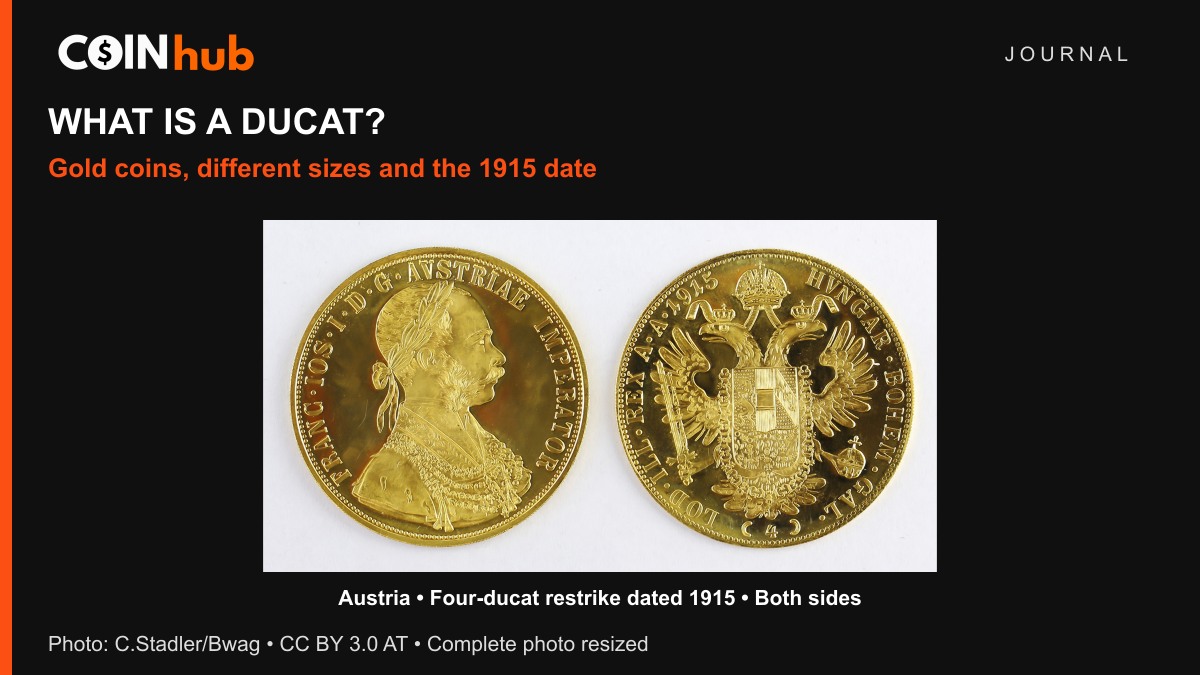
A ducat is an old coin unit used by several European states, best known through its gold issues. It is not one universal coin with one date, size or design. A modern Austrian gold ducat can carry the date 1915 because it is an official restrike: a later issue repeating an older coin design and date.
That date is often the first thing a new collector notices. It is also easy to misread. Before deciding that a ducat is more than a century old, identify its country, ruler and denomination. Then check whether the issue was restruck.
Start with the country, not just the name
The Austrian Mint traces the gold ducat tradition to medieval Venice. Other states later issued their own versions. The same name does not mean that all those coins have the same portrait or come from the same series.
A useful comparison comes from the Gothenburg City Museum's Swedish ducat exhibit. It describes Swedish ducats of roughly 3.5 grams and notes larger double and four-ducat pieces. Its examples belong to Swedish monetary history, not the Austrian Franz Joseph series.
Think of “ducat” as the start of a catalog search. A description such as “Austrian four-ducat restrike dated 1915” is much more useful. It separates the issuing country, the coin value and the date shown on the coin.
Why an Austrian ducat can say 1915
The Austrian Mint identifies its current one-ducat coin as a historical restrike. It says the design began in 1872, while the repeated 1915 date recalls the interruption of gold coin production during the First World War. Franz Joseph appears on the front.
A restrike is not automatically a counterfeit. Here, the issuing mint openly describes a later coin made in a historic form. The mint can make a real restrike today. That does not mean the coin in hand was made in the year printed on it.
For example, a listing that says only “1915 gold ducat” leaves an important question unanswered. Ask whether it is being sold as a restrike or an original-period issue, and what evidence supports that description. The four digits alone cannot settle the question.
One ducat and four ducats are different sizes
The mint's current size and weight figures give a practical comparison. They describe its Austrian restrikes. They are not a standard for every historical ducat:
- One ducat: 19.75 millimeters across, 3.49 grams total weight and 3.44 grams of fine gold.
- Four ducats: 39.50 millimeters across, 13.96 grams total weight and 13.77 grams of fine gold.
Both are listed as Au 986, meaning 986 parts gold in 1,000 parts of alloy. “Fine weight” means the gold portion alone. “Total weight” includes the other metal in the coin. Do not use one figure in place of the other.
The four-ducat product page is the source for the larger coin's figures. Its diameter is twice the one-ducat diameter, not four times as large. Photographs resized to fill a screen can hide that difference.
Read the pictured four-ducat coin
The photograph above shows both sides of an Austrian four-ducat restrike. One side has Franz Joseph's portrait. The other has a crowned double-headed eagle, the date 1915 and the denomination 4 near the bottom. The complete photograph has been resized; it is not shown at actual size.
Use those details to organize a comparison, not to authenticate another coin from a photograph. Start with the portrait and lettering, then the reverse design, date and denomination. A coin with a different ruler needs a different reference entry.
Record an actual weight and diameter separately from the seller's description. A close match is useful evidence, but it does not prove the metal or authenticity. Avoid bending, scratching or polishing a thin gold coin to test it.
Keep the date, gold content and sale price separate
These answer different questions. The date belongs to the design and issue history. Gold content describes the metal. A collector's price concerns a single coin, including its authenticity, type and condition.
Do not use a modern restrike's advertised price as the value of an unrelated early ducat. Equally, do not treat an old-looking date as proof of rarity. Identify the exact issue before comparing completed sales, and note the sale date, currency and fees.
A useful collection record might read: “Austria; four ducats; dated 1915; described as restrike; measured weight pending; seller invoice saved.” That leaves uncertainty visible instead of turning an assumption into a fact. Our coin collection records checklist provides a place to keep the photos and proof.
Sources checked October 8, 2026: Austrian Mint history and current one- and four-ducat specifications, plus Gothenburg City Museum. Linked mint figures describe the current restrike products. The photograph's Commons description is used for photo details and reuse rights, not as the weight standard. No current gold price or appraisal is supplied.