
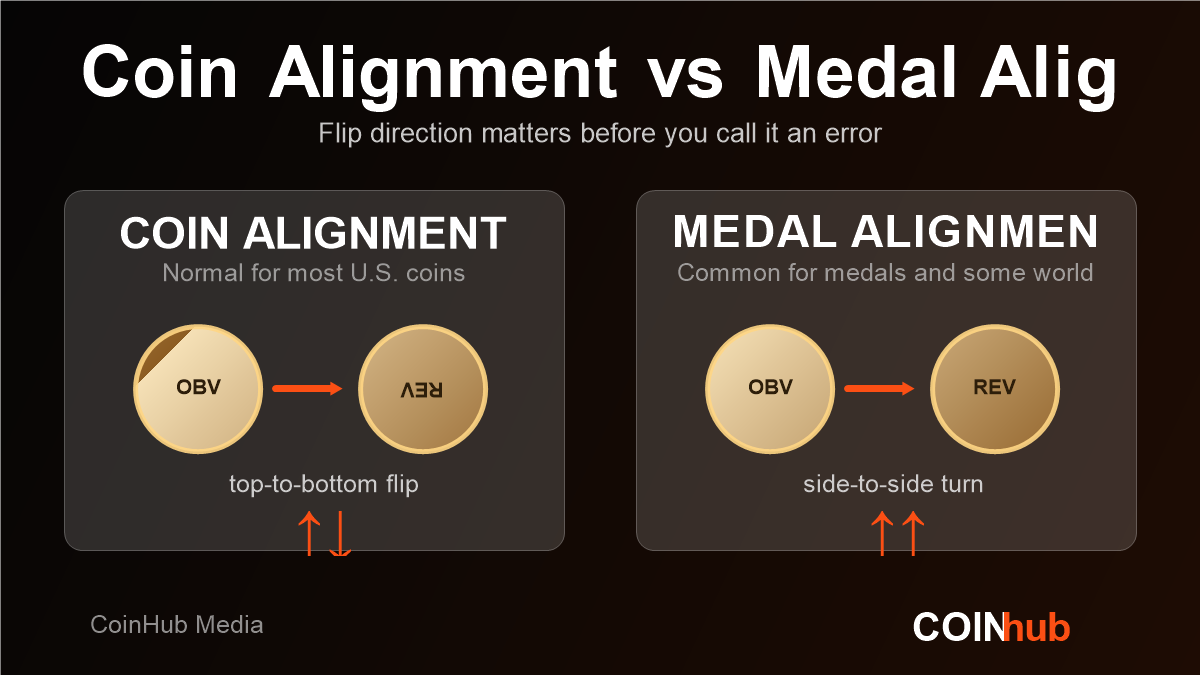
Coin Alignment vs Medal Alignment: The Flip Test Collectors Should Know
If the back of a U.S. coin looks upside down when you turn it side-to-side, that is usually normal. Most U.S. coins use coin alignment, which means the obverse and reverse are oriented opposite each other. If you hold the coin at 3 o'clock and 9 o'clock and flip it top-to-bottom, the reverse should appear upright.
Medal alignment is different. On a medal, token, or some world coins, both sides face the same direction when the piece is turned side-to-side. A U.S. coin that is far outside its normal alignment may be a rotated die error, but small tilts are usually less important than dramatic rotations.
Why this confuses so many collectors
This is one of those coin questions that sounds simple until you actually hold the coin. A beginner finds a quarter, flips it over, sees the eagle or design upside down, and thinks: "Is this a mint error?" The answer depends on how the coin was flipped.
That small detail matters. Coins are round, so there are two natural ways to turn one over. You can flip it top-to-bottom, like turning a page over a horizontal line. You can also turn it side-to-side, like rotating a door on a hinge. For normal U.S. coins, the top-to-bottom flip is the test that should make the reverse appear upright.
Coin alignment vs medal alignment
Coin alignment and medal alignment describe how the two sides of a coin, medal, or token line up with each other.
| Term | Simple meaning | What you should see |
|---|---|---|
| Coin alignment | The two sides are opposite each other. | Hold the obverse upright and flip top-to-bottom; the reverse should be upright. |
| Medal alignment | The two sides face the same direction. | Hold the obverse upright and turn side-to-side; the reverse should be upright. |
| Rotated die error | One side is turned away from the expected alignment. | The reverse is tilted instead of lining up where it should. |
Most U.S. coins use coin alignment. Many medals use medal alignment because a medal hanging from a ribbon is naturally turned side-to-side for viewing. Some world coins also use medal alignment, so do not assume every non-U.S. coin is an error just because it does not flip like a U.S. quarter.
The easy home test
How to estimate rotation
You do not need a professional tool for a first look. Start with a rough visual estimate. A tiny tilt may be normal manufacturing variation or too minor to matter. A rotation around 15 degrees or more is more likely to be worth documenting. A 45-degree rotation is noticeable, a 90-degree rotation is dramatic, and a 180-degree rotation on a U.S. coin creates a medal-alignment look.
Do not clean the coin, tape it, bend it, or mark it while testing. If the rotation looks significant, take clear photos instead.
How to photograph a possible rotated die
The goal is to show the reverse tilt without accidentally changing the coin's orientation between photos. Many rotated-die claims fall apart because the coin was turned a different way between images.
When is a rotated die valuable?
Rotated dies can bring premiums, but value depends on the coin, date, mint, condition, how dramatic the rotation is, and whether specialists recognize the variety.
Small rotations are common enough that they may add little or no value. Larger rotations are easier to see and more interesting to error collectors. Early U.S. coins can show more rotation than modern coins, while modern U.S. coins with major rotation are usually more exciting than tiny tilts.
The safest wording is this: a rotated die may add value, but the rotation needs to be real, measurable, and desirable for that specific coin.
Where this fits with other coin errors
Coin alignment is not the same thing as an off-center strike, doubled die, clipped planchet, die crack, cud, broadstrike, or wrong-planchet error. It is an orientation issue between the obverse and reverse dies.
If you are checking pocket change, compare the orientation first, then use CoinHub's quarter error guide, penny error list, nickel error guide, and dime error guide to look for other major mint mistakes.
The collector mindset
The best collectors do not just ask, "Is this weird?" They ask, "What is normal for this coin, and how exactly is mine different?" Coin alignment is a perfect example. Once you know the normal flip direction, you can spot the difference between a regular U.S. coin, a medal-aligned world coin, and a possible rotated die error.
FAQ
Are U.S. coins supposed to be upside down on the back?
U.S. coins normally use coin alignment. If you turn one side-to-side, the reverse may look upside down. If you flip it top-to-bottom while holding the left and right edges, the reverse should appear upright.
What is medal alignment?
Medal alignment means both sides face the same direction. Many medals use this orientation because they are viewed while hanging or being turned side-to-side. Some world coins also use medal alignment.
Is a 180-degree rotated die the same as medal alignment?
On a U.S. coin, a 180-degree rotated die can make the coin look like it has medal alignment. That does not automatically prove value by itself; the coin still needs to be genuine, correctly tested, and desirable to error collectors.
How much rotation matters on a coin?
Tiny rotations often do not add much value. Rotations around 15 degrees or more are more likely to be worth documenting, and dramatic rotations such as 90 or 180 degrees are usually more interesting. The date, coin type, condition, and market demand still matter.
Should I send a rotated die coin for grading?
Consider grading only if the coin is valuable enough, the rotation is clearly measurable, the coin is in collectible condition, or you need third-party authentication before selling. For common low-value coins with tiny rotation, grading may cost more than the coin is worth.