
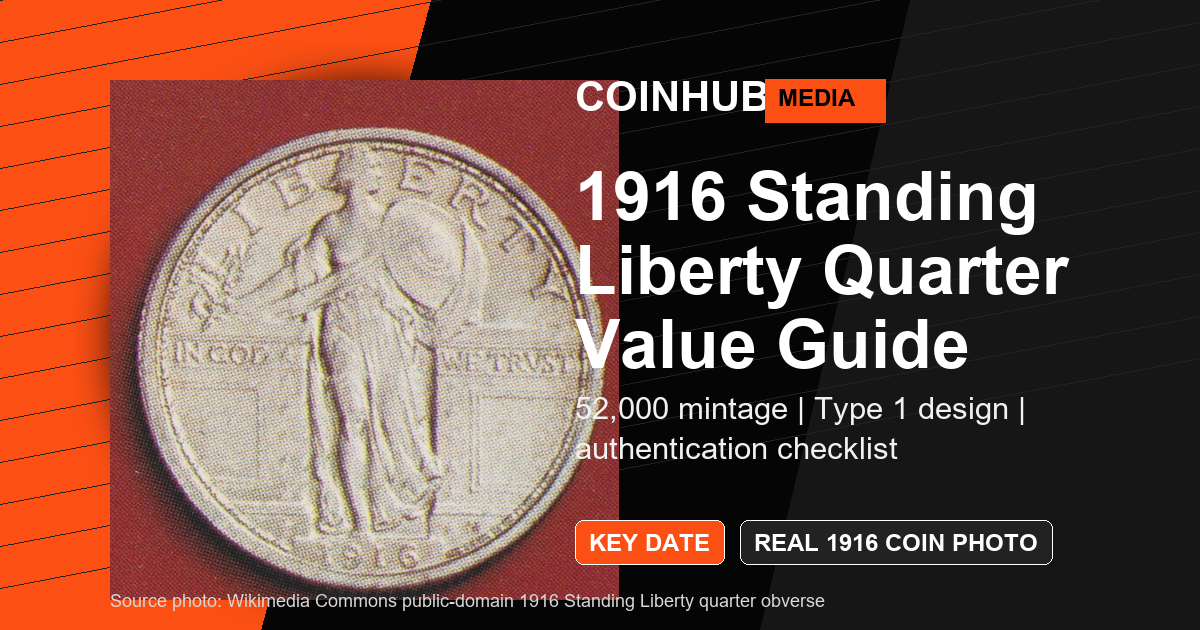
1916 Standing Liberty Quarter Collector Guide
Quick answer:The 1916 Standing Liberty quarter is the key date of the series. PCGS lists a mintage of only 52,000 pieces, and current public price-guide context shows authenticated examples can be worth thousands of dollars even in circulated grades. Because altered dates and problem coins are a real risk, a possible 1916 should be authenticated before it is priced like a major key date.
The Standing Liberty quarter is one of the most recognizable early 20th-century U.S. coin designs, but the 1916 issue is in a different category from most dates. It was the first year of the design, struck in very small quantity at Philadelphia, and released around the same time as early 1917 quarters. That combination makes it a coin collectors search for carefully and counterfeiters have reason to imitate.
If you are sorting old quarters, the biggest mistake is treating every worn Standing Liberty quarter the same. A common 1920s example may be mostly a type coin or silver coin. A genuine 1916 is a key-date coin where authentication, grade, and surface quality can change the value dramatically.
How Much Is a 1916 Standing Liberty Quarter Worth?
Public price guides do not all use the same methodology, but they agree on the main point: the 1916 is valuable in almost any genuine grade. NGC's July 2026 Coin Explorer page places circulated 1916 Standing Liberty quarter values in a broad range from about $3,250 to $14,000. PCGS notes that even very low-grade examples sell for more than $1,000, and Greysheet lists a wide CPG span across 1916 Standing Liberty quarter entries.
Those numbers should be treated as reference points, not a guaranteed CoinHub offer. A certified problem-free coin, a details-grade coin, a cleaned raw coin, and an altered-date coin are completely different value situations.
| Coin situation | Collector meaning | What to do next |
|---|---|---|
| Raw coin that appears to read 1916 | Potentially valuable, but also risky because altered dates exist. | Handle carefully, photograph both sides, and seek expert authentication before selling. |
| Certified PCGS or NGC 1916 | Grade, surface notes, and eye appeal become the main value drivers. | Verify the certification number and compare recent sales in the same grade range. |
| Cleaned, scratched, bent, or damaged example | May still be desirable if genuine, but the discount can be large. | Do not try to improve it. Cleaning usually lowers collector demand further. |
| 1917 Type 1 quarter | Related early design, but far more available than 1916. | Do not apply 1916 values to a 1917 unless the date is confirmed as 1916. |
Why the 1916 Quarter Is So Important
PCGS explains that 1916 Standing Liberty quarters were struck late in 1916 and released in January 1917, which helps explain why the mintage is so small. The design replaced the Barber quarter and introduced MacNeil's Liberty figure with a flying eagle reverse. The Type 1 design was quickly revised, so the 1916 sits at the beginning of a short-lived first design style.
The coin also has a practical collecting challenge: the date sits in a high-wear area. Many Standing Liberty quarters lost date detail in circulation, and the Mint later modified the design to help the date wear better. That is one reason a clear, authentic 1916 date matters so much.
Authentication Checks Collectors Should Know
What Is Full Head?
Standing Liberty quarters can receive a Full Head designation when Liberty's head detail is sharply struck enough to meet grading-service standards. The designation can matter a lot on Mint State coins, but most circulated 1916 quarters are valued first by authenticity, grade, and overall originality. Do not assume a coin is Full Head just because the head area looks better than average.
For a very strong 1916, PCGS and NGC certification can clarify both the numeric grade and whether a special designation applies. That is especially important before consigning a high-grade coin or accepting a quick private offer.
How To Check One Before Selling
Start with clear photos of the obverse and reverse under normal light. Do not rub the date area, use chemical date restorer, polish the coin, or test it with harsh methods. If the date appears to be 1916, store it in a non-PVC holder and compare it with certified examples before making a sale decision.
If you are sorting a larger collection, compare the coin with CoinHub's Standing Liberty quarters worth money guide, silver melt calculator, coin grading services guide, and where to sell coins guide. The 1916 should be treated as a numismatic coin first, not just a silver quarter.
FAQ
Is the 1916 Standing Liberty quarter rare?
Yes. PCGS lists a mintage of 52,000, making it the lowest-mintage regular issue in the Standing Liberty quarter series.
Where is the mint mark on a 1916 Standing Liberty quarter?
There is no mint mark. The 1916 was struck at Philadelphia. On later branch-mint Standing Liberty quarters, the mint mark appears near the base of the wall by Liberty's foot.
Why are dateless Standing Liberty quarters common?
The original date position wore quickly in circulation. Many Standing Liberty quarters lost date detail, which is why a clear, authentic date is important on key-date checks.
Should I grade a 1916 Standing Liberty quarter?
If the coin appears genuine, certification is strongly worth considering. Authentication and grade are central to buyer confidence on this issue.