
Unsearched Coin Rolls: What Collectors Should Know Before Buying
Quick answer: Truly unsearched coin rolls can exist, especially original bank wrapped rolls or fresh rolls obtained from a bank, but the word "unsearched" is often impossible to prove once a roll is sold online. Before paying a premium, collectors should ask what kind of roll it is, who wrapped it, whether the ends look original, and whether the price still makes sense if the roll contains only common coins.
Coin roll hunting is fun because a simple roll can hold silver, wheat cents, older nickels, errors, varieties, or high-grade coins. That possibility is also why "unsearched coin rolls" are one of the most overused phrases in online coin selling. A roll can be real, sealed, and still already picked over. It can also be old and original without guaranteeing anything rare inside.
The smart approach is not to assume every roll is a scam or every sealed wrapper is treasure. The smart approach is to separate different roll types and price the risk honestly.
OBW vs. Customer-Wrapped vs. Seller-Filled Rolls
Original bank wrapped rolls, often called OBW rolls by collectors, have a stronger story because the wrapper, crimping, bank markings, paper type, and age may support the idea that the roll has not been opened. Even then, the roll is not automatically valuable. The coins could be common dates, heavily bag-marked, spotted, toned unattractively, or lower grade than buyers hope.
Warning Signs When a Roll Is Sold as "Unsearched"
- Too much hype: listings that promise key dates, silver, errors, or "guaranteed finds" are not treating the roll like a normal collectible risk.
- Planted end coins: an old coin or silver coin showing on the end does not prove the entire roll is old or original.
- Fresh paper with old claims: modern wrappers, loose crimping, or mixed paper styles can weaken an OBW story.
- No clear source: "estate find" and "attic find" are not the same as documented provenance.
- Premium too high: if the roll price only works when a rare coin is inside, the buyer is paying for a lottery ticket.
What To Ask Before Paying a Premium
| Question | Why it matters |
|---|---|
| Who wrapped the roll? | Bank, Federal Reserve, commercial, customer, and seller-wrapped rolls carry very different confidence levels. |
| Are both ends shown clearly? | Clear end photos help you inspect crimping, paper condition, visible coin dates, and possible tampering. |
| Is the roll priced near face value, bullion value, or a collector premium? | The higher the premium, the more proof you should want before buying. |
| Would you still be comfortable if every coin is common? | This is the best reality check for "unsearched" roll purchases. |
Are Bank Rolls Still Worth Searching?
Yes, but expectations matter. Modern bank rolls can still be useful for finding copper cents, wheat cents, silver halves, older nickels, modern errors, die varieties, and clean examples for albums. But banks are not rare-coin suppliers. Many rolls are processed, mixed, or returned by other customers. Some banks also limit coin orders, especially when coin supply is tight.
If you are roll hunting at face value, the downside is usually time. If you are buying premium "unsearched" rolls online, the downside is money. Those are very different risks.
When a Roll Premium Can Make Sense
A premium can make sense when the roll itself is collectible, the wrapper is desirable, the date and mint are clearly stated, the source is believable, and comparable sales support the price. It may also make sense for collectors who enjoy sealed-roll collecting and are not depending on a hidden key date to justify the purchase.
A premium is harder to justify when the seller cannot explain the source, the wrapper looks modern, the end coins are staged for attention, or the listing leans on mystery instead of evidence.
CoinHub buyer rule
Buy the roll for what can be proven, not for what might be inside. If a seller's story is the main source of value, treat the purchase as entertainment unless the wrapper, provenance, photos, and comparable sales support the premium.
What To Do After Opening a Roll
Search carefully and keep notes. Separate silver, older dates, unusual mint marks, obvious errors, and clean high-grade coins. Do not wipe coins to make them look better. If a coin looks unusually sharp, has strong luster, or might be a variety, compare it before spending money on grading.
Useful next steps include checking CoinHub's free CoinHub Tracker, comparing melt value with the silver melt calculator, and using the coin grading break-even calculator before submitting common coins.
Sources and Research Notes
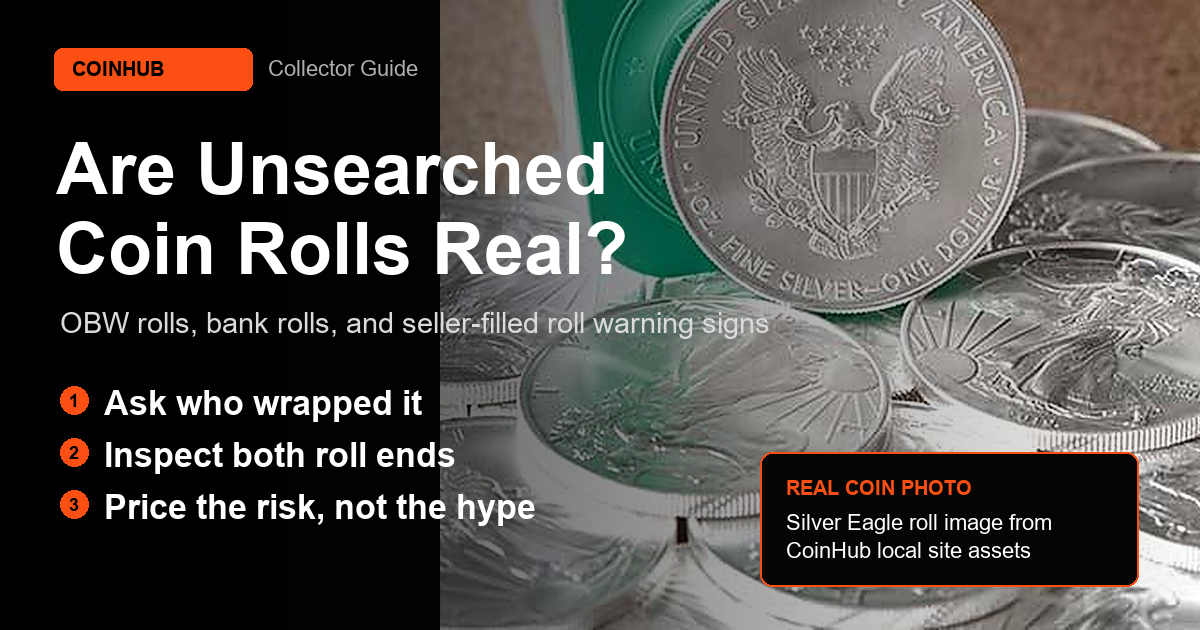
Research for this guide checked current Bing results for "unsearched coin rolls" and "original bank wrapped rolls," including generic roll-hunting guides, marketplace listings, and CoinWeek's OBW roll explainer. Federal Reserve/FedCash coin ordering and depositing pages were checked for bank coin-handling context. The article graphic uses a real Silver Eagle roll photo from CoinHub's local mirrored site assets.
FAQ
Does unsearched mean unopened?
Not always. A roll can be unopened by the current seller, but that does not prove it was never searched before. The source chain matters.
Are original bank wrapped rolls always valuable?
No. OBW rolls can be collectible, but value depends on denomination, date, mint, wrapper, condition, demand, and confidence that the roll is original.
Can a coin on the end prove what is inside?
No. End coins can be interesting, but they do not guarantee the rest of the roll. Judge the whole roll, not only the visible coin.