
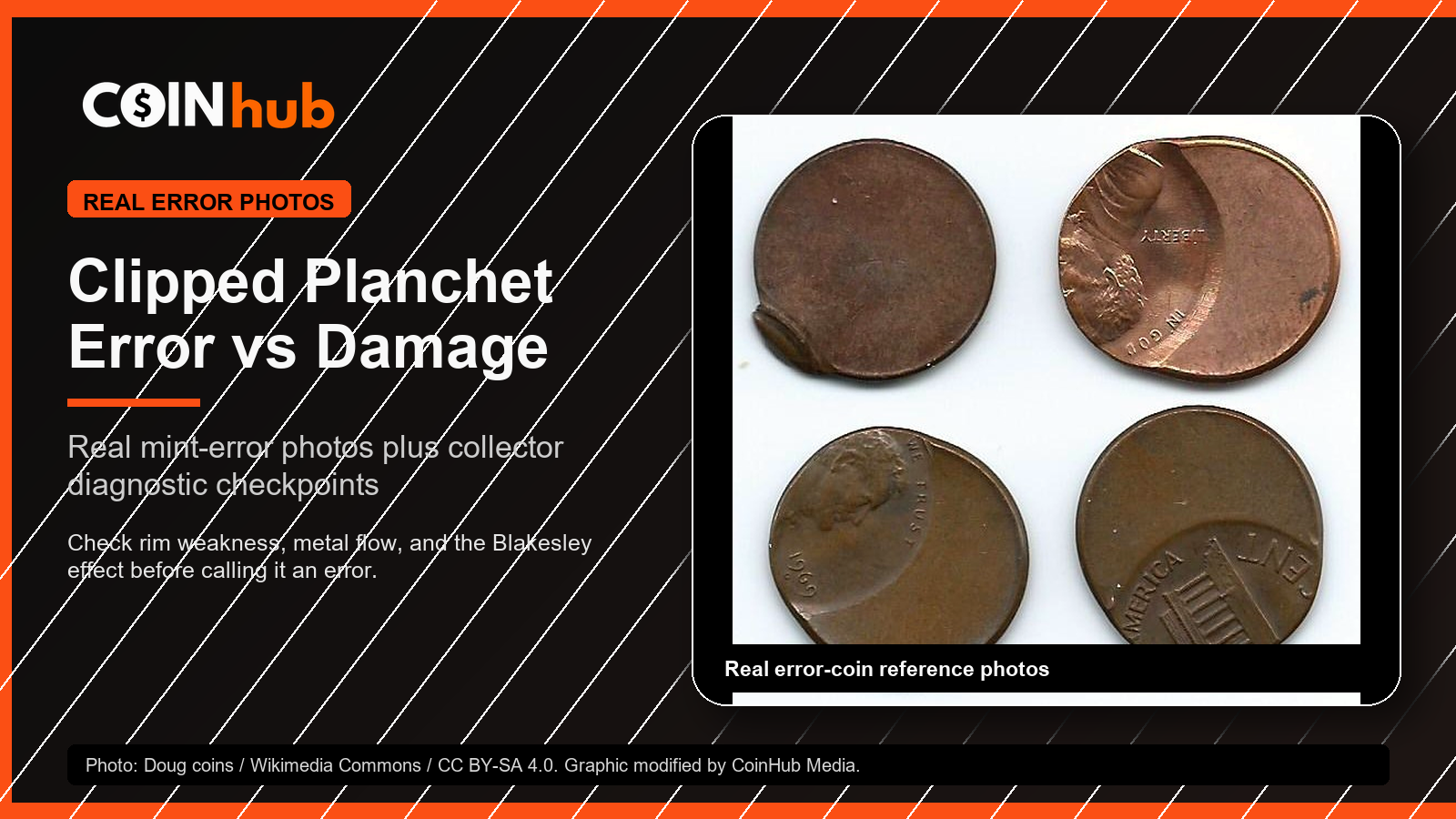
The Main Diagnostics Collectors Should Check
A clipped planchet error can look like a coin had a bite taken out of it, but plenty of damaged coins look similar at first glance. The difference matters because a real clip started before the coin was struck, while post-mint damage happened after the coin left the Mint.
A real clipped planchet usually has a smooth missing area, mint-made metal flow, and often weakness on the rim opposite the clip. A damaged coin usually has jagged cuts, tool marks, bends, scraped metal, or a normal opposite rim.
Do not clean, file, bend, or polish the coin. Photograph both sides, the edge, the missing area, and the rim directly across from the missing area before deciding whether it is worth a closer look.
What Is a Clipped Planchet Error?
A clipped planchet error begins during the blanking process. Coin blanks are punched from a strip of metal before they are struck. If the strip misfeeds, a blank can be punched too close to the edge of the strip or too close to a previous hole. That leaves part of the blank missing before the coin design is struck.
Collectors commonly call these coins clipped planchets, curved clips, straight clips, ragged clips, or incomplete planchet errors. The exact label can vary, but the collector question is usually the same: was the missing area already there when the coin was struck?
Look for these signs before calling it an error:
- Shape of the missing area: curved clips are often smooth and rounded; straight clips can look like a clean flat cut from the edge of the strip.
- Metal flow near the clip: the strike can pull metal toward the open area, so design and rim details near the clip may look stretched or weak instead of sharply cut.
- Blakesley effect: many genuine curved clips show weakness, flatness, or missing rim detail directly opposite the clip.
- Edge texture: a real mint-made clip should not look like fresh plier damage, a saw cut, a drilled hole, or a jagged break from circulation.
- Overall coin shape: a clip should make sense as a blanking error, not as a random chunk torn out after the coin circulated.
Blakesley effect in plain English: when a blank is incomplete, the missing metal can affect how the rim forms on the opposite side during striking. If the rim directly across from the clip is weak or flat, that supports a real mint-made clip. It is helpful evidence, but the whole coin still needs to be evaluated.
Clipped Planchet vs Damage: Quick Comparison
| What You See | More Like a Real Clip | More Like Damage |
|---|---|---|
| Missing edge shape | Smooth curved, straight, ragged, or incomplete area that fits a planchet-strip explanation | Random gouge, torn bite, drill mark, jagged break, or tool-shaped cut |
| Rim opposite the missing area | May show weak or flattened rim detail from the Blakesley effect | Often looks normal if the coin was damaged after striking |
| Metal around the missing area | Can show natural strike flow toward the open space | May show sharp raised burrs, scraped metal, bending, or fresh-looking exposed surfaces |
| Design near the missing area | May be weak or distorted because the blank was incomplete during the strike | Design may be cut through abruptly after it was already struck |
| Value potential | Depends on coin type, size of the clip, eye appeal, condition, and authentication | Usually worth face value or normal collectible value only |
Common Types of Clips
Curved clip: the classic crescent-shaped missing area. This often comes from a blank being punched too close to a previous punch hole in the metal strip.
Straight clip: a straight missing section that can happen when the blank is punched from the edge of the strip.
Ragged clip: an irregular missing area from the rough end or side of the strip. These can be harder for beginners because damage can also look ragged.
Incomplete clip: a partial blanking impression rather than a fully missing piece. These need careful inspection because they can be confused with scratches or other marks.
How to Photograph a Possible Clip
- Take one straight-on photo of the obverse and one of the reverse.
- Take a close-up of the missing area.
- Take a close-up of the rim directly opposite the missing area.
- Take an edge photo if the coin has reeding or a visible rim change.
- Include a normal coin of the same denomination beside it for scale when possible.
Good photos help separate a possible mint error from a coin that was cut, clipped, bent, drilled, or damaged in circulation. They also make it easier for a dealer, error specialist, or grading service to give a more useful opinion.
Is a Clipped Planchet Coin Valuable?
Some clipped planchet errors sell for premiums, but not every clip is expensive. Value depends on the denomination, date, mint mark, size of the clip, whether the date is visible, condition, eye appeal, and whether the error is obvious enough for collectors to want it.
A dramatic clip on a collectible coin can be more interesting than a tiny clip on a common circulated coin. Authentication matters more when the coin is valuable, the clip is unusual, or there are signs that the coin may have been altered.
When Should You Get a Second Opinion?
Ask for a closer look if the clip is large, the coin is otherwise collectible, the rim opposite the clip looks weak, or the piece has enough value that authentication would affect a sale. For common coins with tiny questionable bites, grading can cost more than the coin is worth.
If you are comparing other mint-error types, start with CoinHub's penny error list, quarter error guide, nickel error list, and dime error guide. A missing edge is only one possible error family, and many coins that look strange are actually post-mint damage.
Clipped Planchet Error FAQ
Can a clipped planchet error be faked?
A missing edge can be created after a coin leaves the Mint, so yes, damaged coins can imitate clips. That is why collectors check the rim, metal flow, edge texture, and opposite-side weakness before calling it a mint error.
Does every genuine clipped planchet show the Blakesley effect?
No. It is a strong diagnostic when present, especially on curved clips, but it is not the only thing to check. The size, location, coin type, and strike characteristics all matter.
Are clipped planchet errors the same as off-center strikes?
No. A clipped planchet is a planchet-preparation error where part of the blank is missing before the strike. An off-center strike happens when the blank is not centered between the dies during striking.
Should I clean a possible clipped planchet coin?
No. Cleaning can reduce value and make diagnostics harder to read. Leave the coin as found and document it with clear photos.
Bottom Line
A real clipped planchet should tell a minting story. The missing area, rim, metal flow, and opposite side should work together. If the coin instead shows jagged cuts, tool marks, bending, or fresh damage, it is probably post-mint damage rather than a valuable error.