
CoinHub Labs / local-only pilot
Coin Hunt Atlas
Your own hunt notebook. Every coin searched counts, including the hunts with no finds.
Local notebook, not a national map. Public collection and moderation are not yet configured. No hunt uploads or live community statistics. Read the methodology.
Loading local notebook...
Record a hunt
Your observed results
No recorded sessions.
Self-reported, non-random sample. Set-asides are not authenticated errors. Rates describe only the logged coins, not national odds. All backups and share exports use the full notebook, not this filter.
Session log
No hunts yet. Your first entry will appear here.
Notebook files
Private backups include dates, broad region, and source categories. JSON preserves the notebook format; CSV can be opened in a spreadsheet. Import merges after validation and review; it never replaces the notebook.
Import format and limits
Download the template for exact column names. Use YYYY-MM-DD dates, integers, and the option codes below. The id column may be empty for a new CSV record. JSON must be a version 1 CoinHub hunt notebook export. All three find counts are required. Unknown columns, invalid dates, future dates, fractional counts, duplicate IDs, unsupported codes, and totals above the quantity searched are rejected before any merge.
Limits: 2,000 sessions, 1,000,000 coins per session, 2 MiB per file. Exact field matches are skipped by default, even with different IDs. The review option can retain separate batches with matching counts and different IDs. Different values with an existing ID are rejected: use Edit in the log to revise that session. Identical but genuinely separate batches can be entered manually after a duplicate warning. CSV imports use this notebook's category definitions.
- denominations
- cent, nickel, dime, quarter, half, dollar
- sources
- machine-roll, customer-roll, loose-change, mixed-unknown
- regions
- not-recorded, northeast, midwest, south, west, territory, outside-us
Local data controls
Export a backup before clearing this notebook. Other CoinHub tools are unaffected.
Review an aggregate for sharing
No upload happens here. This creates a file you may choose to share later for a reviewed research dataset. Only denomination totals meeting both 5 sessions and 1,000 coins appear. Dates, region, source, session IDs, and individual rows are removed. This reduces disclosure; it does not guarantee anonymity.
What your notebook can tell you
Method 2026-09-18.1. Record one previously unsearched batch, one denomination, one source category, and one date per session. Count actual coins, not the expected capacity of a wrapper. Exclude deliberately seeded teaching batches, purchased collector lots, and coins you know you already searched. A mixed jar needs separate sessions by denomination. Include every completed hunt, including zero-find sessions.
Three counts, one coin counted once
Check all three categories in this order. A coin goes into the first category that applies. Everything else is an ordinary coin for this protocol, not a failed hunt.
- Non-U.S. coins: Coins identified as non-U.S., even if dated before 1960. Include them in the batch total.
- U.S. dates before 1960: U.S. coins with a clearly readable date earlier than 1960. This is a date observation, not a value or rarity claim.
- Other coins set aside: Other coins needing closer study, including unreadable dates. Exclude anything already counted above; this is not an authenticated error count.
Rates, not rarity estimates
Observed rate = category count / actual coins searched x 1,000. Pooled rates sum coins and finds first; they do not average session percentages. Charts use a fixed 0-1,000 scale, and each row includes the underlying totals. Denominations stay separate. A zero describes this sample only; it does not prove a find is impossible.
These are self-reported observations from your own selected sources. Small samples, repeated coin supply, missed dates, subjective set-asides, and selective logging can change results. Sessions are not necessarily independent. No confidence intervals, national rarity estimates, guaranteed odds, or market values are inferred. Exact duplicate imports are flagged; a renamed or altered duplicate may still need your review.
Privacy and the future research pilot
No public collection, upload endpoint, moderation queue, or live community statistics are configured. Notebook entries stay in this browser's local storage when available. This is not encrypted storage or a cloud backup; people using this browser profile can see it. Clearing browser data removes it. The feature sends no hunt records to a server.
Do not record exact banks, homes, addresses, names, or photo GPS. The form accepts only a broad region, not a place name, and accepts no photographs or free-text notes. Private JSON/CSV backups contain session dates, broad regions, and source categories. Treat them as private files.
The separate aggregate export removes session IDs, dates, regions, and source categories. It groups only by denomination and suppresses groups with fewer than 5 sessions or 1,000 coins. These are conservative pilot disclosure rules, not a guarantee of anonymity or statistical reliability. Review the exact export before downloading. A future reviewed dataset still needs participant consent, deduplication across contributors, evidence checks, a moderator, and a publication policy. No submission happens here.
Why circulation is worth observing
The Mint produces coins, and the Federal Reserve distributes them to banks and credit unions. Coins cycle among institutions, businesses, and people. Where a coin is found does not establish where it was minted, and a local batch is not a random sample of the whole country. U.S. Mint: Bringing Coins into Circulation; Federal Reserve: Its Role in Coin Circulation.
Recording effort as well as interesting observations is a useful citizen-science principle. The checklist/protocol approach of Cornell Lab of Ornithology: eBird Protocols is an inspiration, not a validation of this coin protocol or an affiliation.
Start with the date, denomination, and visible design. A field is background space; relief is the design raised above it. A mint mark identifies the mint, not the current location. U.S. Mint: Anatomy of a Coin.
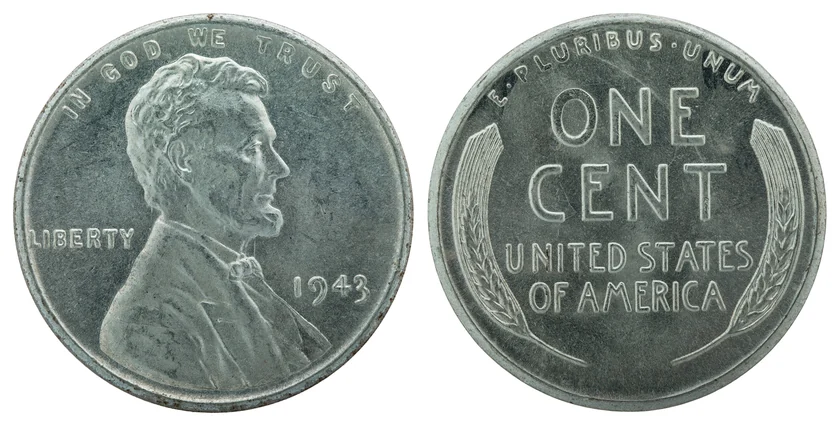
.jpg)
Color alone is not composition evidence: regular 1943 cents used zinc-coated steel. This historical reference is a teaching image, not a reported hunt find. U.S. Mint: The 1943 Cent.