
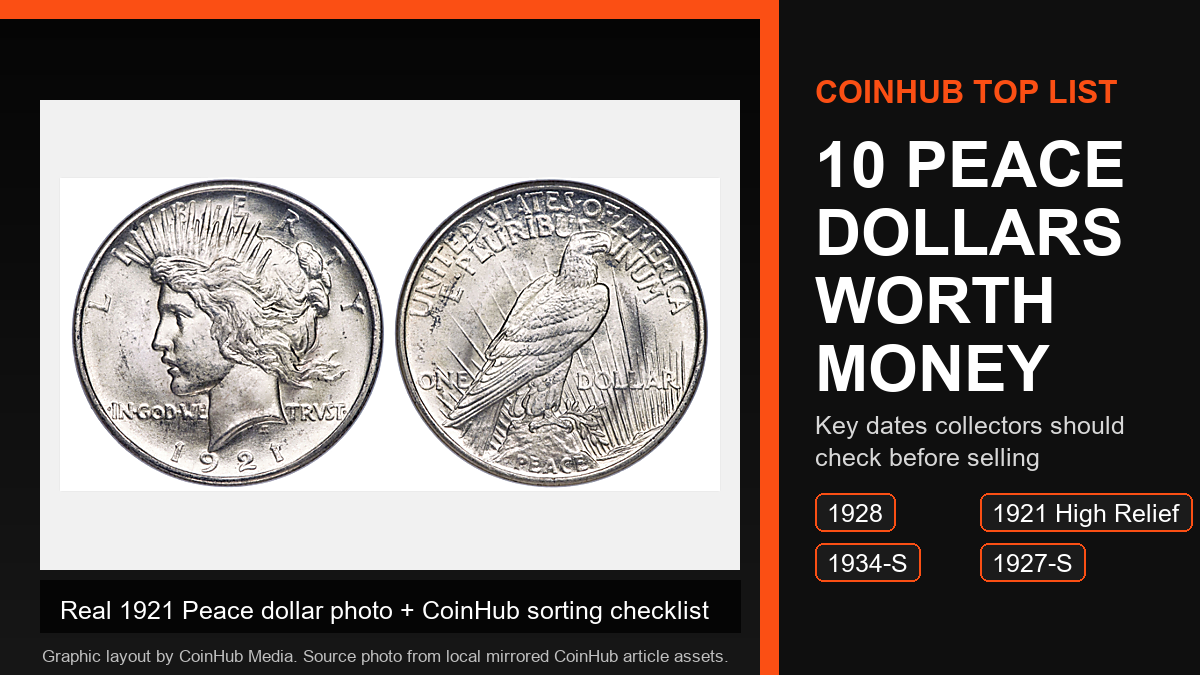
Key Dates Collectors Should Check
Quick answer:The Peace dollars most worth checking first are the 1921 high relief, 1928 Philadelphia, 1934-S, 1927-S, 1924-S, 1925-S, 1927-D, 1935-S, 1928-S, and better high-grade common dates. Date, mint mark, condition, cleaning, and eye appeal matter more than silver content alone.
Peace dollars are 90% silver U.S. dollars struck from 1921 to 1935. Many common circulated examples trade close to normal silver-dollar levels, but a few dates and mint marks deserve a much closer look before you sell a collection, spend a loose coin, or treat every Peace dollar as the same.
This CoinHub list is built for practical sorting. It is not a guarantee that every coin below is expensive in every grade. Instead, it shows which Peace dollars should come out of the generic silver-dollar pile first because collectors pay attention to their mintage, condition rarity, mint mark, or series demand.
The 10 Peace Dollars To Check First
1. 1928 Peace Dollar, Philadelphia
The 1928 Philadelphia Peace dollar is the classic key date of the regular series. PCGS CoinFacts lists a mintage of 360,649, the lowest mintage for a regular Peace dollar. A worn example can still be worth separating from common silver dollars, while problem-free Mint State coins are a very different market.
2. 1921 High Relief Peace Dollar
The first-year 1921 Peace dollar uses the high relief design and is a one-year type within the series. PCGS lists the coin at 26.73 grams, 38.10 millimeters, 90% silver, and a Philadelphia mintage of 1,006,473. Even circulated coins are popular because collectors need the 1921 for a complete type or date set.
3. 1934-S Peace Dollar
The 1934-S is not the lowest-mintage Peace dollar, but it is a major condition rarity. PCGS lists a San Francisco mintage of 1,011,000, and the coin becomes much tougher as grade rises. Watch for cleaned surfaces, dull gray color, rim issues, and weak luster before assuming a raw example is high grade.
4. 1927-S Peace Dollar
The 1927-S is another San Francisco issue that deserves a careful check, especially in About Uncirculated and Mint State grades. Many survive with marks, softness, or past cleaning, so original surfaces are a major part of the value conversation.
5. 1924-S Peace Dollar
The 1924-S can be easy to overlook because the Philadelphia 1924 is common. The S mint mark changes the equation. Pull any 1924-S from a group of Peace dollars and inspect it separately for luster, strike, and surface originality.
6. 1925-S Peace Dollar
The 1925-S is often available in circulated grades, but attractive higher-grade examples are more meaningful. If the coin has strong luster, fewer bag marks, and no cleaning hairlines, it deserves better research than a quick melt-value estimate.
7. 1927-D Peace Dollar
The 1927-D is a better Denver issue with collector demand across the series. Check the D mint mark carefully and compare the coin against normal wear patterns. A problem-free coin with solid detail is more interesting than a heavily cleaned or damaged example.
8. 1935-S Peace Dollar
The 1935-S is the final San Francisco issue and one of the last Peace dollars struck for circulation. It is not automatically rare in low grade, but it is worth checking because collectors like late-series San Francisco coins with original surfaces.
9. 1928-S Peace Dollar
Do not confuse the 1928-S with the lower-mintage 1928 Philadelphia key date. The San Francisco coin is a different issue, but it still belongs in the better-date check pile, especially when the coin has strong eye appeal or higher-grade potential.
10. High-Grade Common Dates
Common dates such as 1922, 1923, 1924, and 1925 can still be worth checking if they are sharply detailed, lustrous, and free of heavy marks. The best common-date Peace dollars are not valued like ordinary worn examples. High grade, attractive toning, and clean cheek fields can matter.
Fast Peace Dollar Sorting Table
| Coin to pull first | Why collectors check it | First thing to verify |
|---|---|---|
| 1928 Philadelphia | Lowest regular-series mintage and the classic key date. | No mint mark; do not confuse it with 1928-S. |
| 1921 High Relief | First-year high relief one-year type. | High relief design and Philadelphia issue. |
| 1934-S | Important condition rarity, especially in higher grades. | S mint mark, originality, and cleaning. |
| 1927-S | Better San Francisco issue with strong date-set demand. | S mint mark and surface quality. |
| 1924-S | Scarcer than the common 1924 Philadelphia dollar. | S mint mark on the reverse. |
| 1925-S | Better date when original and attractive. | Luster, bag marks, and old cleaning. |
| 1927-D | Better Denver issue. | D mint mark and problem-free surfaces. |
| 1935-S | Late-series San Francisco issue. | Original surfaces and grade. |
| 1928-S | Different from the key 1928 Philadelphia, but still worth checking. | S mint mark and condition. |
| High-grade common dates | Common date does not mean common value in high grade. | Cheek marks, luster, strike, and certified grade potential. |
Where Is The Mint Mark On A Peace Dollar?
Look on the reverse near the lower left side of the eagle, close to the tip of the wing and above the word ONE. A Peace dollar with no mint mark was struck at Philadelphia. A D means Denver, and an S means San Francisco. The mint mark is one of the fastest ways to separate a common date from a better one.
What Makes A Peace Dollar Valuable?
Start with date and mint mark, then move to condition. Peace dollars are large silver coins, so many have cheek marks, rim dings, dull surfaces, or old cleaning. A better date with harsh cleaning may sell very differently from a problem-free example. A common date with outstanding luster and very few marks may also deserve attention because high-grade Peace dollars are collected aggressively.
NGC's Peace dollar price guide was showing current series rows for 1921 through 1935 when checked on July 7, 2026, and its price-guide language makes an important point: retail values depend on reported transactions, market availability, demand, and the grade of certified coins. In plain English, do not price a raw Peace dollar from one headline number. Identify the exact issue first.
What Not To Do With Better Peace Dollars
Do not clean a Peace dollar. Wiping, polishing, dipping, or using an abrasive cloth can leave hairlines and reduce collector value. Do not remove a coin from an older holder just to make it shiny. Do not assume every 1928 is the key date until you check whether it has an S mint mark. And do not assume every 1922 or 1923 is only worth silver if the coin looks unusually sharp and clean.
CoinHub tip: If you inherited Peace dollars, sort them into three groups: better dates and mint marks, clean high-grade candidates, and common circulated coins. The first two groups deserve individual research before any bulk sale.
Internal CoinHub Next Steps
For silver-value context, use the CoinHub silver melt calculator. If you are sorting an inherited group, read how to sell your coin collection before breaking up the set. For another classic silver-dollar checklist, compare this with CoinHub's Morgan dollars worth money guide.
Peace Dollar FAQ
Are all Peace dollars worth money?
All genuine Peace dollars contain silver and have collector interest, but common worn dates are not valued like key dates or high-grade certified coins. Date, mint mark, condition, and originality drive the premium.
Is a 1928 Peace dollar always valuable?
The 1928 Philadelphia Peace dollar is the key date most collectors mean. A 1928-S is a different San Francisco issue. Always check the reverse mint mark before pricing the coin.
Should I grade a Peace dollar?
Certification can make sense for key dates, strong Mint State candidates, attractive toned coins, or pieces where authenticity or cleaning is in question. For common heavily circulated examples, grading fees may not add enough value.
Sources checked for this article include PCGS CoinFacts pages for the 1921 High Relief, 1928 Philadelphia, and 1934-S Peace dollars; NGC's Peace Dollars (1921-1935) price guide checked on July 7, 2026; Bing search-result review for current competing Peace dollar key-date pages; and existing CoinHub Peace dollar article assets already mirrored in the local site project.