
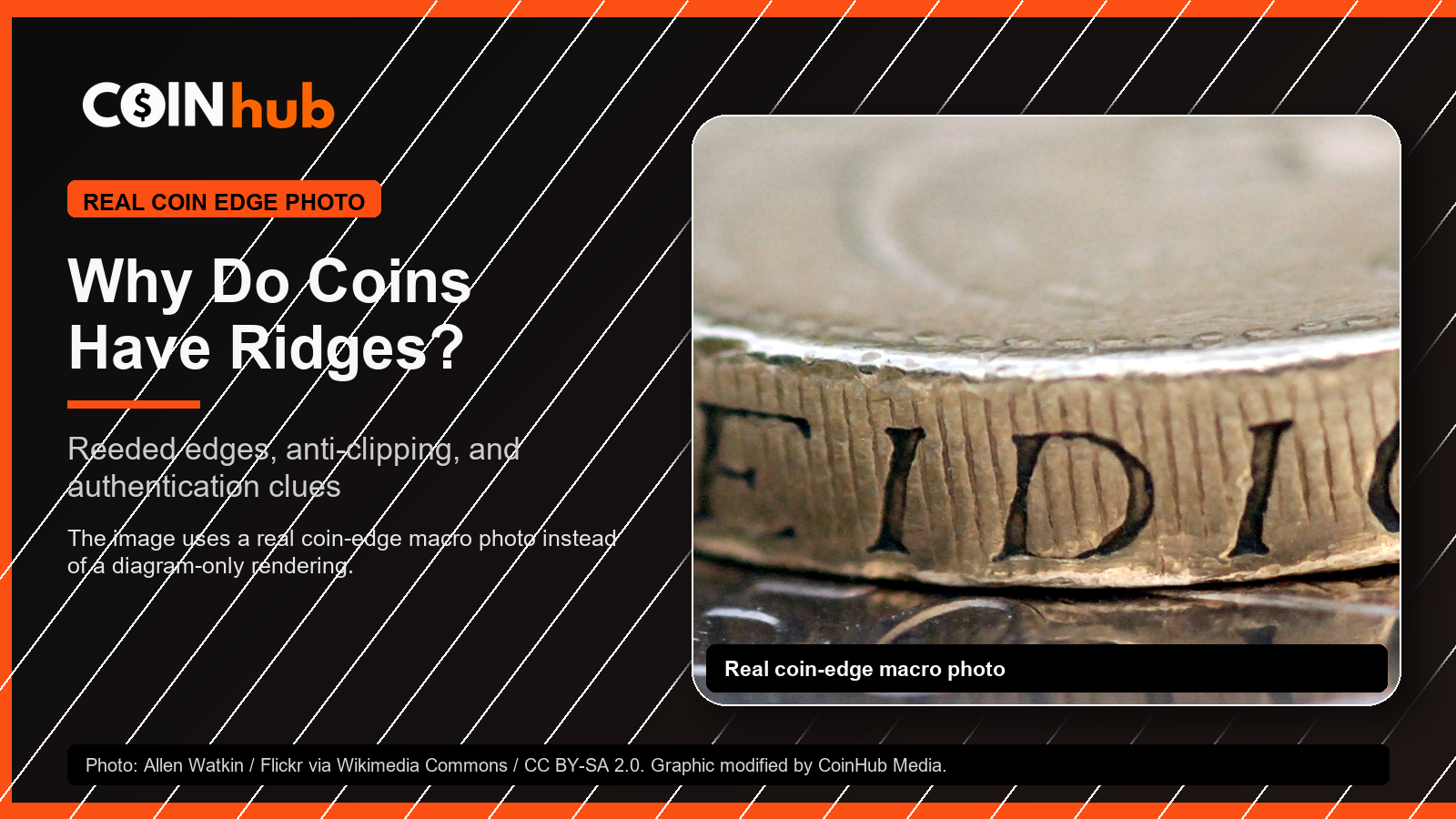
Why Do Coins Have Ridges? The Edge Detail Most People Ignore
Coins have ridges, called reeded edges, because they originally made it harder to shave or file precious metal from the edge of a coin without being noticed. On modern U.S. pocket change, reeding is also a familiar design feature and a quick tactile clue: dimes and quarters have ridges, while pennies and nickels normally have smooth plain edges.
The edge of a coin is easy to overlook because collectors naturally look at the date, mint mark, portrait, reverse design, and obvious errors first. But the edge can answer a lot of questions before you ever grab a magnifier. It can tell you whether a coin is supposed to feel smooth, whether it has normal reeding, whether the rim is worn down, or whether damage has made an ordinary coin look unusual.
The U.S. Mint separates the edge from the rim. The edge is the outside surface around the coin. The rim is the raised border on the front and back that helps protect the design. That distinction matters because a coin can have a normal reeded edge and still show rim damage, or it can have a plain edge because that is exactly how the denomination was made.
What is a reeded edge?
A reeded edge is the series of small grooves or ridges around the outside of a coin. If you run your fingernail around the edge of a dime or quarter, the rough texture you feel is the reeding.
Coin edges are not all the same. The U.S. Mint identifies several common edge styles, including plain, reeded, lettered, and decorated edges. A plain edge is smooth. A reeded edge has little vertical lines. A lettered edge has words, numbers, or symbols around the outside. A decorated edge can include other patterns.
Why ridges were added in the first place
The classic reason is coin clipping. When coins were made from precious metals such as silver or gold, a dishonest person could shave a tiny amount from the edge, keep the metal, and still try to spend the coin. If enough people did it, the coin might look mostly normal but contain less metal than it should.
Reeding made that trick easier to detect. A clipped or filed coin would interrupt the edge pattern. Instead of a clean series of ridges, the edge might look flat, scraped, uneven, or suspiciously smooth. That made the edge a built-in security feature long before modern anti-counterfeiting technology.
The U.S. Mint's own educational material says early dimes were originally silver and that reeded edges were added so people could not file off pieces of silver. That same idea explains why many older silver and gold coins have detailed edge treatment.
Which U.S. coins have ridges?
For modern pocket change, the simple rule is easy to remember:
| Coin | Normal edge | Collector note |
|---|---|---|
| Cent | Plain edge | A smooth edge is normal. Do not call it an error just because it lacks ridges. |
| Nickel | Plain edge | Modern nickels are normally smooth on the edge. |
| Dime | Reeded edge | Ridges are normal. The current Mint dime specifications list a reeded edge. |
| Quarter | Reeded edge | Ridges are normal on circulating quarters. |
| Half dollar | Usually reeded | Most modern Kennedy half dollars have reeded edges, but always check the exact type. |
| Modern dollar coins | Often lettered or plain, depending on series | Some dollar coins put the date, mint mark, or motto on the edge, so the edge is part of the attribution. |
There are exceptions across U.S. coin history, medals, bullion pieces, and world coins. That is why the best first step is not "ridges mean valuable." The best first step is "what edge should this exact coin have?"
Why do pennies and nickels not have ridges?
Modern U.S. cents and nickels normally have plain edges because they were not designed with reeding for everyday circulation. Their metal value and size history are different from silver-era dimes, quarters, halves, and dollars.
This is why beginners often get confused. A smooth-edge penny is normal. A smooth-edge nickel is normal. A smooth-edge dime or quarter, however, needs more context. It might be heavily worn, damaged, altered, broadstruck, struck outside the collar, or something else entirely. The edge alone does not prove the answer, but it tells you what question to ask next.
How collectors should check a coin edge
When a strange edge might matter
A strange edge can matter, but only after you sort out normal design, wear, and damage. Here are a few situations where the edge deserves a closer look:
- A reeded coin has a completely smooth edge: check for heavy wear, post-mint filing, broadstrike behavior, or a struck-out-of-collar possibility.
- A modern dollar coin has missing or unusual edge lettering: some edge-lettering errors are collectible, but many odd-looking edges are damage or normal variation.
- A coin has a missing curved section: compare it with a real clipped planchet diagnostic before assuming it is a mint error.
- An older silver or gold coin is underweight: edge damage, clipping, counterfeiting, or cleaning may be part of the story.
- The edge has a seam: be careful. Seams can be a warning sign on counterfeit, plated, or altered pieces.
Are ridges still useful today?
Yes, but the job has changed. Modern circulating U.S. dimes and quarters are not silver coins that people can profitably clip for bullion. The ridges remain partly because they are traditional, familiar, and useful for quick identification by touch. On bullion and higher-value coins, edge design can still help with authentication and counterfeit screening.
That does not mean reeding makes a coin impossible to fake. Counterfeiters can imitate edge details. It means the edge is one more place where a fake, damaged, or altered coin can give itself away.
Plain edge vs reeded edge: the collector mindset
The edge is not a shortcut to instant value. It is a clue. A smooth edge on a nickel is normal. A smooth edge on a dime is a question. A missing section of metal could be a real clipped planchet, but it could also be damage. A lettered edge could be exactly where the mint mark belongs on a modern dollar coin.
If you are sorting pocket change, start with normal edge style, then move to the rest of the coin. For related checks, read CoinHub's clipped planchet error vs damage guide, coin alignment vs medal alignment guide, dime error list, and quarter error guide. If you are checking silver coins, CoinHub's silver melt calculator can help you separate metal value from collector value.
FAQ
What are the ridges on coins called?
The ridges on the outside of a coin are usually called reeding. A coin with this feature has a reeded edge.
Why do dimes and quarters have ridges?
Dimes and quarters have reeded edges because the design traces back to the old need to discourage clipping or filing precious metal from coins. Today, the ridges remain as a familiar edge style and tactile clue.
Why do pennies and nickels have smooth edges?
Modern U.S. cents and nickels normally have plain smooth edges. That is their standard design, so a smooth edge on those coins is not an error by itself.
Is a smooth-edge quarter valuable?
Not automatically. A smooth-edge quarter could be heavily worn, damaged, filed, altered, or struck abnormally. You need to check weight, diameter, rim detail, surface condition, and whether the coin shows evidence of a real minting error.
Can coin ridges help spot a fake?
They can help, especially on older silver, gold, and bullion coins, but they are only one clue. A fake can have edge details, so collectors should also check weight, diameter, design sharpness, metal, surface quality, and certification when value is significant.