
By Blake Alma
1983 Washington Quarter Value Guide
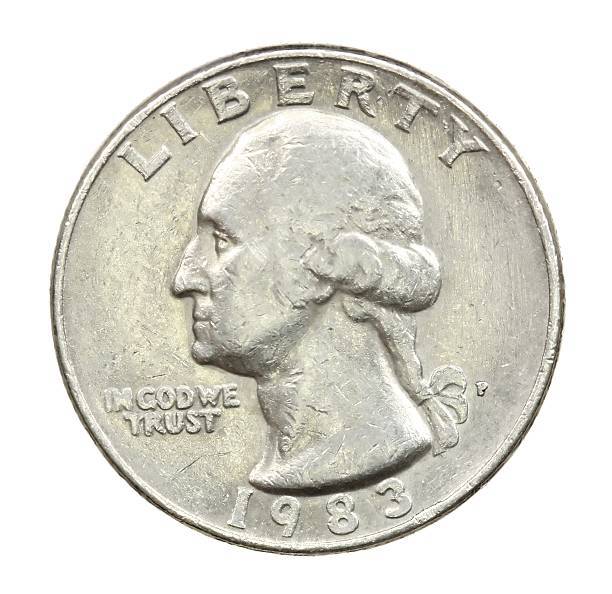
The 1983 Washington Quarter is a copper-nickel clad U.S. quarter. Like 1982, no regular Uncirculated Mint Sets were produced, making high-grade circulation strikes harder to find. Proof coins were issued separately for collectors. Value is driven by condition, mint mark, and errors rather than metal content.
Quick Facts
- Year: 1983
- Denomination: Quarter Dollar
- Series: Washington Quarter
- Composition: Copper-Nickel Clad (Outer layers: 75% copper, 25% nickel; Core: pure copper)
- Weight: 5.67 grams
- Diameter: 24.3 mm
- Edge: Reeded (copper visible on edge)
- Designer: John Flanagan
Mint Marks
Regular circulation quarters dated 1983 were struck at Philadelphia and Denver. San Francisco produced proof quarters for collectors:
- Philadelphia Mint (P mint mark; circulation strike)
- Denver Mint (D mint mark; circulation strike)
- San Francisco Mint (S mint mark; proof)
⚠ Important: The missing regular Uncirculated Mint Sets should not be confused with proof sets. Compare circulation strikes and proofs separately.
Mint marks are located on the obverse, just to the right of Washington’s ponytail.
1983 Washington Quarter Value
Ordinary circulated examples are generally worth face value ($0.25). Uncirculated examples can command a premium, but the date alone does not establish a price.
- Circulated P or D: Check condition and any verified variety before expecting a premium.
- Uncirculated P or D: Compare recent sold examples of the same mint and grade.
- 1983-S proof: Use proof comparisons rather than circulation-strike prices.
Do not apply a top-grade auction result to a worn or ungraded coin. Price guides and sold records need the exact issue, grade, surface condition and sale date to be useful.
Clad Composition and Melt Value
The 1983 Washington Quarter contains no precious metal. Collector value depends on condition, strike quality and any confirmed variety or mint error. The absence of regular Uncirculated Mint Sets helps explain interest in well-preserved circulation strikes.
What Impacts Value Most
- Condition / Grade: The most important pricing factor
- Mint Mark and Strike: Compare P and D circulation strikes separately from S proofs
- Strike Quality: Strong strikes with full luster are preferred
- Originality: Uncleaned coins with original surfaces bring premiums
Potential Mint Errors: Verify the Attribution First
Unusual-looking quarters need examination before they are described as mint errors. Possible error categories include:
- Off-center strikes
- Broadstrikes
- Clipped planchets
- Struck-through grease or debris
- Wrong planchet errors (require authentication)
There is no single price range for these categories. Confirm the error, then compare authenticated examples with similar diagnostics and condition. Damage or ordinary wear is not proof of a mint error.
How to Identify a 1983 Washington Quarter
- Confirm the date (1983) on the obverse
- Check the mint mark on the obverse, to the right of Washington’s portrait: P for Philadelphia, D for Denver, or S for a San Francisco proof
- Check the edge for a visible copper stripe
- Examine luster, contact marks, and overall eye appeal
Collectible Value and Condition
Most ordinary circulated 1983 quarters are worth face value; well-preserved examples can be collectible. A missing-looking mint mark needs closer examination and does not by itself establish a valuable error.
References: PCGS catalogs the 1983-P circulation strike, 1983-D circulation strike and 1983-S proof separately. Its Washington quarter guide documents the P mint mark beginning in 1980, and its 1982-P commentary discusses the 1982–83 Mint Set gap. Facts reviewed September 29, 2026.