
U.S. Coin Guide / 1793
1793 Liberty Cap Half Cent: Left-Facing Liberty
Values by grade
USD per coin| Grade | Coin value |
|---|---|
| G-4Good | Not available |
| VG-8Very Good | Not available |
| F-12Fine | Not available |
| VF-20Very Fine | Not available |
| XF-40Extremely Fine | Not available |
| AU-50About Uncirculated | Not available |
| MS-63Mint State | Not available |
| MS-65Mint State | Not available |
Current grade prices are still being verified.
Price scope: 1793 business strike, Brown (BN), Cohen variety not assigned. Use the variety guidance below for identification.
Opens a 1793 business-strike reference with die marriage unassigned. Review your own coin's grade and details before saving. Guide values are not copied.
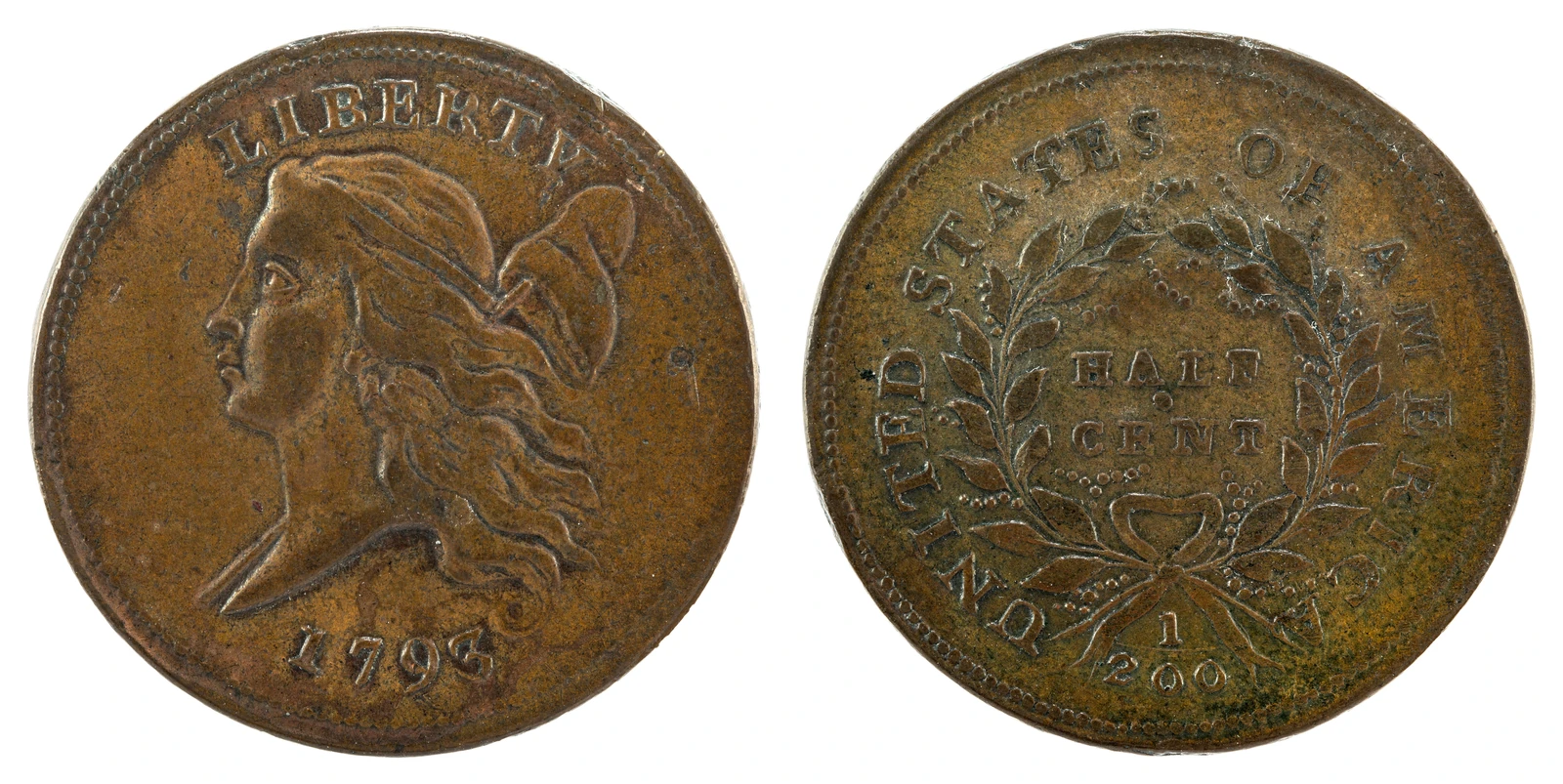
About this coin
The 1793 half cent is the only dated issue of the left-facing Liberty Cap type. Check the denomination, portrait, wreath and lettered edge together. References disagree about its mintage (the number made) and designer, so those claims need their explanations.
Business strike: a coin made for everyday circulation. Die marriage: the pair of metal stamping tools used for a coin’s front and back. U.S. Mint glossary.
- Face denomination
- Half cent; 1/200 dollar
- Issuer and mint
- United States; Philadelphia
- Composition
- Copper
- Nominal weight
- 104 grains (about 6.74 g), the target weight set by law; a worn coin may weigh less.
- Diameter context
- PCGS diameter specification 22 mm. Smithsonian record 1991.0357.0006 lists one coin at 2 × 22.5 mm overall.
- Edge
- Lettered: TWO HUNDRED FOR A DOLLAR
- Reported production
- Conventional 35,334; Eckberg's archival interpretation 31,934. Disputed accounting, not a survivor count.
- Designer context
- Uncertain. Eckberg proposes a shared design hub with the 1792 disme pattern. Historical attributions differ.
Confirm the identification
- Liberty faces left, with flowing hair and a cap on a pole behind the portrait; LIBERTY is above and 1793 below.
- The reverse places HALF CENT inside a wreath, with UNITED STATES OF AMERICA around it and the fraction 1/200 below.
- The edge carries TWO HUNDRED FOR A DOLLAR; record surviving letters without cleaning or removing a coin from its holder.
- The statutory standard is 104 grains of copper, about 6.74 grams; a worn specimen need not match that nominal figure exactly.
- Do not confuse this half cent with a 1793 Chain cent or Wreath cent, or with a silver half disme dated 1792.
How to identify the 1793 half cent
Read the coin’s face value before the date. HALF CENT and 1/200 mean one two-hundredth of a dollar. This is neither a one-cent piece nor a half dime. Early coins can have similar Liberty portraits, so those words matter when choosing coins to compare. The half cent is an early copper coin; the half disme is a separate denomination made of a different metal. On the 1793 half cent, Liberty faces left. The following year’s half cent turns her to the right.
Begin with a complete view of both sides, rather than a close-up of the date alone. Find the cap and pole, then trace the wreath around HALF CENT. If accessible, photograph the date, wreath, fraction and edge in separate views. These details help identify a coin even when its portrait is worn. If the final date digit is unclear, keep that reading uncertain until the rest of the design and an expert’s check support it. A guessed date does not prove the coin is genuine.
Weight, measurements and the first production
The January 14, 1793 law set the weight at 104 grains of copper per half cent and 208 grains per cent. PCGS lists a diameter of 22 millimeters and a weight of 6.74 grams for the issue. The Smithsonian record 1991.0357.0006 gives overall measurements of 2 × 22.5 millimeters for one 1793 half cent. Check the design and edge lettering alongside the measurements.
The Philadelphia Mint struck these half cents in 1793. William R. Eckberg places the start of striking on July 19. In his account, the Mint treasurer received 7,000 half cents on July 20 and 24,934 on July 26. Those are delivery dates. Striking is when the Mint made the coins.
Why the mintage and designer remain disputed
PCGS lists a conventional mintage of 35,334. Eckberg reads Mint Treasurer Tristram Dalton’s receipts as evidence for 31,934 half cents. In Eckberg’s reading, the September 18 receipt lists cents, which leaves the reported extra 3,400 half cents in dispute. PCGS discusses both totals. A mintage is a production figure. Estimating how many coins survive requires separate evidence.
The designer is still uncertain. PCGS lists the designer as unknown. Bill Eckberg compared photographs and argued that the 1792 disme, an experimental ten-cent coin, and the 1793 half cent shared a hub for the front design. A hub transfers a design to the dies that strike the coins.
NGC notes the traditional attribution to Adam Eckfeldt and researcher Karl Moulton’s proposal of Joseph Wright. A resemblance between the coins can help trace the design. Naming the person who cut the dies requires other evidence.
Read the edge and understand Cohen numbers
The edge is a third surface that helps you identify the coin. If the coin is outside a holder, turn it gently above a padded surface and hold it only by the edge. For a coin in a grading service’s holder, record the letters it lets you see and mark the rest unobserved. Do not pry open a holder to see more. Note partial letters, wear and blocked views as they are. Front-and-back photographs alone cannot show whether the edge has the expected inscription.
The edge lettering was added before the faces were struck. In 2013, NGC certified a copper blank prepared for the 1793 half cent. It never received the portrait, wreath or date, but the edge already carried the words and two leaves pointing toward each other. NGC used the edge design and the blank’s size to identify its intended use. The blank’s earlier ownership is unknown.
PCGS recognizes the Cohen C-1 through C-4 die marriages for 1793. A die marriage is a pairing of dies used for the two sides. These four names do not mean four denominations or four grades. Assign a Cohen number only after comparing both sides with a reliable illustrated reference. One berry or hair strand is not enough if wear hides nearby details. This guide covers the general business-strike issue, rather than every die state, unusual edge or exceptional specimen classification.
How to tell the four Cohen varieties apart
Start with the front. C-1 and C-2 share a die with a larger 7 in the date and more space between the Y in LIBERTY and the cap. The front shared by C-3 and C-4 has a smaller 7 and a narrower gap. Then check the back to tell the two pairs apart. Crosby’s illustrated study
The pair codes below use Eckberg’s system. In 1-B, the number identifies the front die and the letter identifies the back die. CoinFacts variety cross-reference
- C-1 (1-A). Look for the long, straight bar in the fraction on the back.
- C-2 (1-B). The back has a curved fraction bar and a clearer dot near the A in HALF.
- C-3 (2-B). The back matches C-2. Check the smaller 7 and the narrower gap between the Y and cap on the front.
- C-4 (2-C). The front matches C-3. On the back, look for a small dot near the upper left of the N in CENT.
If wear or corrosion hides the clues, leave the variety unassigned. Compare both sides before choosing a number. Record the author’s name with any older code, since Crosby and Eckberg used different systems.
Historical photographs of all four varieties
Each pair shows the front and back of the same numbered coin in the 1924 Alvord sale catalogue. Fine marks are faint in this scan, especially on the back of lot 9.
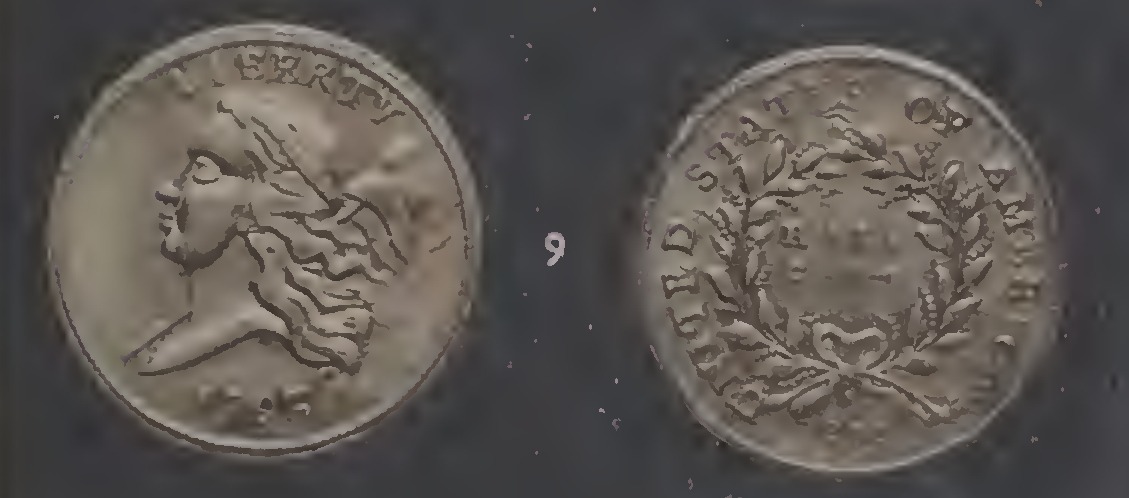
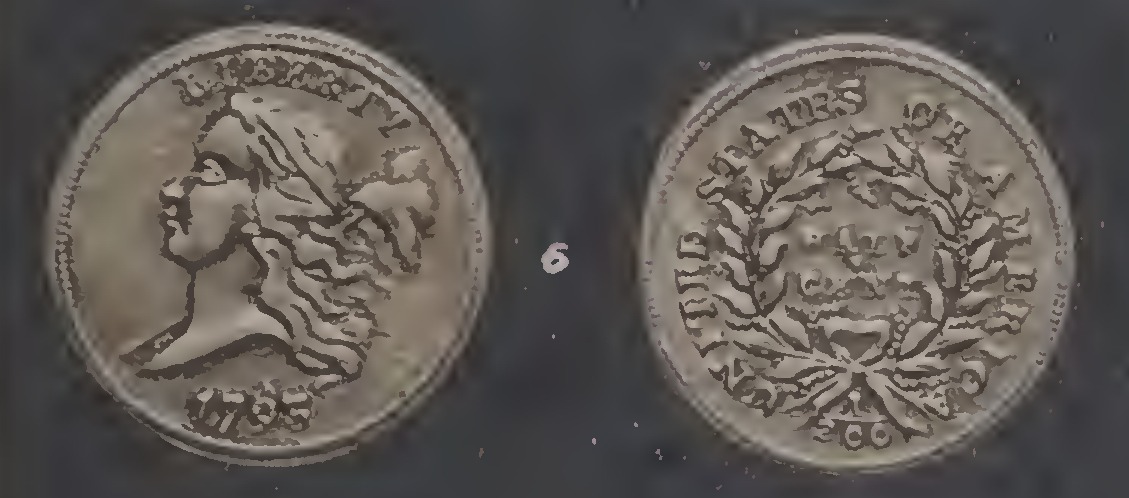
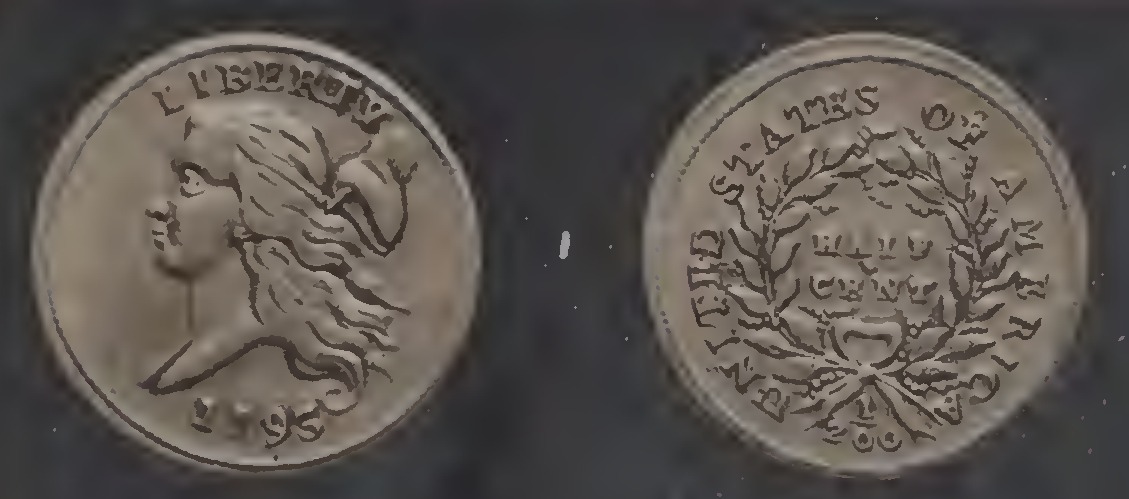
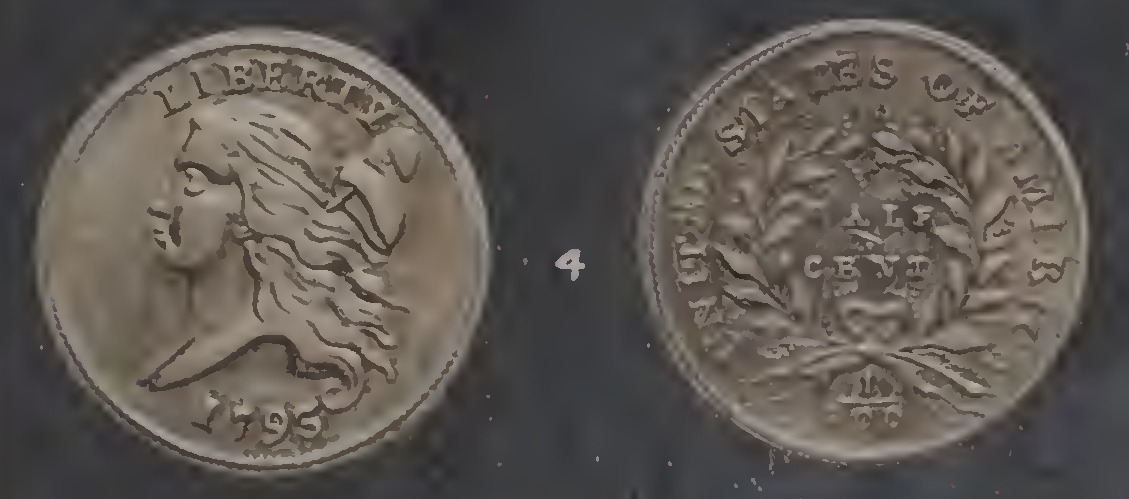
S. H. Chapman’s 1924 Alvord catalogue, first plate. Library of Congress scan via Internet Archive. Public domain in the United States.
What is the Washington Head half cent?
Collectors may encounter a piece dated 1793 with George Washington in uniform facing right. Catalogues call it the Washington Head half cent or Baker 27. Its back can resemble a regular half cent, so check the portrait on the front before using this guide to identify it.
Early catalogues debated whether it was an experimental coin. In the American Numismatic Society proceedings, George Fuld describes a thin metal copy bearing Washington’s portrait attached over the front of a 1793 half cent. The piece is catalogued here as a historical alteration. The four Cohen pairings above are the documented varieties of the regular 1793 issue.
Can a sharp 1793 half cent be a Proof?
Walter Breen recalled seeing unusually sharp, well-centered 1793 half cents struck on broad blanks. He considered the evidence for a special presentation strike uncertain. Sharp lettering and an even border are useful observations, but a Proof or Specimen label needs evidence of how the individual coin was made.
If a coin comes with a story about having been given as a gift, keep the story and its source with the coin’s record. Check the strike separately before using it to choose a grade or compare values.
Judge condition separately from authenticity
On a first-year copper coin, readable, appealing surfaces may tell you more than a sharp portrait on a rough surface. Under changing light, compare the sheltered letters, exposed portrait, rim and fields—the flat areas around the design. Note wear, weak striking and disturbed surfaces separately. They can all affect detail, but they do not mean the same thing or determine a grade on their own. Brown color alone cannot tell you whether a coin was used, cleaned or is genuine. Bright copper does not prove original mint color. Describe what you see before trying to explain its cause.
Look at the lettering in the center of the reverse. On a 1793 half cent, HALF CENT can be faint from the way the coin was struck. The Early American Coppers grading guide notes that the C-1 reverse die buckled, which can leave the words incomplete even on coins graded Very Fine. Compare the lettering with the wreath and the high points of Liberty’s portrait before deciding how much detail was lost to wear.
In a 2015 report, NGC identified transfer-die counterfeits of a 1796 large cent and an 1803 half cent. A false die made from a genuine coin can copy its scratches or dents. Repeated marks can be a clue, but genuine coins struck from the same die can share a die crack. Weight and diameter help screen a coin. For a 1793 half cent, have a specialist examine the coin before you buy. Leave the surfaces as you found them so you preserve the evidence.
Record the coin and compare values
A useful collection record includes the year, denomination, design, observed edge and any supported Cohen number. Copy the exact certification label if the coin has one, and keep your own estimated grade separate from the grading service’s opinion. Keep clear photographs, purchase details and notes about uncertain date digits or an obscured edge. Preserve an older attribution as part of the coin’s history when later research leads you to revise it. These observations make future comparisons more useful.
Use the grade table for a retail guide value for the strike and copper color shown. If you compare auction sales, record the date and check whether the amount includes the buyer’s premium. Compare the same Cohen variety when you know it. Keep straight grades separate from Details grades. A Details grade describes preservation and records a problem such as cleaning or damage.
Guide values are not a promise of what a buyer will pay. If the coin is damaged or its authenticity is uncertain, seek a specialist examination before relying on the table.
Research sources
- PCGS CoinFacts: 1793 half cent, regular strike (specifications and Charles Morgan discussion)
- U.S. Mint: Act of January 14, 1793, Legislation to Regulate Copper Coins
- Smithsonian National Museum of American History: 1793 half cent, 1991.0357.0006
- William R. Eckberg: The Half Cent, 1793-1857, 2022 edition, selected historical discussion
- NGC: Counterfeit Detection, Counterfeit Large Cent and Half Cent, December 15, 2015
- NGC Coin Grading Scale: strike types, wear grades and copper-color descriptions
- U.S. Mint: Caring for Your Coin Collection
- Sylvester S. Crosby, The United States Coinage of 1793, pp. 32–35
- S. H. Chapman, F. R. Alvord sale catalogue, 1924, first photographic plate
- PCGS, From the Grading Room: The Details Grade
- George Fuld, Coinage Featuring George Washington, entry WA.NC.1793.1
- Bill Eckberg, An Astounding Discovery, Penny-Wise, April 2023
- Smithsonian National Museum of American History, 1792 disme pattern
- NGC, Grading Liberty Cap Half Cents
- Early American Coppers, Grading Guide for Early American Copper Coins, chapter 5
- Walter Breen, Presentation Coins and Sets, 1792–1816, section on 1793
- NGC, Unstruck Planchet for 1793 Half Cents (February 20, 2013)