
U.S. Coin Guide / 1794
1794 Liberty Cap Half Cent: Right-Facing Large Head
Values by grade
USD per coin| Grade | Coin value |
|---|---|
| G-4Good | Not available |
| VG-8Very Good | Not available |
| F-12Fine | Not available |
| VF-20Very Fine | Not available |
| XF-40Extremely Fine | Not available |
| AU-50About Uncirculated | Not available |
| MS-63Mint State | Not available |
| MS-65Mint State | Not available |
Current grade prices are still being verified.
Price scope: 1794, relief and die pair unassigned, Brown (BN), business strike.
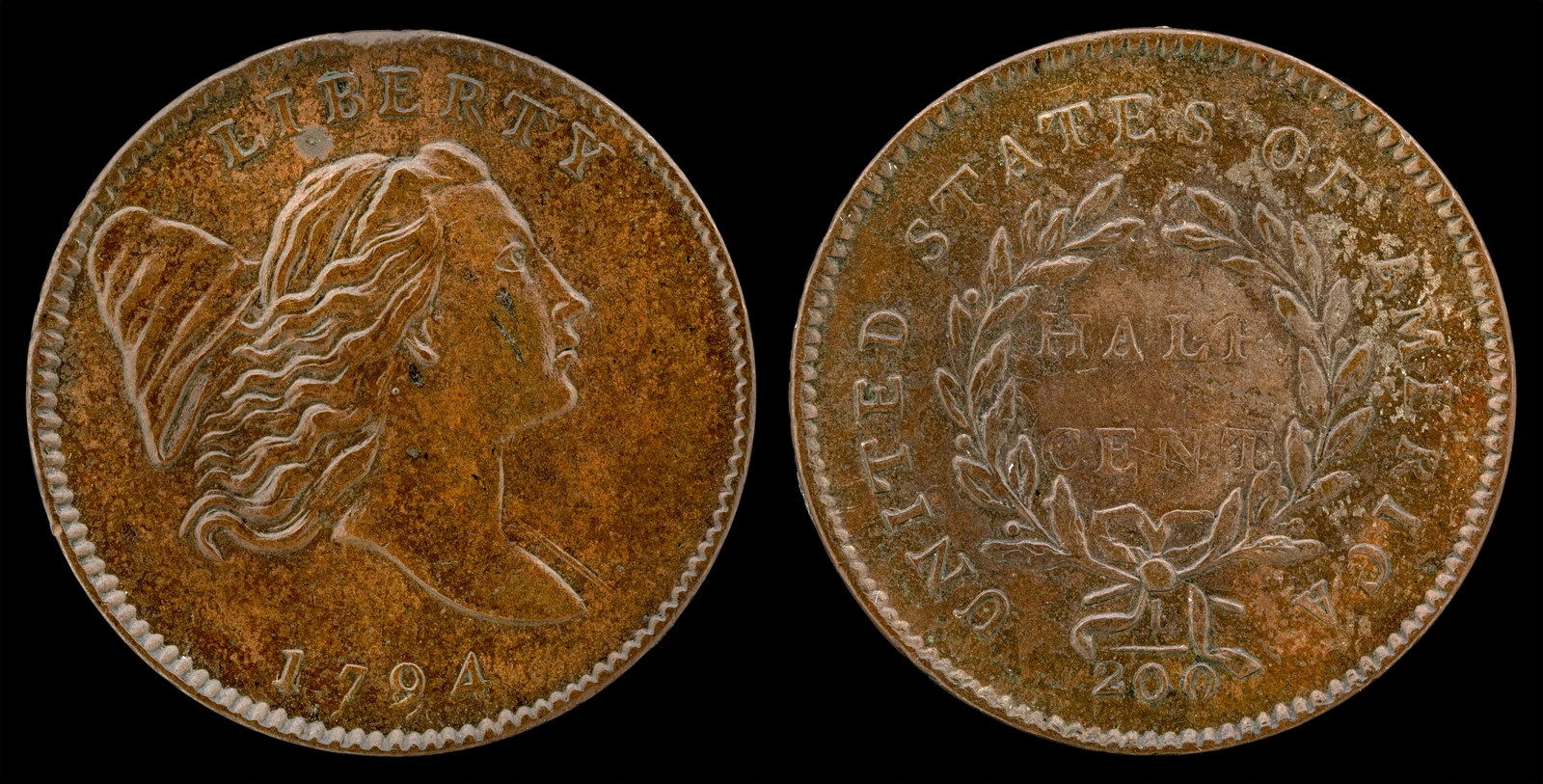
About this coin
In 1794 the half-cent portrait turns right and becomes a distinct large-head type. Lettered edges, relief differences and separate die attributions need more careful recording than a date-only checklist.
- Denomination and mint
- Half cent, 1/200 dollar; Philadelphia
- Designer
- Robert Scot, conventional attribution supported by PCGS and Smithsonian record
- Composition
- Copper
- Nominal weight
- 104 grains, approximately 6.74 g
- Nominal diameter
- 23.5 mm
- Edge
- Lettered: TWO HUNDRED FOR A DOLLAR
- Reported mintage
- 81,600 for the overall 1794 half-cent issue, not a per-variety total
Confirm the identification
- Right-facing Liberty with cap and pole, LIBERTY above and 1794 below; do not confuse it with the left-facing 1793 half cent.
- HALF CENT is inside a wreath, with 1/200 below and UNITED STATES OF AMERICA around the reverse.
- The lettered edge reads TWO HUNDRED FOR A DOLLAR; edge-letter size may matter to a specialist attribution.
- The 1794 large-head type is distinct from the smaller-head half cents of 1795-1797, despite sharing a portrait direction.
- High relief is a design/attribution description here, not a proof designation or a promise of an unworn coin.
What changed in 1794
Start with the way Liberty faces. On the 1794 half cent, she faces right; on the 1793 type, she faces left. Then read HALF CENT and the fraction 1/200 on the back. A large cent from the same year can look much like it in a small photo, but it is a different coin. Read the words, check the edge and note the diameter before you rely on a seller's title or a cropped picture.
Large head is the name of the 1794 type within the right-facing Liberty Cap family. It does not mean that every die left the same portrait impression. A head that looks small in a worn coin's photo does not prove it is the later small-head type. Check the date, the whole design and any supported die attribution together. If a feature is hard to read, leave it uncertain. Do not reshape a photo to make it look like the coin you hope to find.
Scot, the Mint and the reported output
PCGS and the Smithsonian attribute the design to Robert Scot. The copper law of January 14, 1793 set the half-cent standard at 104 grains, about 6.74 grams. PCGS lists Philadelphia and a nominal diameter of 23.5 millimeters. The Smithsonian gives overall dimensions of 2 by 23 millimeters for one Mint-transferred coin, object 1991.0357.0010.
The reported output is 81,600 half cents. Eckberg's account describes five delivery batches and nine die marriages, while PCGS retains the same overall total. A die marriage is the pairing of the stamping tools used for a coin's front and back. The total belongs to the dated issue as discussed in those references; it is not a separate mintage for each relief group or each edge-letter variety. A catalogue may repeat the overall figure on multiple variety pages for context. Adding those repeated figures would count the same production several times.
Relief, dies and the third surface
PCGS groups regular 1794 half cents into Low Relief Head and High Relief Head. The high-relief group includes Cohen C-7, C-8 and C-9. Relief describes the depth of the portrait design. Compare the shape of the bust, date and hair with an attributed example under similar lighting. Breen found the evidence for presentation half cents dated 1794 lacking.
Give the edge its own note. Some 1794 attributions depend on the edge letters as well as the two face dies. If a holder hides the edge, part of the variety may remain unknown. Record what you can see and keep the exact words on an existing certificate. Cohen numbers and their letter suffixes name varieties; they are not numerical grades. This guide does not set out every possible front, back, edge and die-state combination. An annual total does not prove that a missing combination exists.
How to identify the nine 1794 die pairs
Start with the date and hair. The three high-relief varieties share the same front. Its 4 nearly touches Liberty’s bust, and the waves in her hair stand out. The wreath can be weak even when the portrait shows detail. Look for enough detail on both sides before choosing a variety.
C-2 and C-9 share the same back, where the T in CENT leans left. The low-relief front belongs to C-2 and the high-relief front belongs to C-9. A photo of the back alone leaves both possibilities open.
The edge inscription reads TWO HUNDRED FOR A DOLLAR. Eckberg documents both large and small letters for C-1 through C-6 and small letters for C-7 through C-9. Suffixes need a variety reference. For C-1, Jon Lusk illustrates C-1a with large letters and C-1b with small letters. If a holder hides the edge, record the die pair and leave the letter size open.
Eckberg uses a number for the front die and a letter for the back. In 3-E, for example, die 3 made the front and die E made the back.
- C-1 · 1-A · Low relief.
- C-2 · 2-B · Low relief.
- C-3 · 3-E · Low relief.
- C-4 · 4-E · Low relief.
- C-5 · 3-C · Low relief.
- C-6 · 3-D · Low relief.
- C-7 · 5-D · High relief.
- C-8 · 5-C · High relief.
- C-9 · 5-B · High relief.
Thin blanks and doubled edge lettering
The C-9 label identifies the two dies that struck the faces. Auction catalogues document C-9 coins with lettered edges on both thick and thin blanks. The 2010 Davy sale listed two thin examples at 79.1 and 88.0 grains, below the 104-grain standard. Parts of the edge letters extended beyond the narrow edge on those two coins.
Look at the edge and the two faces together. A low weight can prompt a closer look, especially if wear or corrosion has removed metal. The Davy catalogue records a suggestion that the thin blanks were trials for lighter coins. Their intended purpose is still unresolved.
Edge lettering can also repeat. Jon Lusk published a C-9 whose edge shows lettering in two orientations. Keep photographs of the edge separate from the face images so a specialist can check each feature. Doubling on the edge leaves open how many times the coin was struck on its faces.
Photos from the 1924 Alvord catalogue
Each numbered pair shows the front and back of one coin. Fine marks are faint in parts of the scan. The edge lettering is outside the photographs.
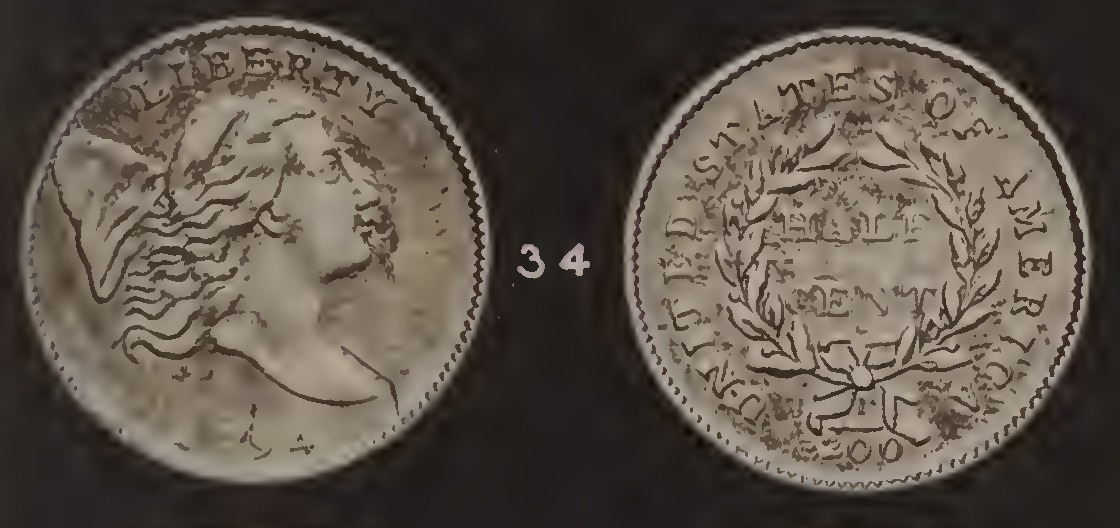
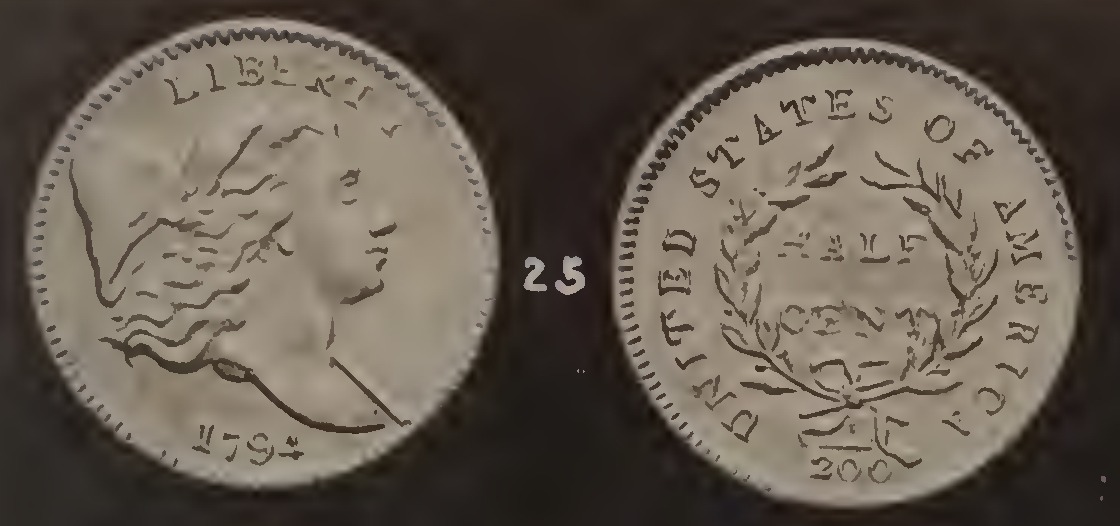
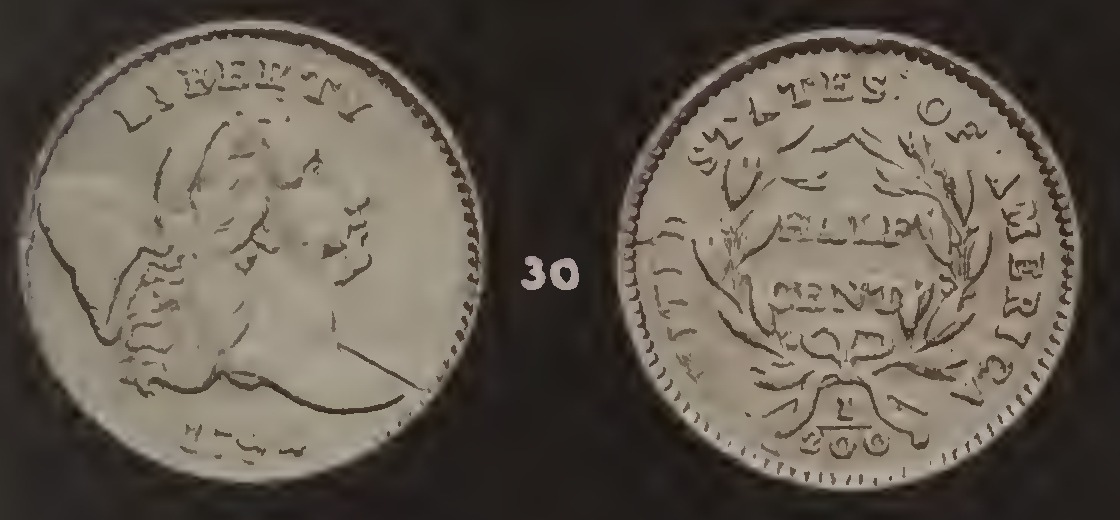
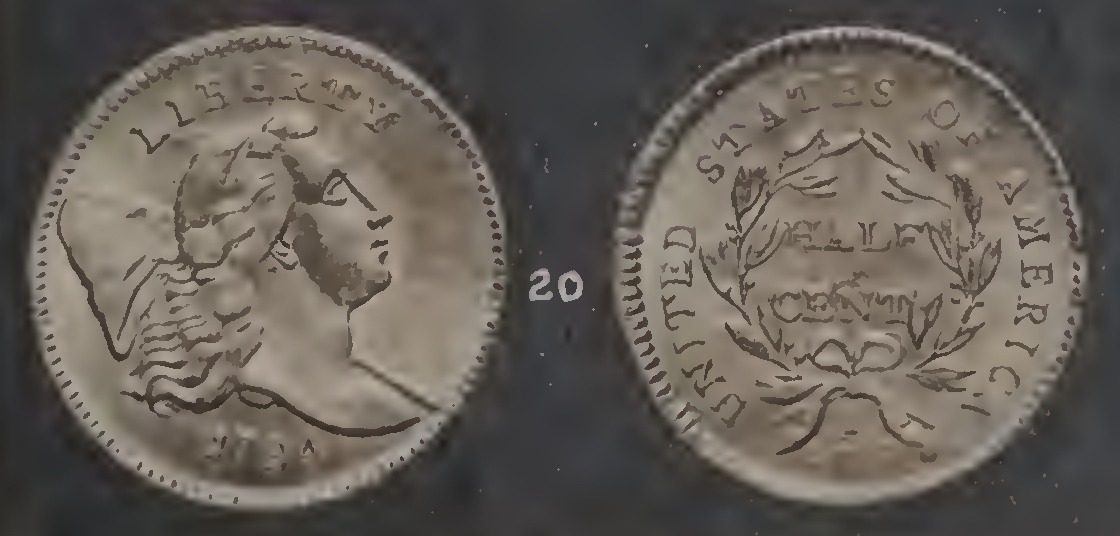
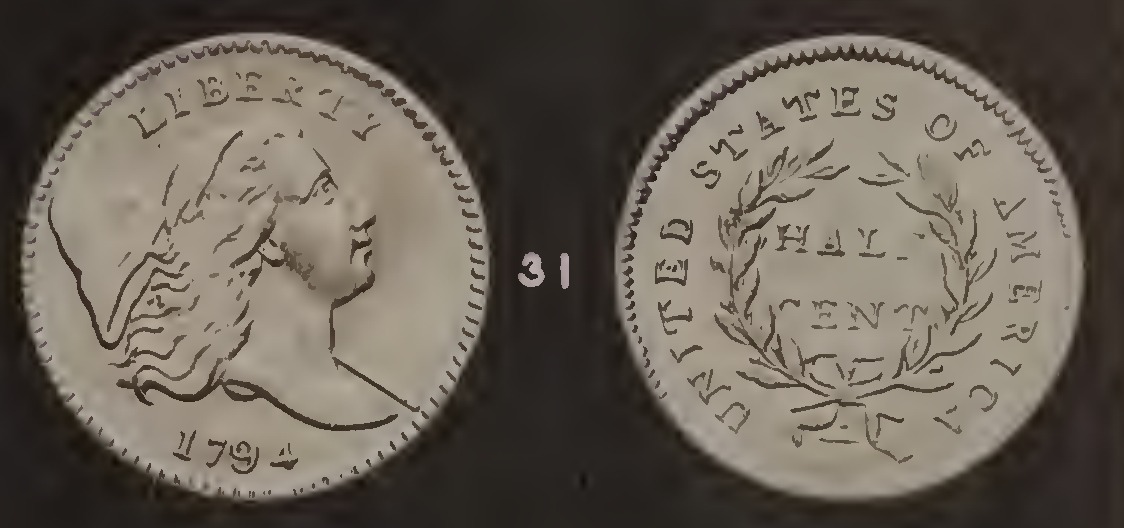
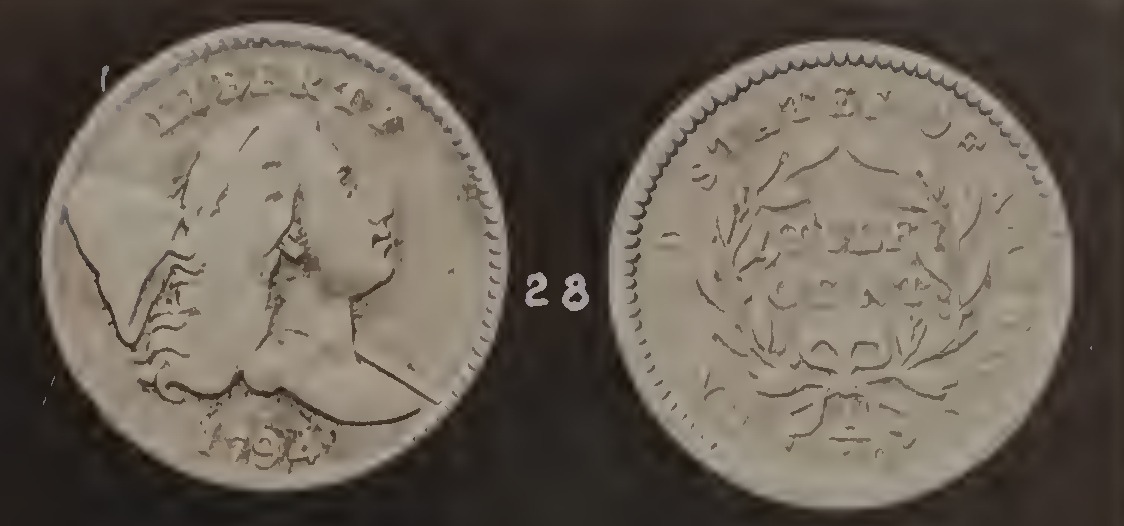
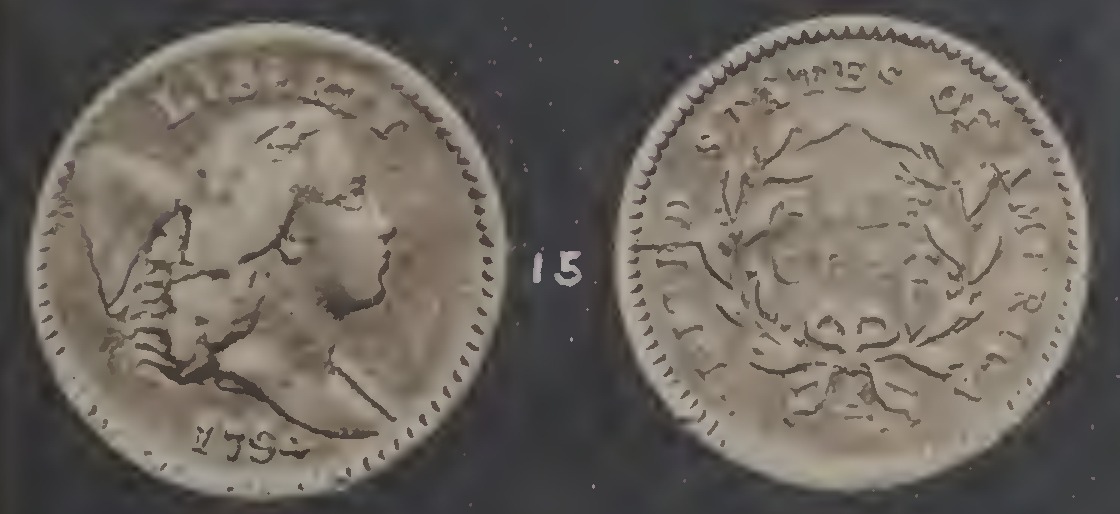
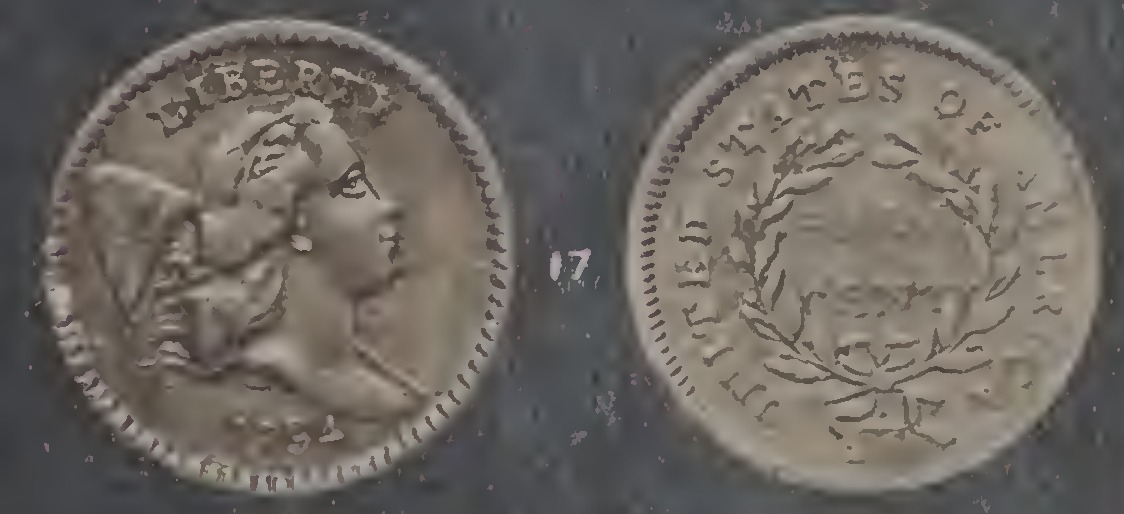
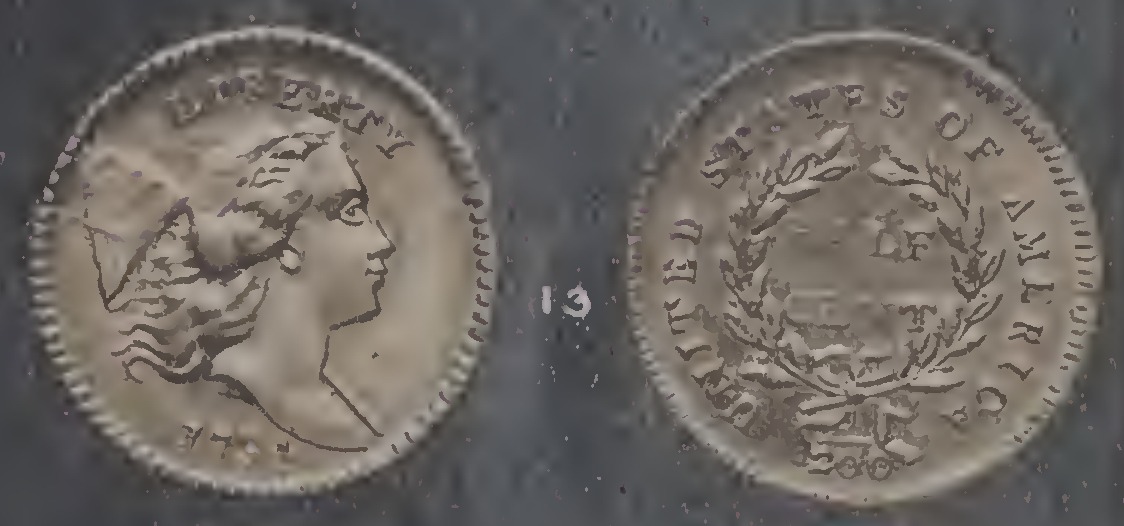
S. H. Chapman, F. R. Alvord sale catalogue, 1924. Library of Congress scan via Internet Archive. Public domain in the United States. First plate · Second plate
A practical condition examination
Look at the portrait, LIBERTY, the date and the wreath before you settle on a grade. Change the light angle to tell a flat spot from a shadow. Compare both sides of each border. The weakest border detail alone cannot tell you the coin's whole condition. Early dies were prepared by hand, and the strike could be uneven. A single clue can therefore mislead you. A specialist should grade the whole coin. Your own notes can still say exactly where the detail is weak or strong.
A brown surface is not damage on its own. A bright patch does not prove that the coin still has its original red color. Look for changes in texture, fine parallel lines, oddly sharp detail around a worn date, and disturbed areas near letters or a rim repair. These clues call for a closer look; they do not prove a cause. NGC's Details grading separates surface problems from wear. Keep a Details label as recorded. Do not turn it into the same numerical grade as a coin without a reported problem just to fill a collection field.
Check that the coin is genuine
Some early coppers are replicas or transfer-die fakes. NGC has described fakes made with a genuine coin as the model. Some were then worn or corroded to make them look old. A rough surface does not, by itself, make a coin false. Nor does a normal die crack prove a fake. Compare several features. If a purchase or variety claim depends on the coin being genuine, ask an experienced examiner to check it. Weight and size can reveal an obvious mismatch, but cannot prove the metal and dies are genuine.
Leave the coin as it is before you show it to the examiner. Rubbing the edge can erase letters. Sharpening a digit can hide the difference between the original strike and later work. Keep the coin dry and in a suitable holder. Keep an old ownership envelope apart from the coin if its material could harm the surface. For a certified coin, check the grading service's record. Compare the actual coin and holder with any certification photos. A matching number is not enough if the objects do not match.
Collect by type, then by evidence
For a type set, you can record one authenticated 1794 large-head half cent before you resolve every specialist suffix. If you collect varieties, record the full Cohen label, visible edge, relief group, die-state notes and the reference you used. Keep photos of the whole front and back, plus any edge you can see. Save the label's exact grade, color and grading service in separate fields. If a later examination changes the variety, keep the old description with the record. It remains part of the coin's history.
Compare values for the same issue, supported variety, grade and copper color. A rare die pair, a coin with smooth brown surfaces and a damaged coin are not equal just because all say 1794. If no verified quote is available, leave the value unknown. Do not record zero.
Guide values are not offers or promises of what a buyer will pay. A record sale of an exceptional coin does not set the value of an ordinary one. Check the physical identity first. For a doubtful or damaged coin, seek a specialist's examination and a suitable appraisal rather than guessing a discount.
Research sources
- PCGS CoinFacts: 1794 half cent, regular strike
- PCGS CoinFacts: 1794 Low Relief Head half cent, regular strike
- PCGS CoinFacts: 1794 High Relief Head half cent, regular strike
- U.S. Mint: Act of January 14, 1793, Legislation to Regulate Copper Coins
- Smithsonian National Museum of American History, 1794 half cent, object 1991.0357.0010
- William R. Eckberg: The Half Cent, 1793-1857, 2022 edition, selected historical discussion
- NGC VarietyPlus: Liberty Cap half cents, explanatory half-cent attribution and edge context
- NGC: Understanding NGC Details Grading (2013), selected surface and condition explanations
- NGC: Counterfeit Detection, Counterfeit Large Cent and Half Cent, December 15, 2015
- U.S. Mint: Caring for Your Coin Collection
- S. H. Chapman, F. R. Alvord sale catalogue, first photographic plate (1924)
- S. H. Chapman, F. R. Alvord sale catalogue, second photographic plate (1924)
- Stack’s Bowers, Widmer Family Collection, March 2026, lot 2009
- Goldberg, Davy Collection of Half Cent Errors, September 2010, lot 16
- Goldberg, Davy Collection of Half Cent Errors, September 2010, lot 17
- Jon Lusk, half-cent edge photographs, Penny-Wise, January 2025, pp. 10–11
- Walter Breen, Presentation Coins and Sets, 1792–1816, section on 1794