
U.S. Coin Guide / 1796
1796 Liberty Cap Small-Head Half Cent
Values by grade
USD per coin| Grade | Coin value |
|---|---|
| G-4Good | Not available |
| VG-8Very Good | Not available |
| F-12Fine | Not available |
| VF-20Very Fine | Not available |
| XF-40Extremely Fine | Not available |
| AU-50About Uncirculated | Not available |
| MS-63Mint State | Not available |
| MS-65Mint State | Not available |
No verified current values are available.
Price scope: No Pole (C-1), Brown (BN), business strike; With Pole (C-2), Brown (BN), business strike.
About this coin
The 1796 small-head Liberty Cap half cent needs more than a readable date to support an attribution. PCGS lists separate With Pole and No Pole Brown (BN) catalogue entries, both with Plain edges and Philadelphia metadata. Compare the actual coin carefully; those catalogue fields do not authenticate it, supply a grade or establish a current value.
Confirm the identification
- Read the half-cent denomination and the 1796 date independently.
- Use the small-head right-facing Liberty Cap context without transferring every feature from another date.
- Treat PCGS1027 With Pole and1030 No Pole as separate attributed catalogue entries, not a complete physical-issue matrix.
- A Plain edge alone does not distinguish those two catalogue labels.
- Grade, authenticity, any actual mint mark and the exact die pairing remain observations to establish for an individual coin.
1796 half-cent archival photos
The front and back of each coin are shown. The Earle catalogue identifies the With Pole example, and the Mills catalogue identifies the No Pole example. The edges are outside the photographs.
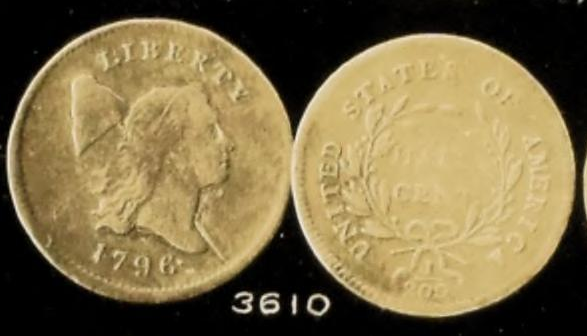
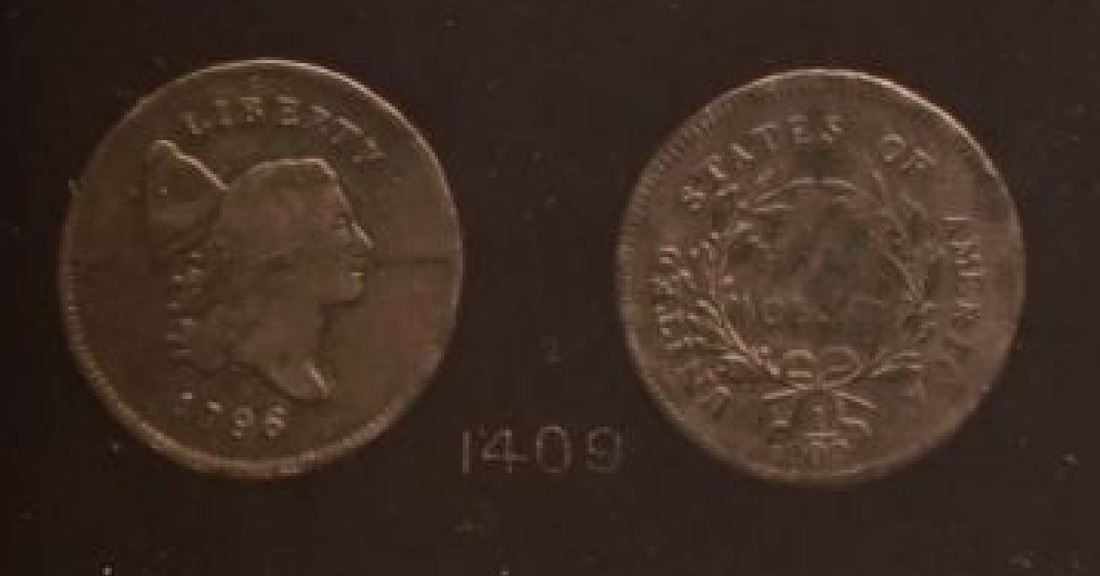
Original photographs from the 1912 Earle and 1904 Mills sale catalogues. American Numismatic Society and Library of Congress copies, respectively. Public domain in the United States.
Earle lot 3610 description · Earle Plate XXXVIII showing lot 3610 · Mills lot 1409 description · Mills plate showing lot 1409
Identify the 1796 half cent before assigning a variety
A half cent dated 1796 has the small, right-facing Liberty Cap portrait. The American Numismatic Association dates the broader right-facing family to 1794–1797. Heritage’s design comparison groups the smaller-bust coins dated 1795, 1796 and 1797. Check the date and denomination first. Then compare the portrait and back. A seller's short title cannot identify the coin for you.
The Mint collection's 1912 catalogue lists a half cent dated 1796 as entry 1303. That record shows a dated example. It does not authenticate your coin or describe every 1796 die. A museum entry, a grading-service entry and the coin in your hand are different records. Keep their descriptions separate until an examiner can compare them.
Compare the With Pole and No Pole catalogue entries
PCGS lists two plain-edge 1796 half cents under its Brown (BN) regular-strike listings. Compare the photos of No Pole (C-1) and With Pole (C-2).
Both of those entries have a Plain edge. The edge alone cannot tell you which pole variety you have. Compare the cap, the area where its support would appear, the date and the back together. A faint feature in one photo may still be part of the coin's design. Ask for clear views and an explanation of the match. A missing line in a photo is not enough to assign a variety.
Historical catalogues give examples of both labels. The 1907 Stickney catalogue identifies lot 1686 as With Pole. The 1924 Alvord catalogue identifies lot 57 as No Pole and describes a crack on its front die. For a worn 1796 coin, compare the cap area and the date with an attributed example before choosing a label.
Henry Chapman, Stickney catalogue, 1907, p. 128 · S. H. Chapman, Alvord catalogue, 1924, half-cent lots
The 1912 Earle plate supplies both faces of the With Pole coin in lot 3610. The 1904 Mills plate pairs both faces of the No Pole coin in lot 1409, whose written entry also describes a plain edge. Compare the space below the cap on the two fronts, and keep a reverse photo with your attribution notes.
Original catalogue description · Original photo plate · Original catalogue description · Original photo plate
Keep a pole label separate from a story about the die
With Pole and No Pole describe the front of the coin. A die marriage is the pair of tools used to strike the front and back. The catalogue entries name those pairs. Why the cap area differs is a separate question and needs its own evidence.
Do not use a story about a 1795 coin to explain a 1796 coin. The 1795 C-6b analysis describes a reworked die, but it concerns that dated example. It does not diagnose the 1796 coin in front of you. Record what you can see. Leave the cause unknown until a specialist can support a link to that specific coin.
Compare the die pairs and the reported mintage
Eckberg identifies No Pole as Cohen C-1 and With Pole as Cohen C-2. Both use the same back die, so the wreath alone leaves the choice open. Compare the cap and the area below it before assigning the variety.
The commonly cited 1,390 comes from one recorded delivery. Eckberg argues that three deliveries, totaling 6,480, could all have consisted of 1796-dated half cents. He uses die evidence and estimates of how many examples survive to support that reading.
A delivery count tells us how many coins the Mint handed over. The date stamped on those coins takes separate evidence. The exact total for coins dated 1796, and the split between the pole varieties, remain uncertain.
Use the 1796 weight document as a standard, not a certificate
Washington's proclamation dated January 26, 1796 says that the reduced copper-coin weights had applied since December 27, 1795. It states the half-cent standard as three pennyweights and twelve grains, equivalent to 84 grains. That differs from the 104-grain half-cent standard in the January 14, 1793 law. The date of the proclamation, its earlier effective date and a date stamped on a coin should not be collapsed into one manufacturing date.
A legal weight does not promise what a worn, damaged or altered coin will weigh today. Note the unit and your actual reading. Let an examiner compare that result with the claimed identity and condition. A close weight does not prove the coin is genuine. A mismatch does not settle that question either. Do not file, scrape or clean the coin to make a weight or an inscription look more convincing.
Judge wear, strike and copper color separately
PCGS uses BN for Brown in these two entries. That is a color label, not a numerical grade. Look at the hair, cheek, letters and wreath. Do not grade from the strongest detail alone. The ANA notes that a weak strike leaves details lightly impressed. Wear can remove detail later. The difference matters when a small feature is faint. It does not let you assign a grade from one photo.
Brown is a copper-color description. It does not mean heavy wear or prove that the surface is original. Note cleaning, corrosion and altered color as well as the detail that remains. Keep those notes separate. Hold the coin by its edge over a soft surface. Use a suitable acid-free, PVC-free holder. Polishing or rubbing can damage the clues needed to identify the variety.
Match a value comparison to the coin you can substantiate
Use the table above for the selected price reference. Match the 1796 date, supported pole variety, grade, copper color and any surface problems before comparing values. A price for one catalogue entry does not automatically apply to the other. A guide value, an asking price, a past auction result and an offer for your coin are different kinds of price. A missing quote is not zero.
Keep front and back photos, plus photos of any edge you can see, with the seller's description and any independent examination. If an attribution changes, keep the old description in the history. Do not silently replace it. Museum and grading records describe examples and categories. The exact number made and the number that survive are still uncertain. Build a sound identity and condition record before making a confident value claim.
Research sources
- American Numismatic Association: Early American Copper Coin Project
- Heritage Auctions: small-bust design comparison, auction1329 lot3621
- Catalogue of Coins, Tokens, and Medals in the Numismatic Collection of the Mint of the United States (1912)
- George Washington: Proclamation on the Reduction in Weight of Copper Coin
- U.S. Mint: Legislation to Regulate Copper Coins, January14,1793
- American Numismatic Association: Coin-Grading Basics
- American Numismatic Association: Numismatic Recipe (copper color)
- U.S. Mint: Caring for Your Coin Collection
- Heritage Auctions: specific1795 C-6b analysis, auction1348 lot3040
- PCGS CoinFacts:1796 With Pole, Brown
- PCGS CoinFacts:1796 No Pole, Brown
- William R. Eckberg, The Half Cent, 1793–1857, pp. 49–51
- Bill Eckberg, How Many 1796-Dated Half Cents Were Coined?, Penny-Wise, April 2021, pp. 43–46