
U.S. Coin Guide / 1797
1797 Liberty Cap Small-Head Half Cent
Values by grade
USD per coin| Grade | Coin value |
|---|---|
| G-4Good | Not available |
| VG-8Very Good | Not available |
| F-12Fine | Not available |
| VF-20Very Fine | Not available |
| XF-40Extremely Fine | Not available |
| AU-50About Uncirculated | Not available |
| MS-63Mint State | Not available |
| MS-65Mint State | Not available |
No verified current values are available.
Price scope: 1 Above 1 (C-1), Brown (BN), business strike; Centered Head (C-2), Brown (BN), business strike; Low Head, plain edge (C-3a), Brown (BN), business strike; Low Head, lettered edge (C-3b), Brown (BN), business strike; Low Head, gripped edge (C-3c), Brown (BN), business strike.
About this coin
To look up a 1797 half cent's value, match its head position and edge before comparing color and condition. Professional Coin Grading Service (PCGS) has distinct plain, lettered and gripped edge entries. Use the table above for the selected price reference. This guide explains the specific catalogue labels and how to choose a matching comparison.
Confirm the identification
- Read the 1797 date and half-cent denomination independently.
- Record the head-position and edge descriptions separately before choosing a catalogue entry.
- Treat 1036 Centered Head/Plain Edge/BN, 35113 C-3b Low Head/Lettered Edge/BN and 1039 Low Head/Gripped Edge/BN as three specific catalogue assertions at different levels.
- BN means Brown; a color designation does not supply an individual coin's grade.
- Leave the exact variety unassigned if the identifying features cannot be established; preserve the surface while checking.
1797 half-cent archival photos
These catalogue photographs compare head position and the date. Four pairs show the front and back; the separate Stickney view shows the front only. Edge descriptions for Alvord lots 58 and 62 come from their written entries. No edge is visible here. Details are faint in the lot 62 pair.
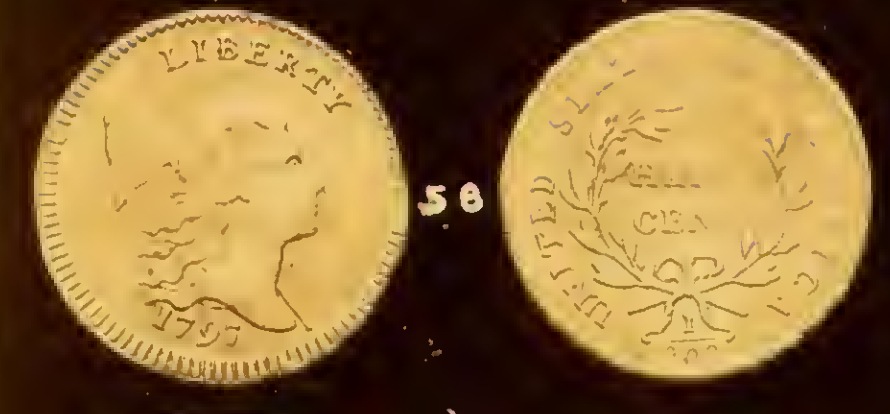
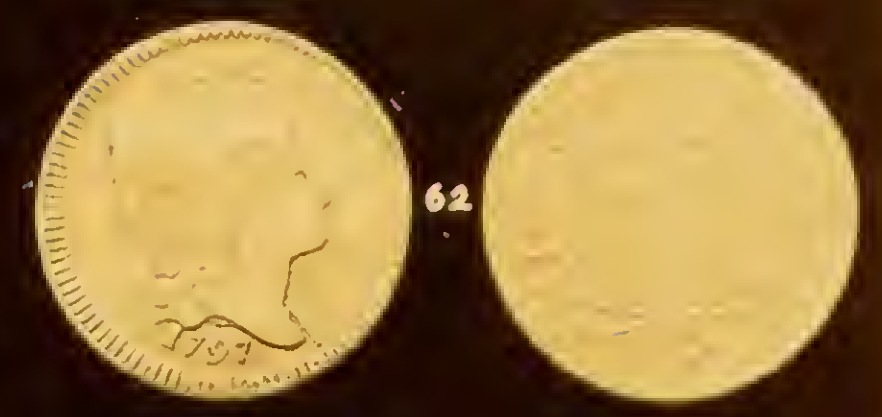
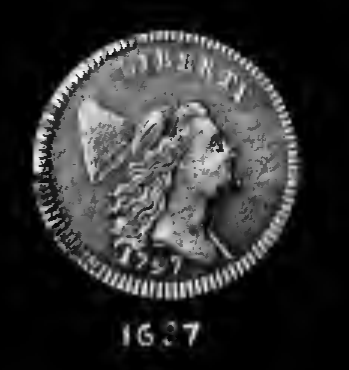
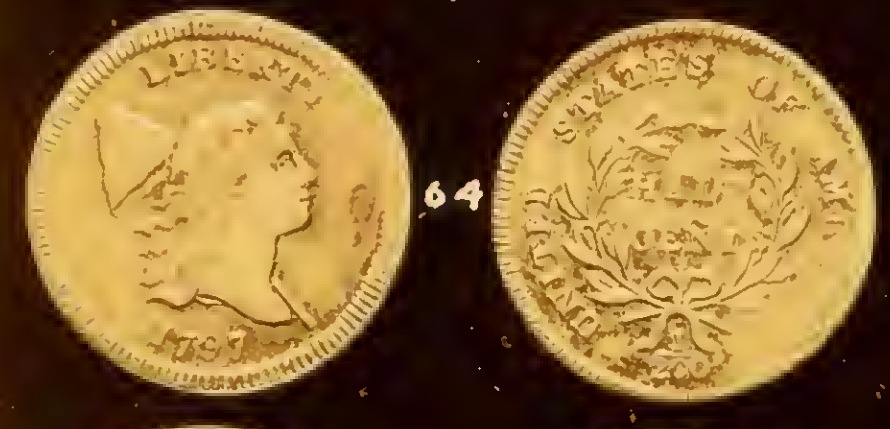
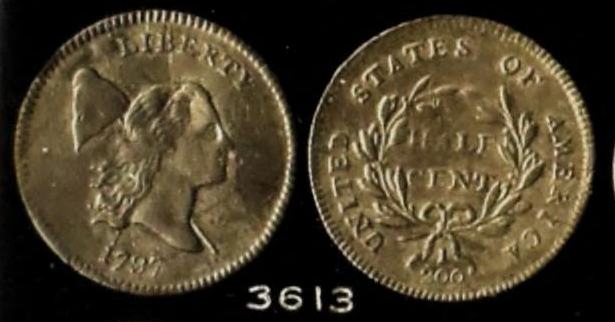
Original photographs from the 1907 Stickney and 1912 Earle catalogues (Henry Chapman) and the 1924 Alvord catalogue (S. H. Chapman). Cornell University Library (Stickney) and American Numismatic Society (Earle/Alvord) scans via Internet Archive. Public domain in the United States.
Alvord descriptions for lots 58, 62 and 64 · Alvord plate showing lots 58, 62 and 64 · Stickney lot 1687 description · Stickney plate showing the front of lot 1687 · Earle lot 3613 description · Earle Plate XXXVIII showing lot 3613
Match a value to the complete description
A 1797 date alone does not identify the right value comparison. Start with the head position and edge, then add the variety, color and condition. Professional Coin Grading Service (PCGS) lists Centered Head with Plain Edge under one entry. Two other entries describe C-3b Low Head with Lettered Edge and Low Head with Gripped Edge. These three entries carry the Brown (BN) color designation and the catalogue label Regular Strike.
Use the table above for the selected price reference. A useful comparison needs the same variety and color, plus a sound condition assessment. Record when a price was observed and whether it is a guide figure or an actual sale. A figure attached to a different 1797 variety does not become a quote for your coin simply because the dates match.
Read head position and edge as separate clues
The smaller right-facing Liberty Cap design includes the 1797 date. Heritage's published design discussion expressly groups 1795, 1796 and 1797 with the smaller bust. The U.S. Mint's 1912 collection catalogue also records a half cent dated 1797. These references give the coin its date and design context; identifying the particular variety is the next step.
Centered Head and Low Head are head-position labels; Plain, Lettered and Gripped describe the edge. The centered-head entry has a Plain edge. The C-3b low-head entry has a Lettered edge, and the other low-head entry here has a Gripped edge. Low Head alone leaves the edge unresolved.
PCGS assigns Philadelphia as the mint for each of these three entries. It also classifies them as Regular Strike. Those are catalogue identity fields. A condition grade describes the state of an individual coin, so it must be considered separately.
Alvord lots 58 and 62 use the same dies, while their entries describe lettered and plain edges. Use an edge photograph to settle that distinction on a coin in hand. Stickney lot 1687 shows the Low Head front with the date close to the bust. Alvord lot 64 shows a centered head; Earle lot 3613 provides the 1 Above 1 pair.
Understand the specific C-3b lettered-edge entry
C-3b is the code for a specific die-variety catalogue entry. Here, a die-variety entry is a more detailed grouping within the broader head-and-edge description. This entry names Low Head and Lettered Edge, with the BN designation for Brown. Its Edge field records the inscription TWO HUNDRED FOR A DOLLAR. Two hundred half cents equal one dollar.
Keep that inscription tied to the entry that supplies it. The C-3b wording does not supply an edge inscription for the plain or gripped listings. A lettered edge alone also does not establish the C-3b code. Confirm the identifying features against a suitable variety reference before assigning that exact code or using its value comparison.
PCGS separates Major Varieties from Die Varieties in its related links. A broad Low Head, Lettered Edge listing and the specific C-3b entry represent different levels of description. Other related labels include 1 Above 1 and Low Head, Plain Edge. They point to further entries to check. They do not provide a complete identification key here, and their presence does not assign those labels to your coin.
Identify five documented 1797 varieties
Start at the date. The C-1 variety has a faint earlier 1 above the first 1 of 1797. C-2 has a centered portrait. The C-3 group has the portrait set lower, so the date sits in a narrower space below the bust.
The three C-3 descriptions share the same face dies. The edge determines the suffix. If the holder covers the edge, record the Low Head observation and leave the suffix unassigned.
- C-1 · 1 Above 1, plain edge.
- C-2 · Centered Head, plain edge.
- C-3a · Low Head, plain edge.
- C-3b · Low Head, lettered edge.
- C-3c · Low Head, gripped edge.
Eckberg describes one half cent dated 1797 struck over a large cent dated 1798. The earlier cent existed before the half cent was struck. That example shows why the date you read on the coin and the time it was made are recorded separately.
In the 1907 Stickney sale, the cataloguer described lot 1688 as apparently gripped and lot 1689 as lettered. He linked their face dies to the Low Head group. PCGS describes the grips as irregular indentations. Their purpose is still unknown.
Henry Chapman, Stickney catalogue, 1907, p. 128
On a Low Head coin, inspect the edge under light from the side. The Norweb photograph of lot 29 shows irregular grooves across part of the edge. The same catalogue records some edge marks on its plain-edge Low Head, lot 30. An isolated nick leaves the variety unresolved.
Henry Chapman described the gripped edge and the low strike on this coin in the 1921 Jenks catalogue, lot 6245. The 1987 Norweb listing traces the coin back to that sale and identifies it as C-3c. Both listings describe one specimen.
Check condition without changing the surface
Color and condition answer different questions. Brown describes color; it does not tell you how much wear a coin has. The American Numismatic Association (ANA) explains that a weak strike can leave details lightly impressed. It also identifies excessive cleaning, environmental damage and artificial toning as condition problems. An indistinct detail needs investigation before it settles a variety or grade.
Preserve the surfaces while checking the edge. Do not polish, brush or rub the coin to make letters easier to see. The U.S. Mint warns that cleaning can reduce value and rubbing can scratch a coin. If the head position or edge remains unclear, record the variety as unassigned until it can be checked. A useful value comparison starts with the features and condition you can substantiate.
Research sources
- PCGS CoinFacts:1797 Centered Head, Plain Edge, Brown
- PCGS CoinFacts:1797 C-3b Low Head, Lettered Edge, Brown
- PCGS CoinFacts:1797 Low Head, Gripped Edge, Brown
- PCGS CoinFacts:1797 related Major Varieties and Die Varieties index
- U.S. Mint collection catalogue (1912), half-cent entry1304
- Heritage Auctions: dated small-bust design comparison, auction1329lot3621
- American Numismatic Association: Early American Copper Coin Project
- American Numismatic Association: Avoiding Trap Coins, color abbreviations
- American Numismatic Association: Coin-Grading Basics
- U.S. Mint: Caring for Your Coin Collection
- William R. Eckberg, The Half Cent, 1793–1857, pp. 52–55
- Howard Spencer Pitkow, Discovering a 1797 C-3c (R6) Half Cent, Penny-Wise, October 2020, p. 213
- Bowers and Merena, The Norweb Collection, Part I (1987), p. 43, lot 29
- Henry Chapman, John Story Jenks Collection (1921), p. 571, lot 6245