
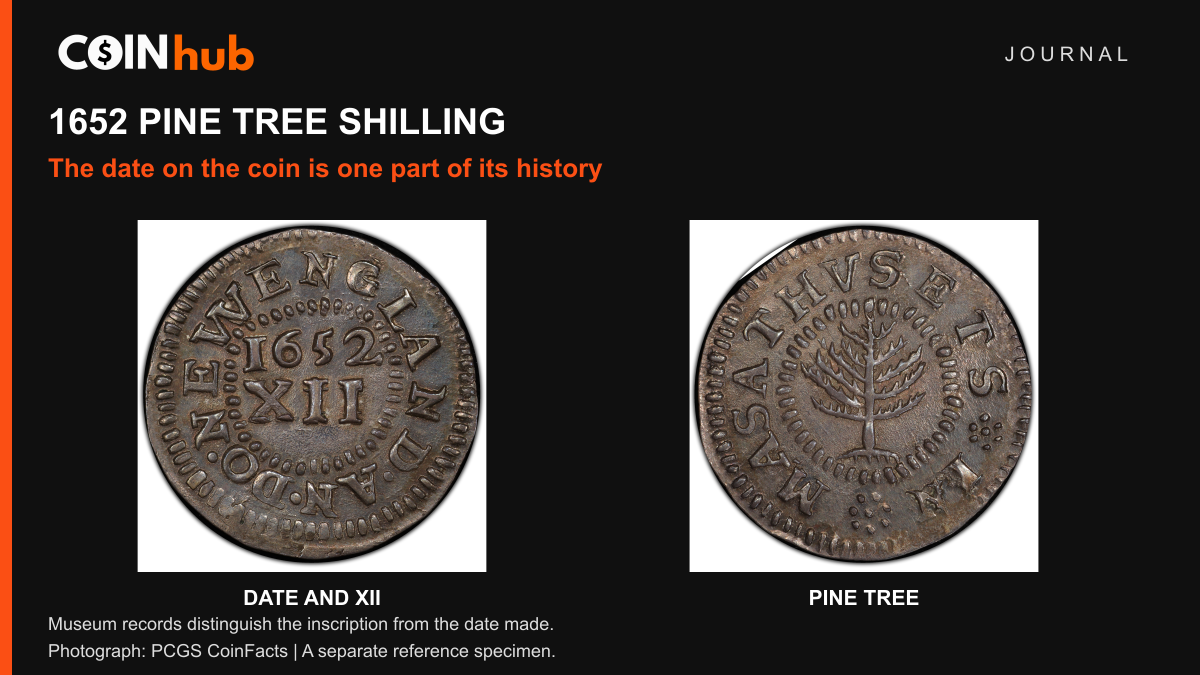
A date on a coin and a date of manufacture can be different things.
Quick answer: A Pine Tree shilling marked 1652 was not necessarily struck in that year. The Smithsonian records one example with 1652 as its date on the object and 1667–1682 as its date made. Read the design, denomination and catalog record together before you assign a year of issue.
The large 1652 in the photograph is real design information. It does not prove that the silver piece in the photo left the mint in 1652. This is one reason to read an early coin with care. A quick glance at the date can mislead you.
What the two dates tell you
The Smithsonian's Massachusetts Pine Tree shilling record keeps two fields apart. They are easy to mix up. “Date on object” transcribes 1652. “Date made” gives the later range 1667–1682. The record identifies a silver coin made in Massachusetts.
This is more useful than trying to get an exact year from the four digits alone. The date on a coin tells you what it says. The date made tells you when research places the design or the piece. Both fields can be right.
A second Smithsonian shilling has a narrower recorded range of 1667–1674. Its description places it around 1670. This is a different museum coin. Its dates do not date the PCGS coin in our photo. Do not give one coin the full history of another just because they look alike.
Why Massachusetts coins kept 1652
The museum explains that a shortage of money led Boston authorities to allow John Hull and Robert Sanderson to set up a mint in 1652. Silver coins followed in several denominations. Nearly all carried the same date, even as production continued.
The museum gives more than one reason why the date may have stayed the same. It may have marked the mint's founding. Another idea links it with the time when England had no king. The right to issue coins belonged to the Crown. The museum treats this as a possible reason, not proof of what the makers meant.
Keep that care in your own notes. You can explain the ideas without claiming to know what Hull or Sanderson meant. Neither theory tells you the exact year that an unknown coin was struck.
The practical lesson is simpler than the political story: 1652 belongs in the description, but it cannot do all the dating work. Keep the inscribed date and the researched production range in separate fields.
Read the tree, the words and XII
| Look for | What to record | Limit of that clue |
|---|---|---|
| Tree side | The tree, surrounding letters and borders | A tree alone does not establish the exact variety |
| Date side | 1652, XII and the surrounding words | The inscription does not give an exact striking year |
| Whole piece | Both faces, edge and any holder record | A photograph alone does not authenticate the coin |
In the reference photo, the date side is at left and the tree side is at right. XII is the Roman numeral for twelve. It gives the shilling's value in pence. Keep it with the tree and legends when describing the piece, rather than treating it as a second date or a modern catalog number.
The wording is not laid out like a modern U.S. coin. Letters follow the rim, and their shapes may look unfamiliar. Copy what you can actually read. If part of a word is weak or off the edge, mark it as unclear instead of borrowing letters from a different specimen.
The tree gives the type its familiar name. It does not make every early Massachusetts silver coin a Pine Tree shilling. Read the value and design together. A broad label such as “colonial silver” is a starting category, not a final identification.
What small planchet means here
A planchet is the metal blank used to make a coin. PCGS identifies the photographed reference as a Small Planchet Pine Tree shilling. That is a type description to retain when following its catalog entry. It is not a grade.
Do not decide between large and small planchet types from two screen images shown at different sizes. A website can enlarge a small coin to fill the same space as a larger one. Use the full record, size and weight, and expert guides to the design.
A worn edge, uneven outline or weak letter also needs context. Those features can have more than one cause. They do not prove that a coin was clipped or made from a rare die. They do not prove that an unknown piece is real.
Write a note that preserves the uncertainty
A useful first note might read: “1652-dated Massachusetts Pine Tree shilling; XII visible; exact die variety and striking year unassigned.” Save clear photos of both faces with the seller's or collection's description. Keep old claims apart from facts you can check.
If a specialist supplies a Noe or other catalog attribution, retain the reference name as well as the number. A number without its reference can be hard to interpret later. Do not copy the pictured coin's attribution or grade onto another piece merely because the date matches.
Handle an uncertain coin by its edges and leave the surface alone. Cleaning can remove evidence and damage its appeal. If you find or plan to buy a piece like this, ask someone who knows the series to check it. A coin can look right in a photo and still need expert review.
Value is another question. First check the type, whether it is real, and its state of wear. Then seek sold examples that match. A price attached to one grade or variety does not value every 1652-dated piece, and a modern replica does not acquire a colonial date of manufacture from its design.
The date is still worth reading. It connects the coin with Massachusetts mint history. The better record simply preserves two answers: what the coin says, and what reliable research can establish about when it was made.
Sources and photograph: Smithsonian object records 1979.1263.00420 and NU.82.48.09 supply the dated museum evidence and qualified historical explanations. The pictured Small Planchet reference is a separate PCGS CoinFacts photograph, used with CoinHub's existing permission. Its two panels come from one photo. They are cropped and resized; coin details are unchanged. No exact striking year, authentication or current value is assigned to an unknown coin.