
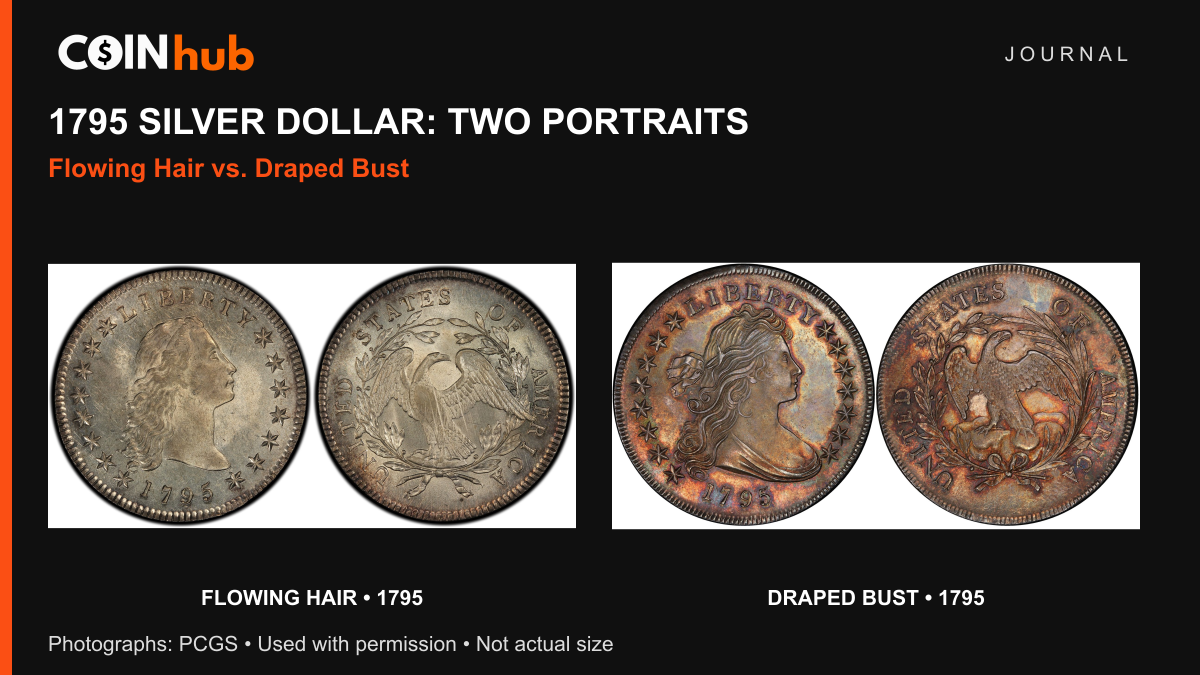
A 1795 U.S. silver dollar can have either a Flowing Hair or a Draped Bust portrait. Start with Liberty's hair and clothing. Flowing Hair has loose strands behind her head and a bare neckline. Draped Bust has a ribbon in the hair and cloth across the lower portrait.
The date alone cannot choose the type. Both designs appear on dollars dated 1795. These are regular design changes, so a different portrait does not by itself mean that a coin is a mint error.
Read the two reference photographs
The left pair above shows a 1795 Flowing Hair dollar. The right pair shows a 1795 Draped Bust dollar with a centered bust. PCGS supplies both complete photographs, including the front and back of each coin.
On the Flowing Hair example, follow the long strands down behind Liberty's neck. Then look at the lower edge of the portrait: there is no folded garment crossing it. On the Draped Bust example, find the bow behind the head and the broad folds across the chest. Those two areas make a stronger comparison than the shape of one curl.
Color is not the type difference. The reference coins have different surface colors and lighting. Compare the engraved shapes, not whether a coin looks gray, gold or blue in a photograph.
Why two portraits share one date
The PCGS type history places Flowing Hair dollars in 1794 and 1795, with Draped Bust replacing that design during 1795. The U.S. Mint's dollar history also describes the later portrait's tied hair and draped bust.
A type is a broad design group. A variety is a narrower difference within that group. Decide the broad portrait first. Trying to name a small leaf or star detail before that step can send you to the wrong catalog entry.
Matching a portrait tells you which design a coin resembles. It does not prove that the coin is genuine, establish a grade or assign a price.
Keep the reverse with the portrait
The reverse is the back of the coin. Both pictured examples show an eagle within a wreath, with the country's name around the outside. The eagle and wreath details differ, so an “eagle reverse” description alone is too broad to settle the type.
Keep each front photograph paired with its own back. If a listing shows several loose coins, ask which two photographs belong together. A sharp front image is not a complete record when the reverse is missing or belongs to another item.
PCGS also separates two-leaf and three-leaf Flowing Hair varieties. Within the 1795 Draped Bust group, centered and off-center bust listings describe portrait placement. These catalog names are another reason to record the full description rather than shorten everything to “1795 dollar.”
Make a record before looking up a value
- Read the date and compare the complete portrait.
- Photograph both faces with the whole rim visible.
- Record the ribbon, neckline and reverse details you can actually see.
- Copy any holder's type and variety wording exactly.
- Mark unclear areas instead of filling them in from a reference picture.
For example, a dark listing photograph might show what looks like a hair ribbon but hide the lower bust. Write “ribbon appears present; drapery unclear” and request a better image. That is more useful than calling the coin Flowing Hair because the seller's title says so.
A worn coin can lose fine details, and glare can hide them in a photo. Keep it uncleaned while you resolve the question. If you are considering a purchase, have the actual coin and its attribution checked by a qualified early-dollar specialist or grading service.
For the broader historical context, see CoinHub's guide to America's first dollar coins. Use this comparison for the narrower first step: choosing the correct 1795 design before any specimen-specific assessment.