
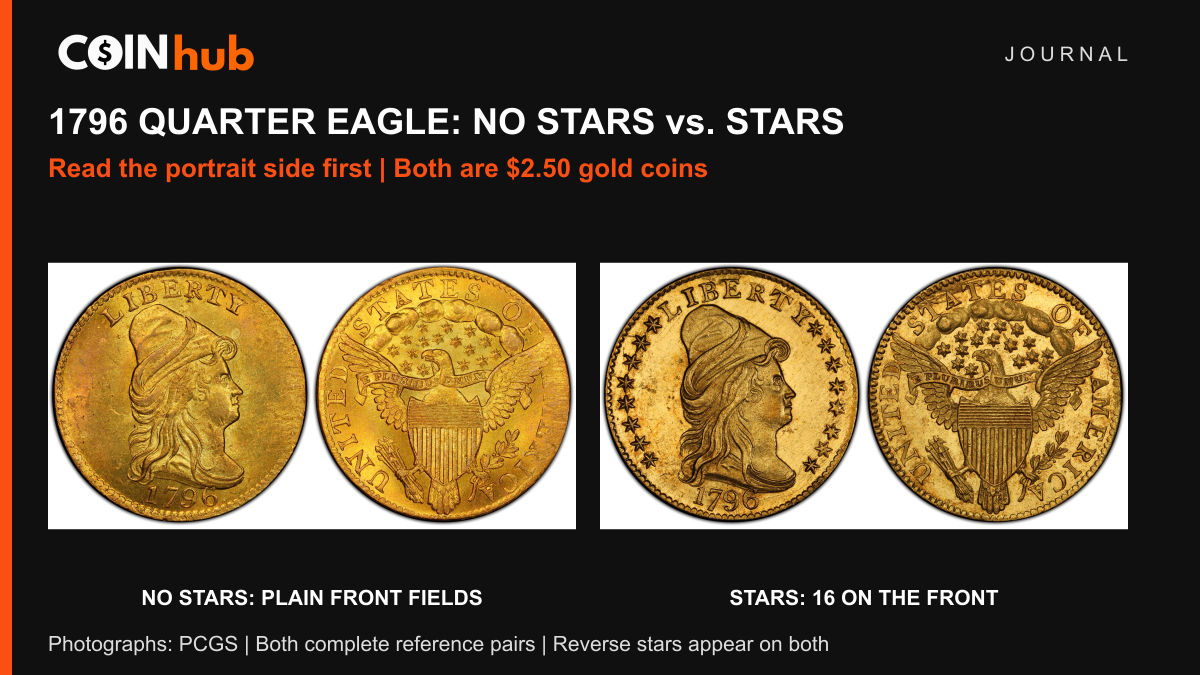
The 1796 quarter eagle comes with two distinct front designs: No Stars and Stars. No Stars has a plain field around Liberty. The Stars type has 16 stars around her portrait. Both are gold coins worth $2.50 at face value, not silver quarters.
Look at the portrait side first. “No Stars” names that side only: its eagle reverse still has stars. Seeing stars above the eagle does not turn a No Stars coin into the other type.
Why a quarter eagle is a $2.50 coin
An eagle was the name of a ten-dollar U.S. gold denomination. A quarter of that amount is two dollars and fifty cents. The word quarter here describes a share of an eagle, not the familiar 25-cent silver coin.
NGC's early quarter-eagle history places the denomination's first coinage in 1796, after its authorization in 1792. The portrait and eagle belong to the early gold series. Do not sort an unknown piece by date alone.
Find the stars around Liberty
In the PCGS No Stars reference, Liberty faces right, LIBERTY runs above her and the date sits below. The open space on each side of the portrait is part of the intended design. It is not a group of weak or missing stars.
The PCGS Stars reference has eight stars at the left and eight at the right. Count around the front, not across the reverse. The photographs above retain both faces so the distinction stays attached to the whole coin.
| Check | 1796 No Stars | 1796 Stars |
|---|---|---|
| Front around Liberty | Plain fields without stars | 16 stars, eight on each side |
| Stars above the eagle | Present on the reverse | Present, in a different arrangement |
| Meaning of the label | A front-design type | A different front-design type |
The change was more than a few added stars
It is tempting to picture the Mint adding stars to the exact same die. A die is the steel tool that stamps a coin. PCGS's Stars account describes a distinct design, including changes in the spacing of LIBERTY and the reverse star layout.
Those details matter when two images seem alike at first glance. Compare the whole portrait, lettering and eagle side with the correct reference. One feature can help sort types; it cannot prove that a coin is genuine.
The No Stars front is a one-year type. Later Draped Bust quarter eagles have stars around Liberty. A blank-looking field on a worn or altered later coin is not a new No Stars issue.
Keep stars, wear and alteration separate
Use clear light and a full image of each face. Heavy wear can hide small details, and a poor listing photo can hide the field texture. Removing stars from another coin would not create the genuine 1796 No Stars type.
Do not clean, scrape or polish a coin to find a star. Save the original listing, holder label and photographs. A replica may copy the broad design, so a matching star count is only the start of an examination.
If a certified holder is present, check its number with the named service and compare the actual coin with that record. A valid number by itself does not prove that a different coin or holder is genuine. Leave a sealed holder intact.
Identify the type before comparing prices
A price attached to one 1796 quarter eagle does not value the other type—or another example of the same type. Grade, surface problems, exact attribution and the sale's fees all affect the comparison. A guide price and a completed auction result are different kinds of evidence.
Keep a simple record: date, denomination, front star count, reverse photograph and any verified certification. Then compare like-for-like examples with help from a specialist in early U.S. gold. No current price range is assigned here.
The useful first distinction is visible without a sales pitch: plain fields around Liberty or 16 front stars. Record that observation while keeping the questions of authenticity, grade and value open.
References: PCGS CoinFacts entries 7645 and 7647 and NGC's early quarter-eagle history, checked October 15, 2026. Historical mintage and survival comments are not used as a current population count.
Photographs: PCGS, complete No Stars and Stars reference pairs, reused under CoinHub's saved permission. Each original is proportionally resized; labels and CoinHub branding added outside the coin images. These are reference coins, not CoinHub sale inventory or grades assigned to a reader's coin.