
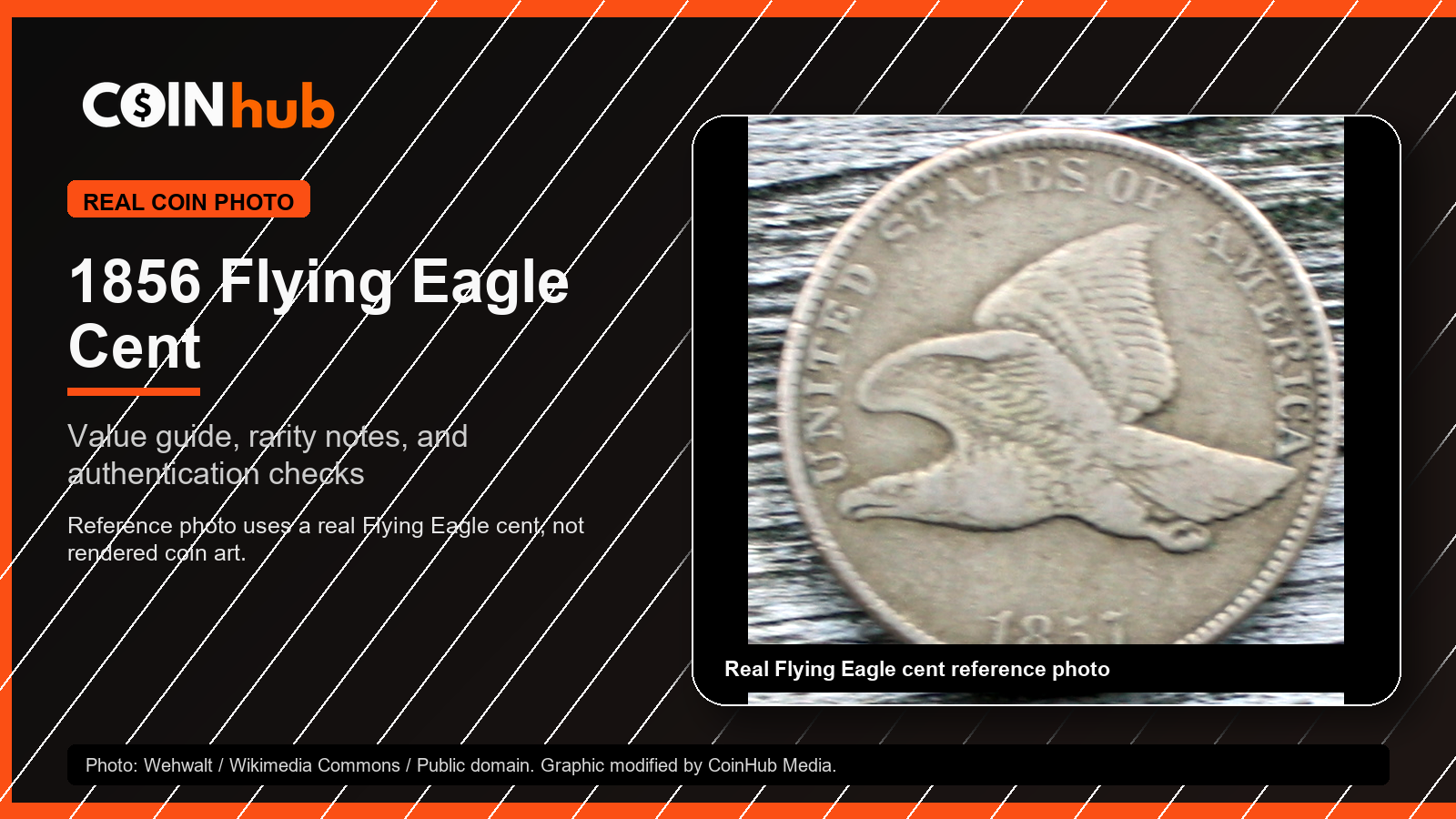
1856 Flying Eagle Cent Collector Guide
Quick answer:An 1856 Flying Eagle cent is a major-value U.S. small cent, not a normal pocket-change penny. PCGS lists a 634-piece presentation mintage for the regular-strike listing and estimates only about 550 survivors in all grades. Typical authenticated examples can be worth thousands of dollars, while elite pieces have brought six figures at auction.
The 1856 Flying Eagle cent matters because it sits at the beginning of the small-cent era. It was struck before regular Flying Eagle cent production began in 1857, and many examples were made as presentation pieces for officials and influential people. That unusual origin is why collectors still debate how to describe some 1856 examples: pattern, presentation piece, proof, restrike, or circulation-style strike.
For a collector, the practical point is simple: if a genuine 1856 Flying Eagle cent is in front of you, slow down. Do not clean it, do not test it with harsh chemicals, and do not sell it as a common old cent until it has been checked carefully.
How Much Is An 1856 Flying Eagle Cent Worth?
Value depends on authenticity, die variety, proof or non-proof attribution, surface quality, and grade. Greysheet's current 1856 Flying Eagle cent page shows a broad CPG value range from about $5,500 to $228,000 across its listed 1856 entries. PCGS also shows how dramatic the high end can be: its proof auction-price page records a $312,000 sale for a PCGS PR67+ example in November 2024.
That does not mean every 1856 Flying Eagle cent is a six-figure coin. Lower-grade, cleaned, damaged, or problem examples can trade far below record pieces. The record sale is useful because it shows the ceiling for an exceptional certified coin, not the value of an average example.
| What you have | Collector meaning | What to do next |
|---|---|---|
| Raw 1856 Flying Eagle cent | Potentially valuable, but authentication is essential. | Protect it from handling and get a professional opinion before selling. |
| Certified PCGS/NGC example | Grade, holder, attribution, and surface notes drive value. | Verify the cert number and compare recent auction records in the same grade. |
| Cleaned or damaged coin | Still desirable if genuine, but value may be heavily reduced. | Do not try to improve it; cleaning usually makes the problem worse. |
| 1857 or 1858 Flying Eagle cent | Much more common than 1856, though still collectible. | Check date, variety, grade, and condition before assuming major value. |
Why The 1856 Flying Eagle Cent Is Different
Most Flying Eagle cents collectors encounter are dated 1857 or 1858. The 1856 issue is different because it was tied to the move from large cents to smaller copper-nickel cents. PCGS notes that at least 634 examples were struck for presentation purposes, and later restrikes add complexity to the total number known.
PCGS's series page explains that the exact number struck is difficult to pin down because additional 1856-dated pieces were made later, and not every restrike can be easily separated from the original strikes. That uncertainty is one reason advanced collectors care about die varieties and certification.
Key Specifications
Proof, Pattern, Restrike, Or Business Strike?
The 1856 Flying Eagle cent can be confusing because different examples were made in different contexts. Some were presentation pieces, some are commonly treated as proofs, and some later pieces were restruck after collectors wanted examples. PCGS keeps separate regular-strike and proof listings, and the proof listing uses a 1,500 mintage figure.
For most owners, the label question should not be guessed at home. Whether a coin is certified as Proof, Mint State, or a specific Snow variety can change how buyers evaluate it. A raw coin with a good story is still a raw coin until an expert confirms it.
How To Spot A Serious Example
History: The Penny That Helped Launch Small Cents
Before small cents, Americans used larger copper cents that were expensive and inconvenient compared with the smaller format that followed. The Flying Eagle design helped show how a smaller copper-nickel cent could work. Stack's Bowers notes that collector demand grew quickly in the late 1850s, with the 1856 issue becoming popular early in the hobby's history.
That early collector demand still matters today. The coin is not valuable just because it is old. It is valuable because it combines historical importance, low availability, collector fame, and a complicated production story that specialists still study.
Should You Sell An 1856 Flying Eagle Cent?
If you think you have one, the first goal is information, not speed. Photograph both sides in natural light, keep it in a non-PVC holder, and avoid repeated handling. If it appears genuine, professional certification through a major grading service or review by an experienced rare-coin dealer is usually worth considering.
For inherited coin collections, separate any Flying Eagle cents from common Lincoln cents, Wheat cents, and Indian Head cents. A single 1856 Flying Eagle cent could be one of the most important coins in the group. If you are sorting a broader penny collection, CoinHub's rare pennies worth money list and Wheat penny value guide can help you separate common finds from better coins.
Bottom Line
The 1856 Flying Eagle cent is one of the most important coins in the U.S. small-cent story. It is scarce, historic, heavily collected, and valuable enough that authentication should be treated as part of the process.
If you have a possible 1856 Flying Eagle cent, verify the date, protect the coin, avoid cleaning, and compare it only after you understand grade and authenticity. For help with selling decisions, start with CoinHub's sell your coins guide so you know what to prepare before asking for an offer.
FAQ
Is the 1856 Flying Eagle cent rare?
Yes. PCGS lists a 634-piece presentation mintage for its regular-strike listing and estimates about 550 survivors in all grades. The total struck is debated because later restrikes also exist.
Is an 1856 Flying Eagle cent a penny?
Collectors often call it a penny, but the official U.S. denomination is one cent. It is part of the Flying Eagle cent series.
Where is the mint mark on an 1856 Flying Eagle cent?
There is no mint mark. The 1856 Flying Eagle cent was struck at Philadelphia.
Should I certify an 1856 Flying Eagle cent?
For a coin this valuable, certification is strongly worth considering. Authentication, grade, and attribution can make a major difference in buyer confidence and market value.
Are 1857 and 1858 Flying Eagle cents valuable too?
They can be collectible, especially in higher grades or better varieties, but they are usually much more common than the 1856 issue. Do not use 1856 values for an 1857 or 1858 coin.