
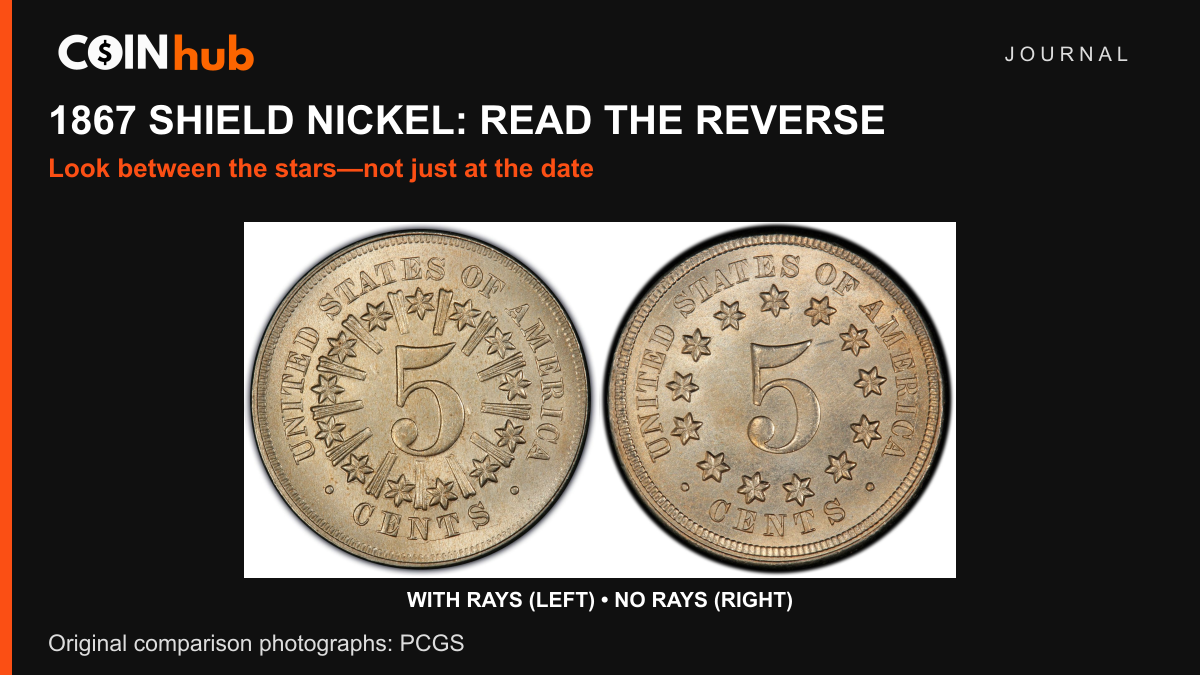
One date, two deliberately different designs
Turn the coin to the side with the numeral 5 before making a variety note. The shield and date are on the other face. This is an easy distinction on a clear example, but a seller's title or a dim photograph is not a substitute for seeing the reverse.
Find the rays in the right place
In the comparison above, start at the top star. On the left, elongated groups of lines occupy spaces beside the stars and point inward toward the central design. On the right, the stars remain, but those intervening rays are absent. The rays are separate design elements; they are not the points of the stars or the small border details near the rim.
The photograph shows reverse types, not the dates of the individual photographed coins. For your own attribution, keep the reverse photograph together with a photograph of the dated face. A loose reverse image cannot by itself establish that a coin is an 1867 issue.
- Read and photograph the date on the shield side.
- Turn to the large 5 and orient the reverse upright.
- Compare several spaces between stars with the illustrated examples.
- Record With Rays, No Rays, or uncertain, based on what is actually visible.
Why the Mint removed the rays
PCGS's With Rays account explains that striking difficulties and premature die cracking continued into 1867. The Mint removed the rays in an effort to ease production problems. This was a purposeful design revision, not a case of individual coins accidentally losing a feature.
The No Rays type continued through the remainder of the Shield nickel series. That history gives the two 1867 reverses their collecting interest: they document a transition within the same dated issue. It does not turn every No Rays nickel into a mint error.
When the photograph does not settle it
| What you can see | Useful conclusion | Next step |
|---|---|---|
| Repeated ray groups clearly visible between stars | The reverse supports With Rays | Confirm the date on the same coin |
| Clear spaces between well-defined stars, matching the No Rays reference | The reverse supports No Rays | Save both-face photographs |
| Glare, wear or blur obscures most of the star ring | Attribution remains uncertain | Obtain sharper photographs or examine in hand |
| One odd raised line or damaged patch | One feature is insufficient | Compare the full reverse rather than labeling the isolated mark |
For a new photograph, place the coin securely and change the lighting angle rather than polishing the surface. Keep the original image and take an additional view if reflections cover the diagnostic area. An enlarged blur is still a blur. If a purchase depends on the type and the seller cannot provide usable photographs, leave the identification unresolved.
Keep type, manufacture and condition separate
A useful inventory note has distinct fields: date, reverse type, strike category if established, condition assessment and source of identification. For example, “1867; With Rays visible; grade not assigned” communicates more than “rare 1867 nickel.” It tells the next reader which conclusion has evidence and which questions remain open.
PCGS catalogs the No Rays regular strike separately from other attributions. Do not apply a proof result, a premium-grade sale or a named die variety to an ordinary coin merely because the reverse type matches. For key dates and the broader value context, use our Shield nickels worth money guide.
Is an 1867 No Rays nickel missing something by mistake?
No. No Rays names an intentional reverse design. A damaged or weakly photographed coin requires its own inspection, but the recognized type itself is not an error.
Can I identify the type from the shield side?
Use that side for the date. The diagnostic rays are on the reverse around the 5, so request a photograph of that side before assigning the type.
References and photographs checked September 19, 2026. This guide identifies reverse designs; it does not authenticate, grade or appraise an individual coin.