
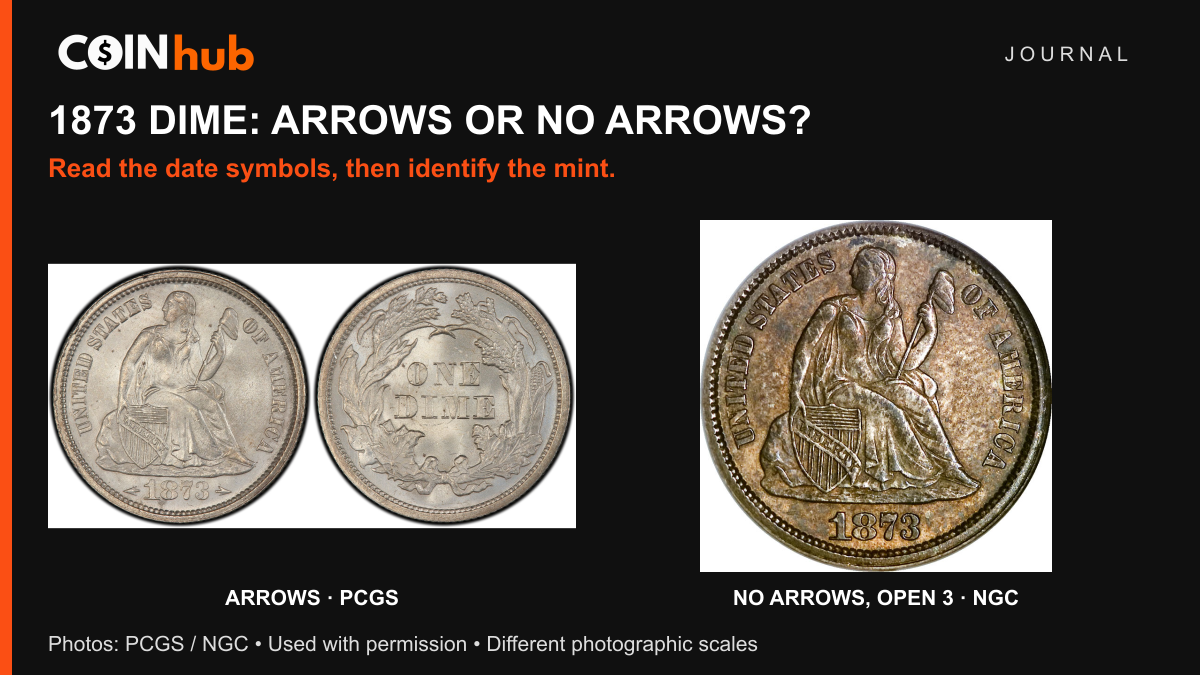
The arrows on an 1873 Seated Liberty dime sit beside the date and mark a small increase in the coin's standard weight. A No Arrows dime lacks those two symbols. Both types were made in 1873, so the date alone cannot tell you which one you have.
Start with that visible design difference. Then identify the mint and the coin's condition as separate steps. The words “1873 No Arrows” do not, by themselves, establish that a dime is the famous Carson City rarity.
Look on both sides of the date
Hold the coin with Liberty upright and find 1873 below her seated figure. On the Arrows design, a small arrow points outward on each side of the date. On the No Arrows design, those spaces do not contain arrows.
The photographs above show Philadelphia examples of the two designs. The full coin pair comes from PCGS; the single obverse, or front, comes from NGC. Their colors and apparent sizes differ because they are photographs of different coins. Compare the symbols beside the date, not the brightness of the surfaces.
On a worn coin, use soft light and a sharp photograph before deciding that a small feature is absent. Dirt, damage or a weak image can obscure details. Do not scrape the spaces beside the date to make an identification easier.
First read the date. Then record whether an arrow is visible on each side. If the area is too worn or damaged to judge, keep the identification open instead of treating uncertainty as a rare variety.
Why the Mint added the arrows in 1873
PCGS explains that the arrows marked a slight weight increase. The new standard for the dime was 2.50 grams. Its alloy remained 90% silver and 10% copper; the arrows did not signal a switch to a different silver percentage.
The change came during the year, which is why collectors distinguish 1873 dimes with arrows from those without them. The symbols made the changed issue recognizable without asking people to detect a tiny weight difference by hand.
A modern scale can supply useful supporting information, but it should not replace the design check. Circulation removes metal, and a small reading difference may reflect wear or the scale itself. A weight near a published standard does not prove that a coin is genuine or settle its exact variety.
Open 3 and Closed 3 answer another question
Some descriptions of 1873 dimes include Open 3 or Closed 3. Those terms describe the shape of the last digit in the date. They do not mean the same thing as Arrows and No Arrows.
NGC's entry for the 1873 Open 3 No Arrows dime explains that the shape of the 3 was changed after concern that it resembled an 8. That change came shortly before arrows were added. The photographed NGC example shows why a label can legitimately say both Open 3 and No Arrows.
Write the features on separate lines in your collection notes: date, arrows, shape of the 3, and mintmark. This prevents a seller's shortened title from becoming your only identification record. Use a reference for the exact issue when deciding between closely related date styles.
The mintmark matters before any value comparison
Turn the dime over and check the reverse, or back, for a mintmark. A Philadelphia example and a Carson City example are not interchangeable simply because both have the date 1873. The CC mintmark is part of the identity of the Carson City issue.
CoinHub's Seated Liberty dime guide covers the broader series and its important dates. This date-arrow check is a smaller task: establishing which design is actually on the coin before choosing a matching reference or sale.
For example, a photograph of a Philadelphia No Arrows dime should not be valued using an auction headline about an 1873-CC No Arrows dime. The missing mint identification changes the comparison. Condition, surface problems and authenticity also remain unresolved until they are examined.
Why an 1875 dime can lack arrows without reverting
The arrows were a temporary signal. Stack's Bowers' type reference places them on the later 1873 issues and the 1874 dimes. The arrows disappeared in 1875, while the new weight standard remained.
That makes the date essential to the explanation. “No arrows means the older weight” is not a rule you can apply to every Seated Liberty dime. The same empty spaces beside the date can belong to different periods in the series.
Keep the final record simple: a clear photograph of each side, the date and mint, the observed arrows or their absence, and the reference used. If you later seek a value opinion, those details give the specialist a useful starting point. Preserve the coin's surfaces while you resolve the remaining questions.