
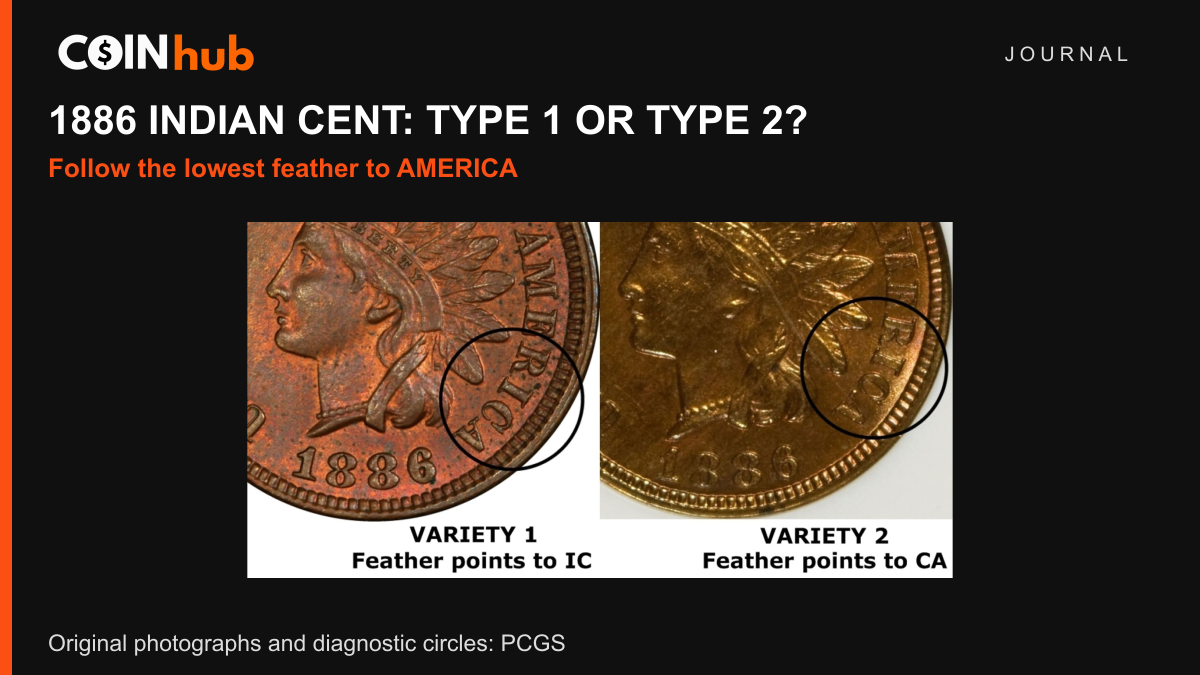
One feather settles the first identification question
The date 1886 does not tell the whole story on an Indian Head cent. Two obverse types were used that year, and the easiest comparison is near the bottom of the feathered headdress. Follow the lowest feather toward the word AMERICA. Its relationship to the letters distinguishes Type 1 from Type 2.
Quick answer: On an 1886 Type 1 Indian Head cent, the lowest feather points between the I and C of AMERICA. On Type 2, it points between the C and final A. PCGS also describes these as Type of 1885 and Type of 1887. If wear or a photograph hides the feather tip, record the type as undetermined until you have better evidence.
Read AMERICA before comparing the feather
Begin with a straight-on photograph of the obverse—the side with the portrait and date. Turn the image until the date reads normally. Find AMERICA along the right side, then locate its ending letters I-C-A. The relevant feather is the lowest one, closest to those letters, rather than one near the top of the headdress.
Imagine extending that feather's direction toward the lettering. Does it lead into the gap before C, or the gap after C? The original PCGS comparison in the graphic preserves its diagnostic circles and labels so you can orient yourself without relying on a seller's description. The two details are enlarged separately, so their displayed sizes are not measurements.
| Observation | Type 1 | Type 2 |
|---|---|---|
| Lowest feather points toward | Gap between I and C in AMERICA | Gap between C and final A in AMERICA |
| Other name you may encounter | Type of 1885 | Type of 1887 |
| What the name describes | Earlier obverse type used in 1886 | Revised obverse type introduced in 1886 |
| What it does not determine | Grade, copper color or authenticity | Grade, copper color or authenticity |
Why two types share the same date
Charles Barber revised the Indian Head cent obverse in 1886. PCGS describes changes to the portrait and relief as well as the easily observed feather position. Collectors can therefore find two designs within the same dated issue. This is a design-type distinction, not evidence that an individual coin was struck incorrectly.
The regular-strike mintage for 1886 was 17,650,000 cents in total. That combined figure does not provide an exact production count for either type. PCGS notes that the split is unknown in its explanation of the two 1886 types. Treat a precise Type 2 mintage offered without supporting records cautiously. A total issue mintage and a count for one subtype answer different questions.
When the correct answer is still undetermined
A small marketplace thumbnail may show enough to read 1886 but not enough to place the feather. Wear, corrosion, shadows, a scratched holder or an angled photograph can obscure the diagnostic area. Enlarging a blurry image makes the blur larger; it does not restore the missing edge.
Ask for a sharply focused full obverse and a close-up showing both the feather and the final letters of AMERICA in the same frame. A crop containing only a feather loses the reference letters that make the comparison useful. Keep the full-coin picture with the detail so the images remain connected to the same specimen.
Do not rub the surface or remove material to make the point clearer. Adjust lighting and camera position first. For basic precautions while making those photographs, see our coin-handling checklist. If the surface is too worn or damaged for a confident match, leave the attribution open.
Keep type, color and grade in separate boxes
A listing might say “1886 Type 2, BN” and then give a numerical grade. Type 2 names the obverse. BN describes a brown copper color designation. The grade is a separate assessment of condition. None should be inferred from another: identifying Type 2 does not establish original red color, and a bright photograph does not authenticate a coin.
For a useful collection record, write down the date, observed feather position, attributed type and source of the attribution. Add the holder information exactly as printed if the coin is certified. For an uncertified coin, distinguish your observation from a professional opinion. “Lowest feather appears to point between C and A; clearer photograph needed” is more informative than an unsupported certainty.
Does Type 2 automatically mean a particular value?
No. A variety identification narrows the comparison, but condition, color, surfaces and authenticity still matter. Compare actual completed sales of the same type and a reasonably similar grade and color designation. A price attached to a high-grade red specimen is not a sound estimate for a worn brown coin.
Likewise, avoid turning the unknown mintage split into a fixed rarity ratio. The practical win is a correct identification and a better set of comparable coins. Once the feather is clear, you can research the right catalog entry instead of pooling every 1886 cent into one price category.
Sources checked September 18, 2026: PCGS 1886 Indian cents overview and Type 2 CoinFacts commentary. This is a visual identification guide, not a grade, authentication or current price quotation.