
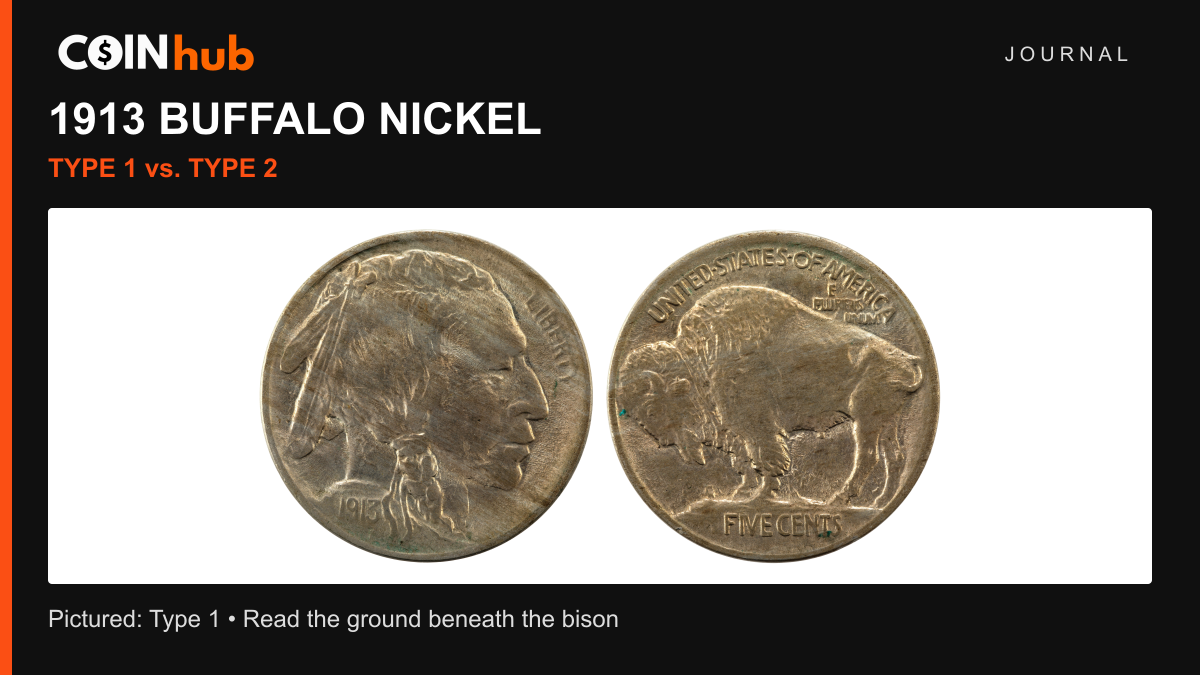
Start beneath the bison, then read the date and mintmark
A listing that says only “1913 Buffalo nickel” leaves out information you need. Philadelphia, Denver and San Francisco produced this first-year series, and a comparison becomes misleading when it mixes mintmarks, reverse types or conditions. Identify the reverse before reaching for a value guide.
The reverse comparison that matters
| Feature | Type 1 | Type 2 |
|---|---|---|
| Ground under the bison | A pronounced raised mound | A smaller mound above a straighter boundary |
| FIVE CENTS | On the raised ground | In a recessed space below the ground line |
| Dates associated with the design | 1913 only | Introduced in 1913 and continued through the series |
| Meaning of the difference | Original reverse | Revised reverse, not an accidental missing feature |
PCGS divides the series by the location of FIVE CENTS. Those words are a more useful starting point than a seller’s shorthand such as “mound” or “plain.” Find the lettering, locate the ground line above or behind it, and compare the entire arrangement.
The hero photograph shows both sides of one real 1913 Type 1 specimen. It is not a side-by-side Type 1/Type 2 photograph. For a second design reference, open the Type 2 section of the linked PCGS series catalog.
Why the Mint revised the design
James Earle Fraser’s Buffalo nickel replaced the Liberty Head nickel in 1913. On the original reverse, the elevated denomination was vulnerable to wear. The revised design protected the lettering by moving it into a lower area. PCGS’s Type 1 entry describes this practical reason for the change.
That history also explains why you should not diagnose the type from how strong the letters look today. A lightly worn Type 1 may retain clear lettering, while a badly worn Type 2 may have weak lettering. The location and surrounding design remain the relevant distinction.
A four-step identification routine
- Photograph the complete reverse. Keep the bottom rim and denomination in the frame. A tight crop of the animal alone removes the area you need.
- Find FIVE CENTS and the ground line. Record “raised mound” or “recessed below line” only when the photograph supports it.
- Read the mintmark. Look below FIVE CENTS for D or S. A Philadelphia example has no mintmark. Do not turn an unclear mark into a confident Philadelphia attribution.
- Return to the obverse. Read the date separately. Save both observations before searching sold examples.
A useful inventory description is “1913-D Buffalo nickel, Type 1, raw, condition not professionally assessed.” It records what you know without borrowing a grade from a photograph of someone else’s coin.
What if the date is worn away?
A recognizable original Type 1 design points to 1913 because it is a one-year type. A Type 2 reverse does not establish 1913: that design continued on later Buffalo nickels. NGC’s series listings show the wider run of Type 2 issues.
If the design itself is too worn to distinguish, leave the type uncertain. Do not apply acid, scratch the date area or polish the reverse to force an answer. A clear description of the limitation is more useful to the next collector than a guessed key date.
Compare the same coin before comparing money
Search by year, mintmark and type together. Then separate raw coins from certified coins and ordinary circulation strikes from proofs. The first year of a series can be interesting without every surviving example being scarce.
Our broader Buffalo nickel guide provides series context. Use this page for the reverse identification first; use current, closely matched completed sales for a later value assessment. A dramatic price for a different mint or condition is not your coin’s value.
Is a Type 2 missing part of the mound?
The different ground and recessed denomination belong to the revised design. Compare the whole reverse before calling missing detail an error. For separate mint-error mechanisms, see the nickel error reference.
Sources and current search results checked September 13, 2026. No live retail price, proof mintage, population total or auction record is asserted. Photographic attribution appears beneath the hero.