
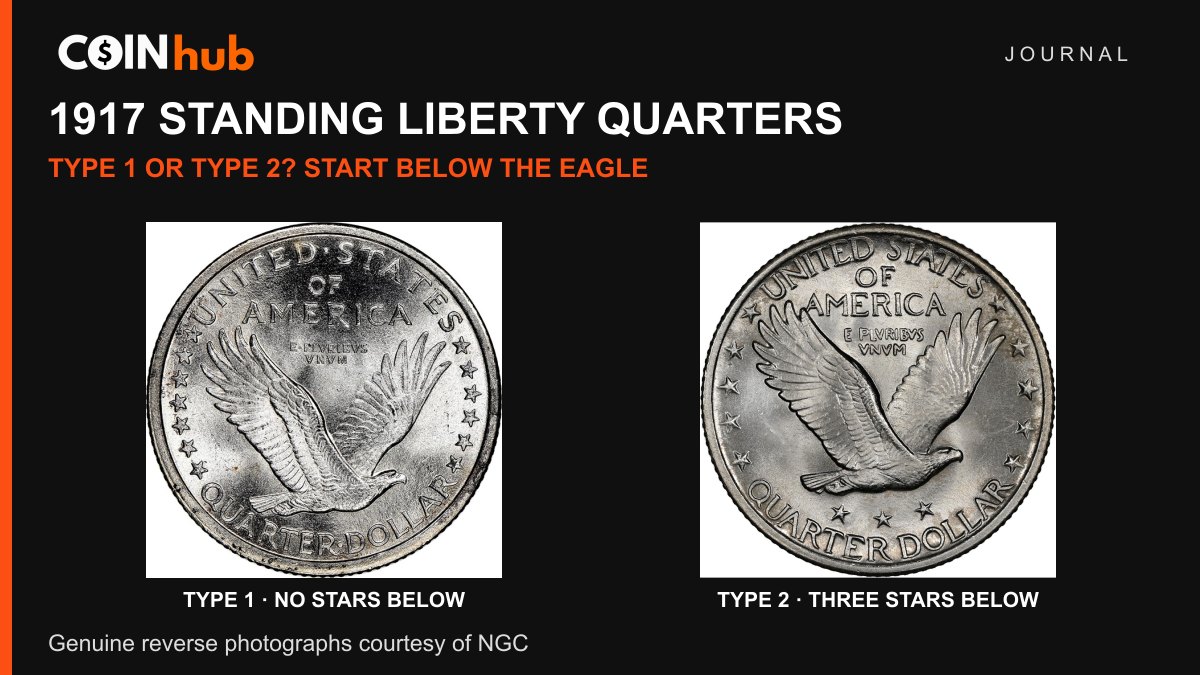
Look below the eagle, then turn the coin over
“1917 quarter” is an incomplete identification. The year includes two design types, and the coins came from Philadelphia, Denver and San Francisco. A useful collection record therefore needs the year, mint and type before you compare examples or search for a missing album entry.
Compare these two genuine reverses
The photographs above are genuine 1917 examples published by NGC. On the left, the eagle flies low over the denomination without three stars underneath. On the right, the eagle sits higher and three stars occupy the space between it and QUARTER DOLLAR. The two images show separate coins.
| Check | Type 1 | Type 2 |
|---|---|---|
| Below the eagle | No stars in that lower space | Three stars below the eagle |
| Liberty’s upper body | Exposed breast; no chainmail rising to the neck | Chainmail covers the upper body |
| What to do next | Confirm a readable date and the other face | Confirm a readable date and the other face |
NGC also discusses differences in the shield rivets and hairstyle. Those are useful corroborating details when a complete, sharp photo is available. Begin with the large design relationships rather than trying to count tiny, partly worn features in a seller’s thumbnail.
A practical record for a 1917 quarter
- Photograph the entire obverse. Keep the date, lower rim and mintmark area visible. For this series, D or S appears near the star left of the date.
- Photograph the entire reverse upright. Save a close-up below the eagle as a separate file, keeping the full view for context.
- Write an observation before an attribution. For example: “three stars below eagle; chainmail visible; date reads 1917.”
- Record uncertain details explicitly. If the date or a mintmark cannot be read, say so. Do not complete an identification from a holder slot or a handwritten envelope.
- Match the same issue when researching. Keep a Type 1 Philadelphia example separate from a Type 2 Denver example in your notes.
A clear file name might be “1917-quarter-reverse-full-view” followed by a second file labeled “lower-stars-detail.” That simple pairing keeps an enlarged diagnostic attached to the coin it came from.
If the two sides appear to disagree
NGC documented a counterfeit combining a Type 1-style obverse with a Type 2-style reverse. The mismatch was a warning, not evidence of a newly discovered Mint mule. The published examination found additional physical problems.
If your photographs seem inconsistent, first check that they depict the same object and that you have interpreted each feature correctly. Preserve the listing and original images, ask for clear matching views, and seek authentication before assigning a rare-error name. A seller’s confident title does not resolve conflicting evidence.
The history needs more care than a one-line legend
In his NGC history of the 1917 quarters, David W. Lange points to correspondence about the design’s artistic fidelity and discusses changes beyond Liberty’s clothing. He also notes that the 1917 Type 1 was not exactly identical to the 1916 coin.
That is a useful reason to keep identification and explanation separate. You can recognize a design feature without claiming to have proved every motive behind its revision. This guide does not present the familiar censorship story as a settled explanation.
Does Type 1 prove that a worn quarter is dated 1916?
No. Type 1 also appears in 1917. A missing date remains missing evidence; do not label it 1916 merely because the reverse lacks the three lower stars.
Does identifying the type establish the value?
No. Keep mint, condition, authenticity and any certified designation in the comparison. Our Standing Liberty quarter guide covers the broader series. This page supplies no current price estimate.
Primary references and Google/Bing results checked September 16, 2026. Observation and photo-record steps are CoinHub editorial guidance. No grade or authenticity finding is assigned to a reader’s coin.