
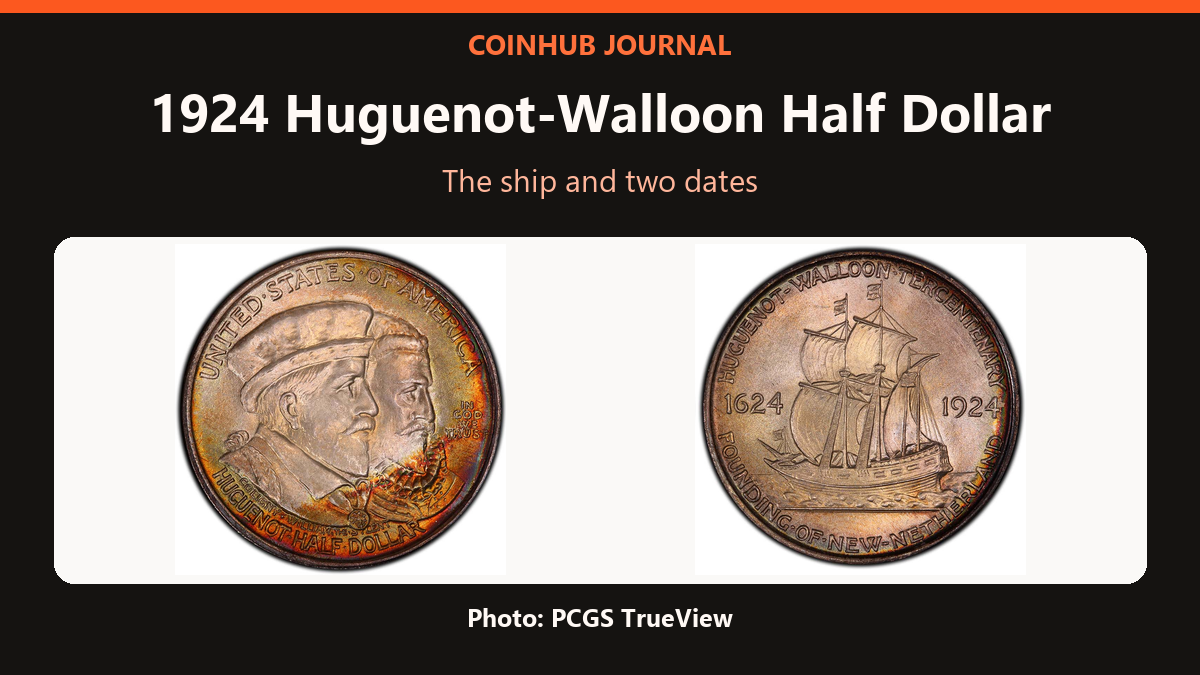
The 1924 Huguenot-Walloon half dollar is the U.S. silver coin with two profiles on the front and a ship between 1624 and 1924 on the back. The first date is the event the coin marks. The second is the year the coin was issued.
A ship is an easy place to start, but it is not enough by itself. Look for FOUNDING OF NEW NETHERLAND along the lower rim and HUGUENOT-WALLOON TERCENTENARY at the top. Those words and the dates identify the design together.
Why the coin has two dates
The U.S. Mint’s commemorative coin record says the half dollar marked 300 years since the 1624 settlement of New Netherland by Walloons and Huguenots. A tercentenary is a 300th anniversary. You can check the math right on the coin: 1924 minus 1624 is 300.
New Netherland was a Dutch colony that included what is now New York. The Mint identifies the ship as the Nieuw Nederland. The sails and rigging take up most of the reverse, or back. The dates sit outside the ship, where you can see them even if some fine detail has worn down.
Who are the men on the front?
The obverse, or front, shows Admiral Gaspard de Coligny and William the Silent. The short labels COLIGNY and WILLIAM THE SILENT are tucked below the portraits. HUGUENOT HALF DOLLAR runs beneath them.
The two men were earlier Protestant leaders. As PCGS’s study of the coin explains, both died before the voyage. Their presence on the coin honors the history behind the settlers. It does not mean either man was aboard the ship in 1624.
How to confirm the design from photos
- Start with the back. Find both dates, then read the line about New Netherland under the ship.
- Match the front. Look for two profiles facing right and the names below them. A photo of just the ship leaves out useful evidence.
- Check the issue. The Mint identifies Philadelphia as the mint. The coin has no mint mark. The 1624 date does not make it a coin struck in the 1600s.
The Mint credits both sides to George T. Morgan, who also designed the Morgan dollar. That connection is about the artist. The two coins have different designs and denominations, and this one says HALF DOLLAR at the bottom of the front.
What a photo can tell you
The photo above is a PCGS TrueView of a specific certified example. Its color is useful for seeing this coin’s surfaces. A silver coin can tone in a different way and still be the same issue. Do not use the reference coin’s color or grade to label your own.
If you are comparing listings, ask for clear views of both sides in good light. Wear or marks on the cheeks and around the ship can matter when you compare condition. A match to the design identifies the type. It does not prove the coin is genuine or assign it a grade.
Sources: U.S. Mint commemorative coin record and PCGS’s Huguenot-Walloon reference and TrueView photograph. The photograph shows a single example, not a grade or price promise.