
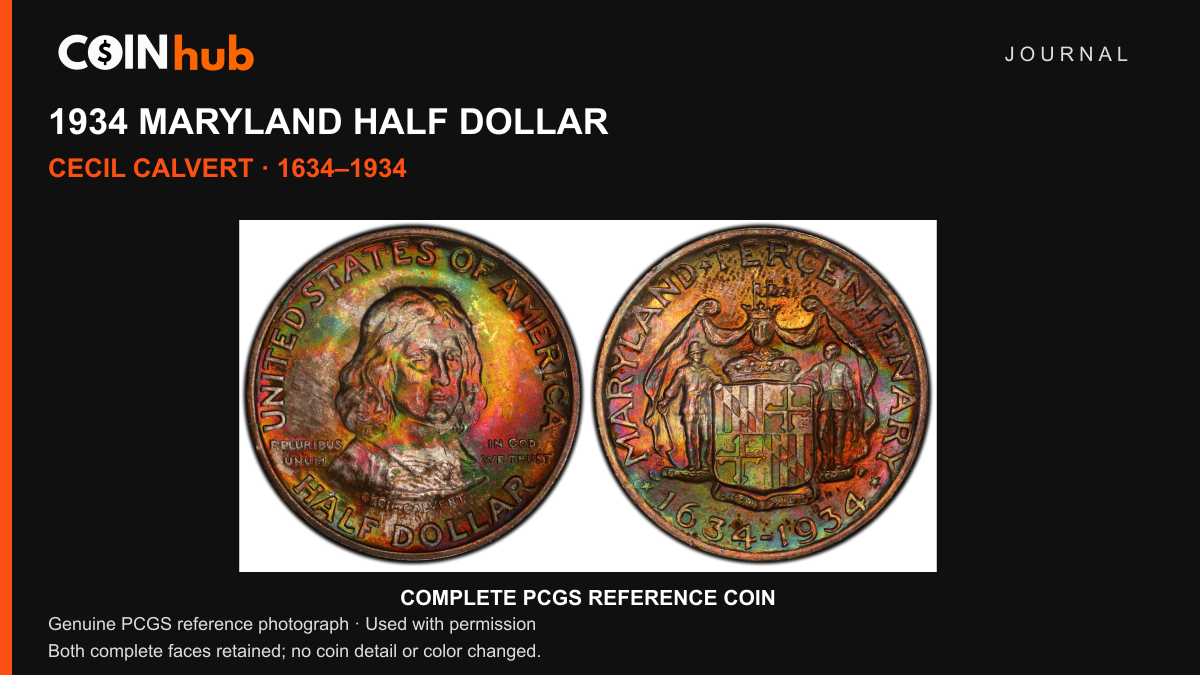
The man on the 1934 Maryland half dollar is Cecil Calvert, Lord Baltimore. A coat of arms sits on the other face, with a figure on each side. Its 1634–1934 dates mark 300 years since the English colony began. They do not mark Maryland's statehood.
Start with the name below the portrait, then turn the coin over to read the anniversary. Read both sides before you try to name the coin.
Read CECIL CALVERT beneath the portrait
The obverse, or front, shows Calvert facing toward the viewer's right. His name appears along the lower edge of the bust. UNITED STATES OF AMERICA surrounds the upper design, with HALF DOLLAR below. The short mottoes sit beside his shoulders.
The Mint identifies Calvert and the reverse arms in Maryland Tercentenary Half Dollar (https://www.usmint.gov/learn/coins-and-medals/commemorative-coins/maryland-tercentenary-half). Tercentenary means a 300th anniversary. You do not need to know that word before reading the dates.
The main photograph shows both complete faces of a genuine PCGS reference coin. The strong colors belong to that coin. Other Maryland halves can look quite different. The photo does not give your coin a grade.
Look past the shield to the two figures
The reverse, or back, has a quartered shield below a crown and helmet. Two full-length figures stand beside it. MARYLAND TERCENTENARY runs around the upper edge, and the dates sit below the ribbon at the bottom.
The American Numismatic Association identifies the figure with a spade as Labor and the other as Fisheries. Its guide is 1934 Maryland Tercentenary Half Dollar (https://www.money.org/1934-maryland-tercentenary-half-dollar/). The ribbon carries the state motto; the shield alone is not the whole design.
Use three clues when you check a small listing photo: the Calvert name, the two figures and the paired dates. A crop of one symbol can hide the rest. Ask for a full view of each face if a key part is missing.
What the two dates commemorate
| Clue | Meaning on this issue |
|---|---|
| 1634 | The colonial founding year commemorated by the coin. |
| 1934 | The coin's issue year, 300 years later. |
| TERCENTENARY | The name for that 300th anniversary. |
The arithmetic is simple: 1934 minus 1634 equals 300. The dates belong to the design...they are not two years when the coin was made. Nor do they say that people first lived in Maryland in 1634. The coin marks the start of the English colony.
Hans Schuler designed both sides. The Mint and ANA identify his work, while PCGS lists the issue under 1934 50C Maryland (Regular Strike) (https://www.pcgs.com/coinfacts/coin/1934-50c-maryland/9328).
A complete coin is a better starting point
Save front and back photos with the full rims and words in view. Record the date pair and HALF DOLLAR wording. Keep any holder label with those images. PCGS lists Philadelphia as the mint and a composition of 90% silver and 10% copper.
Naming the design does not prove a coin is genuine or give its grade. Copies can appear beside genuine coins in search results. Check a seller's title against the coin itself and its records.
Price is another separate question. Check that the coin is genuine, then assess wear and surface problems before comparing recent sales. A historical issue price, a dealer's asking price and an auction result for a different grade are different kinds of evidence.
Photograph notes
PCGS's genuine reference photograph is used with permission. Both complete faces keep their original detail and color. CoinHub added the layout and labels around them. The picture helps you read the design. It does not give your coin a grade or value.