
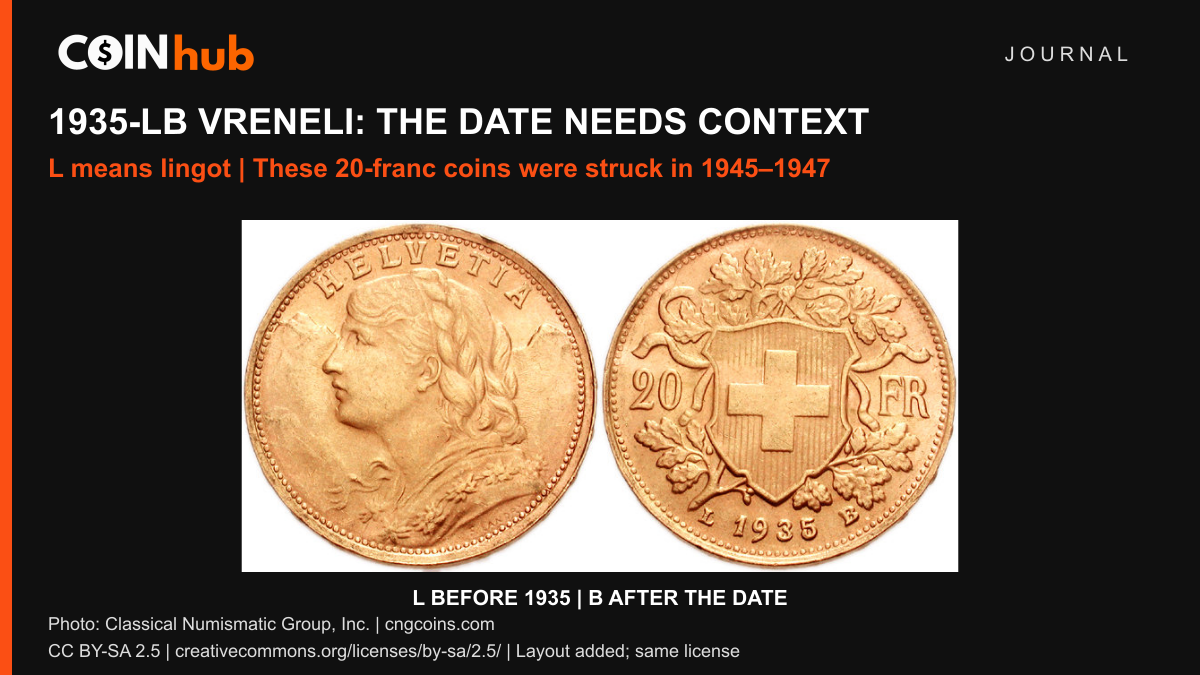
The L before 1935 on a Swiss 20-franc gold Vreneli marks later coins struck in 1945–1947. Swissmint explains that L stands for lingot, meaning ingot or bullion. The date was retained to indicate the earlier gold-fineness standard. It does not mean the coin was made during 1935.
Look at the whole bottom of the reverse. In the photograph above, the marks read L, then 1935, then B. Catalogs may compress that into “1935-LB” or “L 1935 B.” Those labels describe the same arrangement rather than one combined letter symbol.
Read the letter on the coin, not just the listing title
First confirm the denomination. The back of the illustrated coin shows 20 and FR on either side of the Swiss shield. The portrait side says HELVETIA. The L sits to the left of the date on the shield side, not beside the portrait.
A cropped sale photograph can omit that small area. A title containing only “1935 Swiss gold” leaves an important distinction unresolved. Ask for both complete faces and a clear view of the marks before choosing a catalog entry.
| What you record | Why it helps |
|---|---|
| 20 FR denomination | Keeps the coin separate from other Vreneli denominations |
| L before 1935 | Identifies the mark associated with the postwar strikes |
| The B after the date | Preserves the complete inscription for catalog comparison |
| Full front, back and edge | Records more than a date-only view or seller's label |
Why the Mint retained an earlier date
In its official Vreneli explanation, Swissmint describes strong demand for gold coins after the Second World War. More than 20 million 20-franc pieces were struck between 1945 and 1947 with the L 1935 date arrangement.
The Mint connects the retained date to the fineness required by the 1931 Coinage Act. Fineness means the share of precious metal in an alloy. Its explanation concerns a monetary standard; the digits are not a promise that every marked coin physically existed in 1935.
Swissmint's historical Vreneli account also separates the L 1935 strikes from coins carrying their actual later dates. A date on a coin can refer to an issue or standard as well as the calendar year in which the press operated.
The later 1947 date is a separate comparison
Swissmint says predating was later abandoned. Its explanation connects the later coins with an edge inscription referring to the 1931 law. That is a reason to preserve edge information rather than treating every postwar Vreneli as an identical object.
Do not open a sealed certified holder to inspect the edge. Use the holder record, existing photographs or informed examination. A missing edge photograph is a gap in your record, not evidence that the coin has the wrong edge.
What the L does not tell you
The letter explains an issue distinction. It does not identify one exact year within 1945–1947, establish where the metal in an individual coin came from, or prove that a piece is genuine. Avoid attaching a detailed metal-origin story to a coin based on that mark alone.
It also does not establish a rare-date premium. A price for an original 1935 issue cannot automatically be applied to the later L-marked issue. Condition, authenticity and the correct catalog entry still matter. This article gives no current gold quote, dealer offer or appraisal.
When comparing a listing, put its title beside the actual date photograph. Record the visible marks exactly, then add “postwar L-marked issue” as the researched identification. If the picture cannot show the L clearly, leave that part uncertain until a better view is available.
Sources: Swissmint's current English FAQ and linked historical Vreneli account, checked October 16, 2026. The official history supports the striking period and meaning of L; it is not used to assign an individual coin to one exact production year.
Photograph: Classical Numismatic Group, Inc., source coin record, via Wikimedia Commons, CC BY-SA 2.5. The complete original is resized with CoinHub text and layout added; the photographic layout adaptation is shared under the same license. CoinHub trademark rights remain separate. No source endorsement implied.
