
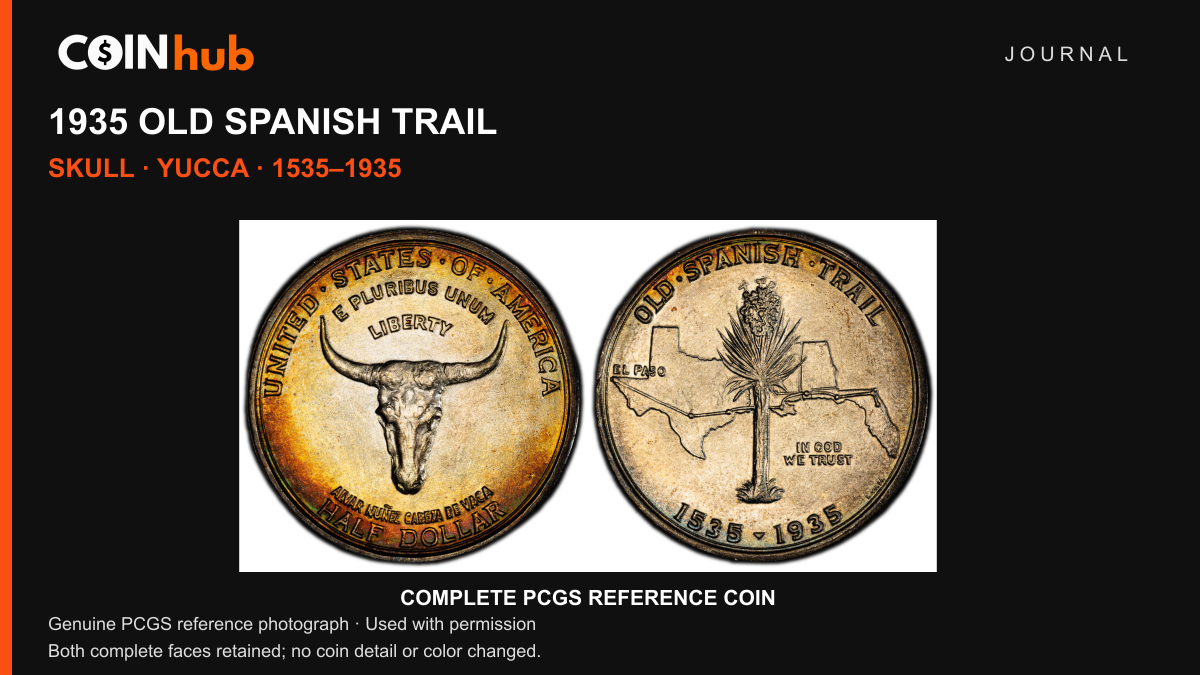
The 1935 Old Spanish Trail half dollar has a steer skull on one face and a flowering yucca over a map on the other. Its dates, 1535–1935, describe the anniversary commemorated by the issue. They do not mean the coin was made in 1535.
There is another detail worth checking...the map is part of the commemorative story, not a reliable route guide. Read it alongside the skull, the name Cabeza de Vaca and the coin's 1935 issue date.
The skull is a name clue
The obverse, or front, shows a longhorn steer skull with wide horns. UNITED STATES OF AMERICA arcs above it, while HALF DOLLAR identifies the coin below. CABEZA DE VACA appears beneath the skull, between the design and the denomination.
The American Numismatic Association explains the visual pun: Cabeza de Vaca's name means cow's head. A skull takes the place of a portrait because his appearance was not established for the design. The reference is 1935 Old Spanish Trail Half Dollar (https://www.money.org/
That name-and-image connection is more useful than calling it a coin with a cow on it. The pictured object is a skull. Keep the name and HALF DOLLAR visible when saving an identification photo.
Find the yucca, El Paso and two dates
The reverse, or back, carries a map with a flowering yucca in front of it. EL PASO appears toward the left. OLD SPANISH TRAIL runs around the upper edge, and 1535–1935 sits along the bottom.
The official record, Old Spanish Trail Half Dollar (https://www.usmint.gov/
Start at the top and follow the lettering down to the dates. The complete reference photograph lets you see how the plant, map and words fit together. A crop of the flower alone can lose the details that separate this issue from another commemorative.
What 1535–1935 tells you
| Clue | How to read it |
|---|---|
| 1535 | The historical starting date used by the commemoration. |
| 1935 | The coin's issue year, 400 years later. |
| Map and EL PASO | Part of the commemorative design, not proof of an exact travel route. |
The arithmetic gives 400 years. That explains the paired dates without turning either one into an overdate error. PCGS catalogs the issue as 1935 50C Spanish Trail (Regular Strike) (https://www.pcgs.com/
The ANA guide also warns that the mapped route is not an accurate account of Cabeza de Vaca's journey. Treat the coin as evidence of what its promoters chose to commemorate. Do not use its line across the map to settle where the explorer actually traveled.
Read the design before judging the coin
For an identification record, save both complete faces, the date pair and any holder label. Check the skull and name together, then the yucca, EL PASO and OLD SPANISH TRAIL. Several matching features make a stronger reading than one isolated symbol.
A matching design still does not prove authenticity, grade or value. Replicas can appear beside genuine examples in search results. Keep the seller's description separate from the actual object, and seek a qualified opinion when authenticity is uncertain.
Compare prices only after that work. A record for a high-grade reference coin does not price a worn or damaged piece. Preserve the surfaces as found; cleaning can remove evidence rather than answer the question.
Photograph notes
The genuine PCGS photograph is used with permission. CoinHub retained both complete faces and their original detail and color, adding only the surrounding labels and layout. It provides a design comparison, not a grade or authentication finding for another coin.