
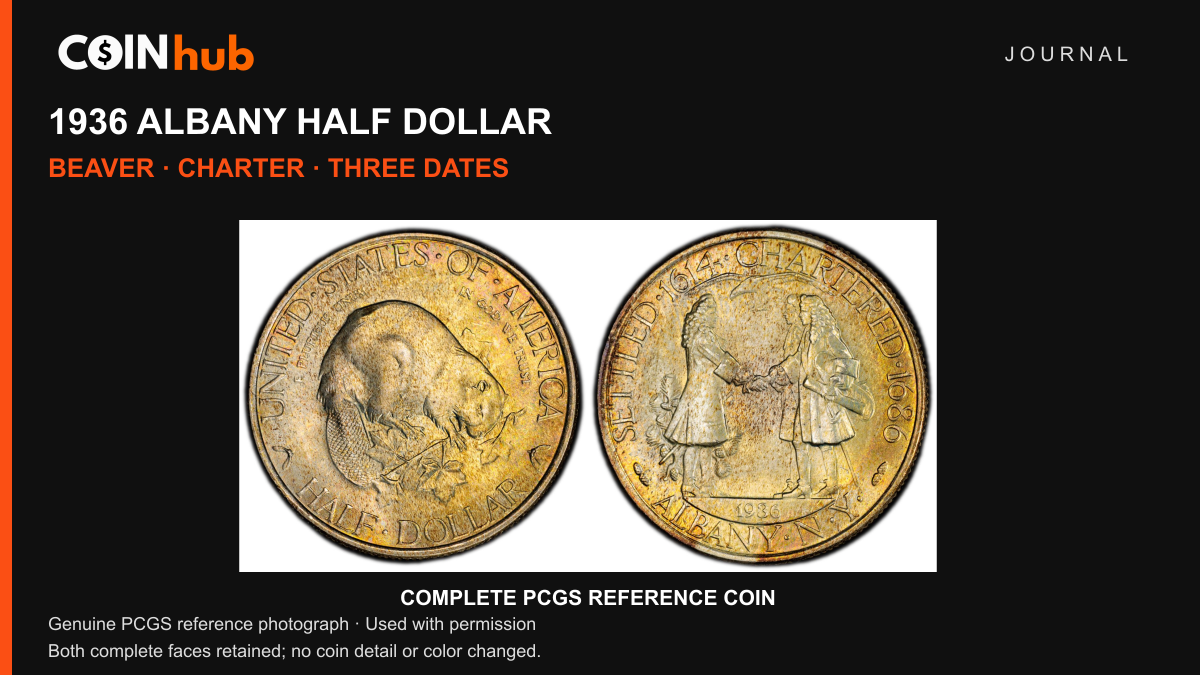
The 1936 Albany half dollar pairs a beaver with a city-charter scene. Three dates tell its story. SETTLED goes with 1614, CHARTERED with 1686, and 1936 is the issue year. The coin marks 250 years since the 1686 charter.
Read the words beside the dates...they explain the years. This is a silver commemorative, a coin made to mark an event. A charter sets out a city's powers. This coin honors Albany, New York, and its charter.
Why a beaver appears on the coin
The beaver holds a branch beneath its mouth, with leaves and winged maple seeds around the design. UNITED STATES OF AMERICA curves around the upper edge, and HALF DOLLAR names the denomination below. The PCGS photo shows the whole face, not just the animal.
The American Numismatic Association connects the beaver with the area's fur trade and notes that the animal also appears on Albany's city seal. Its reference is 1936 Albany, New York, Charter Half Dollar (https://www.money.org/1936-albany-new-york-charter-half-dollar/).
Those clues help name the coin. The animal alone does not tell you its country or face value. Read the surrounding words too, especially if a seller has shown only one cropped side.
The three men explain the charter
Turn to the face with three standing figures. The Mint identifies Governor Thomas Dongan, Peter Schuyler and Robert Livingston in the charter presentation. An eagle flies above them. The small date 1936 sits below their feet. ALBANY N.Y. runs along the lower rim.
The official design record is Albany, New York Charter Half Dollar (https://www.usmint.gov/learn/coins-and-medals/commemorative-coins/albany-new-york-charter-half). Gertrude K. Lathrop designed the coin. Check the photo to see which words go with each scene.
Follow the outer lettering from SETTLED 1614 to CHARTERED 1686. These mark two past events, not two years when the coin was made. SETTLED refers to European settlement. It does not mean that human life in the area began in 1614.
Count from the charter year
| Date | How to read it |
|---|---|
| 1614 | Paired with SETTLED in the outer inscription. |
| 1686 | The city charter year; the starting point for this anniversary. |
| 1936 | The issue year, 250 years after 1686. |
Subtract 1686 from 1936 and you get 250. Subtract 1614 and you get 322. The result shows why the charter date matters. Calling this only a settlement coin misses that point.
Q. David Bowers separates the historical dates, issue date and actual 1936 striking year in Commemorative Coins of the United States, Chapter 7: How to Use This Book (https://www.pcgs.com/books/commemoratives/chapter07). The three dates belong on the design. They do not prove that one date was punched over another.
Keep the design and condition records separate
PCGS identifies the issue as a Philadelphia half dollar made of 90% silver and 10% copper. Its reference entry is 1936 50C Albany (Regular Strike) (https://www.pcgs.com/coinfacts/coin/1936-50c-albany/9227). The source grade belongs to the coin in that photo.
In your notes, record the beaver, charter scene, three dates and HALF DOLLAR wording. Add clear pictures of both faces and any holder label. Do not assign your coin the reference specimen's grade because its design looks the same.
Naming the design does not prove a coin is genuine or give its price. Check its surfaces and wear before you compare completed sales. Preserve an unusual find as it is instead of polishing it to match a bright listing photo.
Photograph notes
The complete PCGS reference pair is used with permission. Its color and detail are unchanged. CoinHub added the labels and layout around it. Use both faces to read the design; they cannot prove that your coin is genuine.