
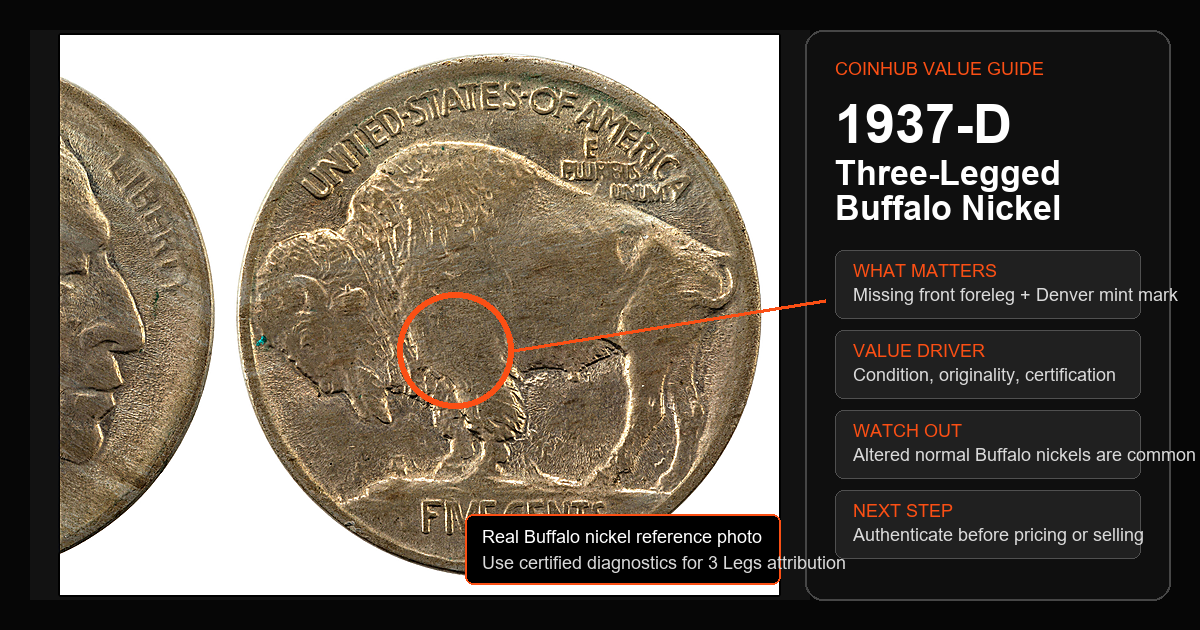
1937-D Three-Legged Buffalo Nickel Value: What Collectors Should Check First
The 1937-D three-legged Buffalo nickel is one of the most famous U.S. nickel varieties because the bison on the reverse appears to be missing most of its front foreleg. Collectors like it because the feature is dramatic, easy to understand, and tied to a real Mint production story. That popularity also makes it one of the Buffalo nickels most likely to be misidentified or altered.
Why the 1937-D Three-Legged Buffalo Nickel Is Valuable
Value comes from the combination of fame, demand, visibility, and certification risk. A normal 1937-D Buffalo nickel can be collectible, but the three-legged variety is a separate market. PCGS identifies the missing front foreleg as the key attribute, while the American Numismatic Association notes that the coin sits in the error-variety overlap: something went wrong with the die, then multiple coins were struck with the same look.
NGC's current price-guide context shows why collectors should slow down before selling one casually. Even circulated certified examples can carry meaningful premiums, while Mint State examples are a different market entirely. Exact value still depends on the individual coin, so use price guides as research tools rather than guaranteed offers.
| Value factor | Why it matters | Collector note |
|---|---|---|
| Authentication | Altered normal Buffalo nickels exist because the famous missing-leg look is easy for sellers to hype. | For serious money, buy or sell certified examples from PCGS, NGC, ANACS, or another respected service. |
| Grade | Wear, strike, date strength, horn detail, and surface quality all affect market value. | A problem-free certified XF coin is not priced like a cleaned or damaged raw coin. |
| Original surfaces | Cleaning, scratches, corrosion, artificial toning, and tooling reduce collector confidence. | Do not clean a possible 3 Legs nickel before expert review. |
| Correct reverse diagnostics | The real variety is not just any weak or missing-looking leg on a worn Buffalo nickel. | Use the missing front foreleg plus supporting die characteristics, not one blurry photo. |
| Denver mint mark | The famous variety is a 1937-D coin, so the D mint mark under FIVE CENTS matters. | A 1937 Philadelphia or San Francisco nickel is not this variety. |
How To Identify a 1937-D Three-Legged Buffalo Nickel
Is a Weak Buffalo Leg the Same as the 3 Legs Variety?
No. Buffalo nickels are often worn, weakly struck, or damaged, and many have soft details around the bison's legs. That does not automatically make them the 1937-D 3 Legs variety. The market pays for the specific recognized variety, not for any coin where a leg looks faint in a photo.
This is especially important when buying online. Listings that say "looks three-legged" or "possible 3 leg" should be treated carefully unless the coin is certified or the seller provides clear diagnostic photos. A bargain raw example can still be real, but the risk is part of the price.
What To Do If You Think You Found One
First, protect the coin. Do not clean it, rub the leg area, use chemicals, or try to improve the look for photos. Take sharp pictures of both sides, including the date, mint mark, full reverse, and close-up of the missing-leg area. Then compare the coin to certified reference examples and consider grading if the diagnostics look promising.
If you are sorting a larger nickel group, CoinHub's Buffalo nickel value guide, 1926-S Buffalo nickel guide, and 1916 doubled die Buffalo nickel guide can help you separate other better dates and varieties. For selling decisions, use the coin grading break-even calculator and CoinHub's where to sell coins guide before accepting a fast offer.
Sources Checked
Research for this guide used PCGS CoinFacts for the exact 1937-D 5C 3 Legs record and specifications, NGC Coin Explorer for current July 2026 price-guide context, the American Numismatic Association's history article on the variety, Bing search results for competitor intent, and CoinHub's local mirrored Buffalo nickel image assets for the real-coin reference graphic.