
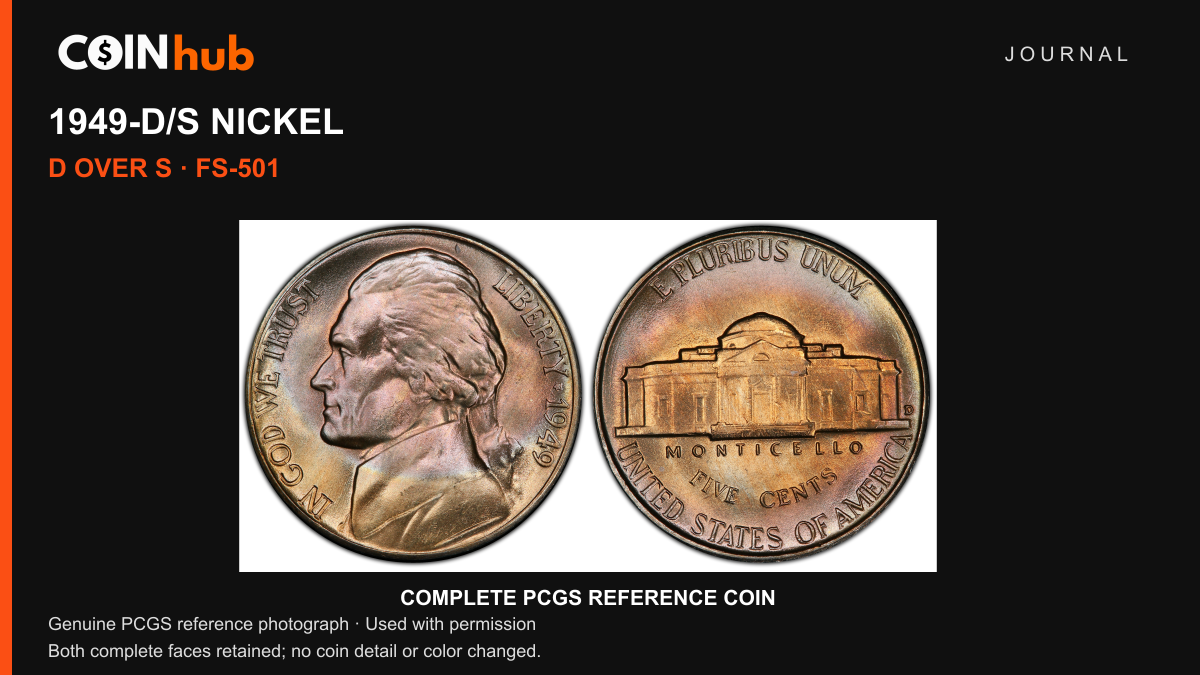
The 1949-D/S nickel FS-501 has a D mint mark over an earlier S. Look on the back, to the right of Monticello, and compare the extra detail around the D with an attributed reference. The final D identifies the Denver issue; the S is a remnant of an earlier punch on the die.
A thick D alone ain't enough. Wear, glare and damage can make a small letter hard to read. Start with the full date and mint mark...then check the exact shape in a clear close-up.
Find the small D beside Monticello
The obverse, or front, shows Jefferson and the 1949 date. Turn to the reverse, or back, with the Monticello building. The mark is beside the building, rather than above its dome. Keep a full back photograph so the letter's location stays clear.
The main image shows both complete faces of one genuine PCGS reference coin. The separate catalog photograph below gives a closer view of the D/S feature. It is not an enlargement of that same specimen, and the two photographs have different light and surface color.
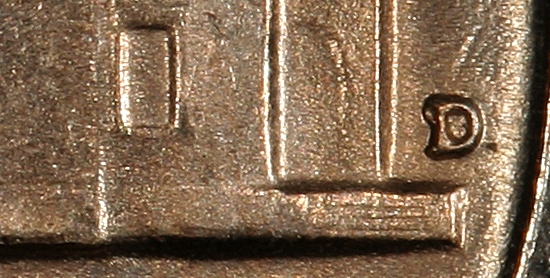
Compare with the exact entry, 1949-D/S 5C Overmintmark, FS-501 (Regular Strike) (https://www.pcgs.com/
What D over S actually describes
A die is the steel tool that strikes a coin's design. An overmintmark forms when a different mint letter is punched over an earlier letter on that tool. Here, the order is S first and D afterward. It does not mean that a finished nickel traveled between two mints to receive the letters.
PCGS discusses this variety in 1949-D/S 5C (Regular Strike) (https://www.pcgs.com/
In this setting, D means Denver and S means San Francisco. The official background is Mint Marks (https://www.usmint.gov/
Keep FS-501 separate from Full Steps
| Term | What to check |
|---|---|
| D/S overmintmark | Different mint letters on the die: D over an earlier S. |
| D/D repunched mark | A repeated impression of the same letter, not D over S. |
| FS-501 | The catalog identifier attached to this variety. |
| Full Steps | A separate designation concerning the steps on Monticello. |
The PCGS entry separates its regular-strike and Full Steps views. A matching mint mark does not establish Full Steps. Likewise, clear steps do not prove the D/S variety. Read the full holder label and examine each claim on its own.
Make a useful comparison record
Save both complete faces, a sharp mint-mark close-up and any holder label. Try a second light angle without changing the coin. If the extra shape vanishes into blur or glare, keep the identification open rather than filling in what you hope to see.
The CoinHub Variety Attribution Assistant can help organize possible categories and next checks. It cannot confirm this variety or assign an FS number. Seek a qualified attribution before selling an uncertain coin as FS-501, and do not scrape or polish the mark.
For broader background, CoinHub founder Blake Alma's The CoinHub: An Ultimate Guide to Coin Errors is an optional resource from our own publisher. Exact reference photos still control this comparison. A source specimen's grade or record price does not carry over to your find.