
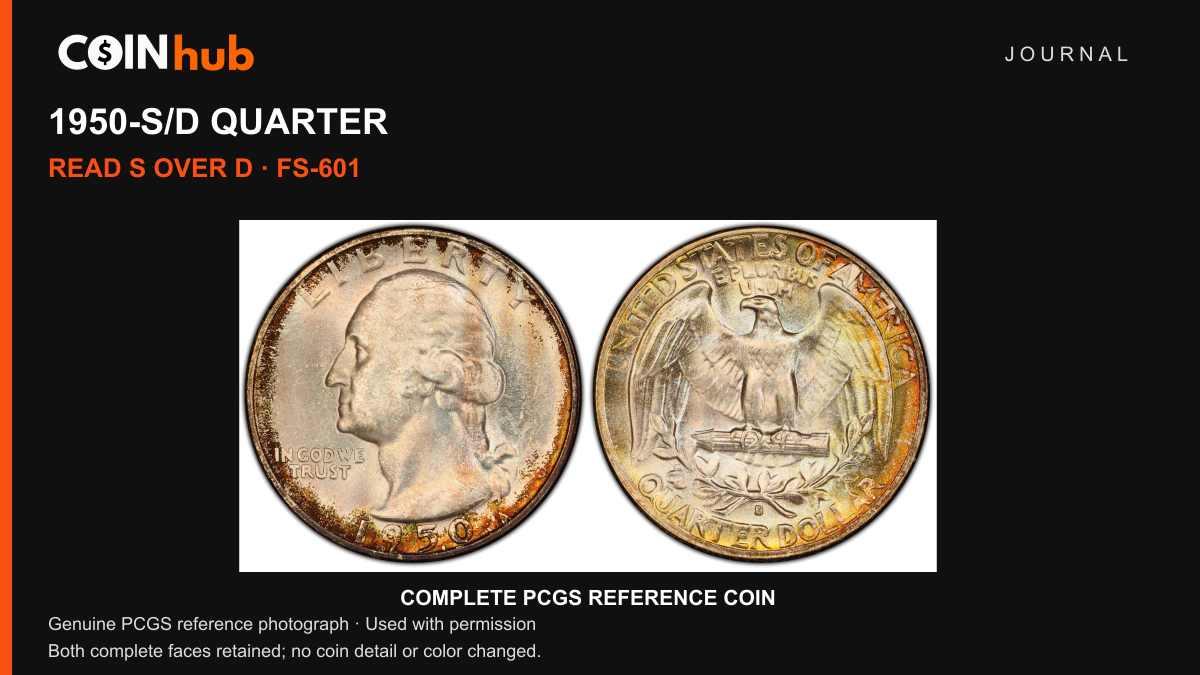
The 1950-S/D quarter FS-601 has a final S mint mark over an earlier D. Look below the eagle on the back, then compare the extra D detail with an attributed close-up. This is the San Francisco variety...the opposite 1950-D/S has a different final letter and a different pattern.
That order matters. Search results sometimes mix the two, and both can carry FS-601 in their full names. A reference number alone ain't enough to identify your coin. Keep the year, denomination and mint letters together.
Start with the S below the eagle
The obverse, or front, carries Washington's portrait and the 1950 date. Turn to the reverse, or back. The small mint mark is below the wreath and above QUARTER DOLLAR. On this variety, the letter you are trying to read first is S.
The main PCGS photograph shows both complete faces of one attributed reference coin. The separate close-up below comes from the same CoinFacts variety catalog. It is not a crop of that whole-coin specimen, and its lighting and surface color differ.
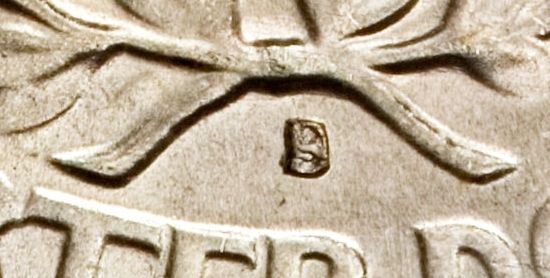
PCGS lists the exact variety in 1950-S/D 25C OMM, FS-601 (Regular Strike) (https://www.pcgs.com/coinfacts/coin/1950-s-d-25c-omm-fs-601/145639). Match the location and shape together. A thick letter or one bright line does not confirm an overmintmark.
What S over D means
An overmintmark is a die variety caused by one mint letter being punched over a different letter on the die. A die is the steel tool that strikes a coin's design. The marks were on that tool before the quarter was made; this does not mean a finished coin was struck once at each mint.
GreatCollections describes the D remnants beneath and around the S in its primary record, 1950-S/D Washington Quarter Over Mintmark FS-601 PCGS Genuine XF Details, item 1844397 (https://www.greatcollections.com/Coin/1844397/1950-SD-Washington-Quarter-Over-Mintmark-FS-601-PCGS-Genuine-XF-Details). That listing documents another coin, not the specimen pictured here.
S means San Francisco and D means Denver in this setting. The official explanation is Mint Marks (https://www.usmint.gov/learn/collecting-basics/mint-marks). The final S identifies this as the San Francisco issue.
Keep three different comparisons separate
| Label | What the label describes |
|---|---|
| 1950-S/D | A final S over an earlier D. Use the S/D reference photo. |
| 1950-D/S | A final D over an earlier S. Its diagnostic is a different comparison. |
| 1950-S/S | A same-letter repunched S, rather than S over D. |
CoinHub's 1950-D/S quarter guide shows the Denver pattern. Use it to see why the order changes the identification, not as a substitute photograph for this S/D. Neither label means that the reverse lettering is a doubled die.
Make the close-up useful
Save a complete front and back view before making a tight mint-mark crop. Use steady focus and try a second light angle. Glare can hide part of a letter, while a blurry edge can suggest detail that is not clear in the original photograph.
Compare your original images with the reference. If wear or damage prevents a clear match, keep the result as a possible variety. Do not clean or scrape the mark to make the D easier to see.
The CoinHub Variety Attribution Assistant helps organize possible categories and the next checks. It cannot confirm this overmintmark or assign an FS number. Seek a qualified attribution before describing an uncertain coin as FS-601 for sale.
Identification comes before a price
A record sale for a high-grade coin does not price a worn or damaged find. The whole-date mintage also does not count this particular die variety. First confirm the attribution and surface condition, then compare recent completed sales for genuinely similar coins.
For broader background, CoinHub founder Blake Alma's The CoinHub: An Ultimate Guide to Coin Errors is an optional resource from our own publisher. It does not replace the exact reference photographs for this comparison.