
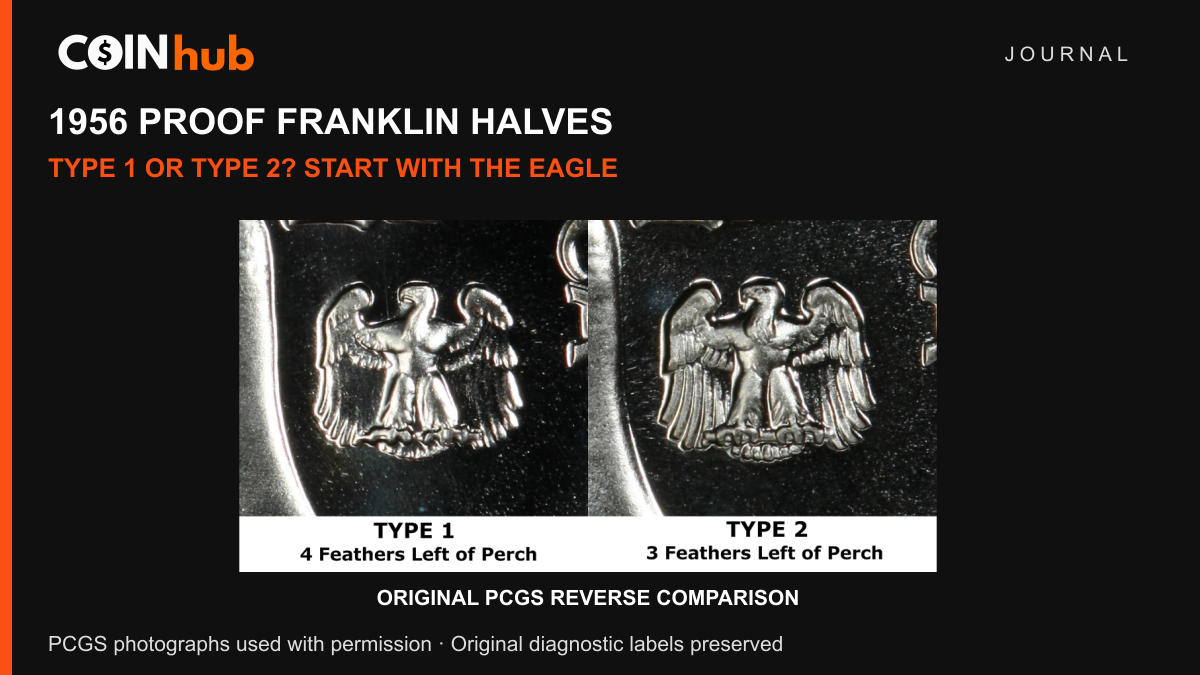
To tell a 1956 Proof Franklin half dollar's Type 1 reverse from Type 2, look at the small eagle beside the Liberty Bell. Type 1 shows four clear wing feathers to the viewer's left of the perch. Type 2 shows three. Use a sharp close-up: a blur can hide the line that separates two feathers.
This is a difference between two reverse designs used for 1956 Proofs. It is not, by itself, an accidental minting error. Nor does it tell you a coin's grade or current value. The first job is to identify the design you can actually see.
Find the eagle on the back
The obverse, or front, carries Benjamin Franklin's portrait and the date. The reverse, or back, has the Liberty Bell. A small eagle sits to the viewer's right of the bell. That eagle holds the key to this comparison.
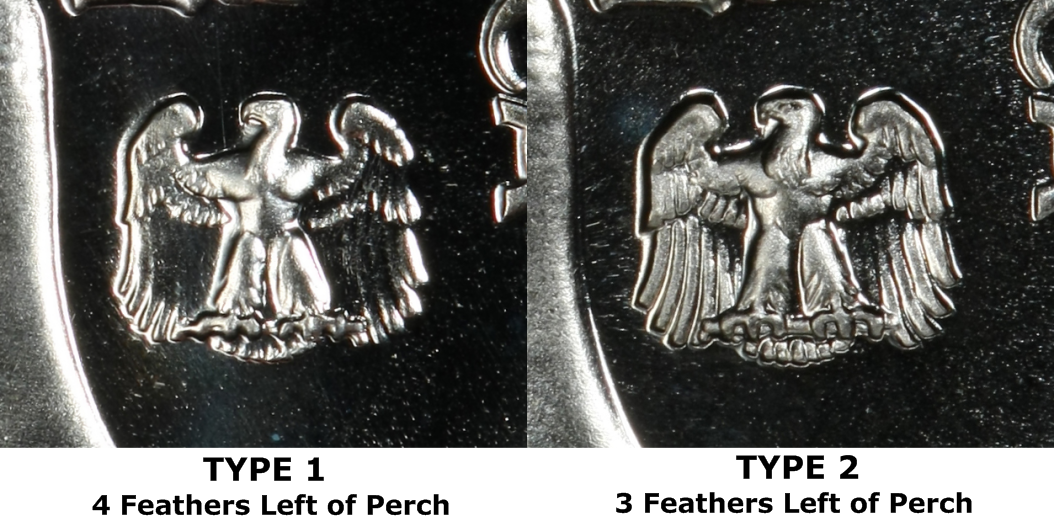
| Reverse | What to look for |
|---|---|
| Type 1 | Four clear wing feathers left of the perch; the earlier reverse style |
| Type 2 | Three clear wing feathers left of the perch; sharper neck and breast detail |
Start with the feather count. Neck and breast detail can help support what you see, but lighting and image quality can make those features hard to judge. Compare the same area at a useful size rather than deciding from a small sales thumbnail.
Why two reverse types exist
A hub is a master tool used to make coin dies. A die is the tool that strikes a coin's design into the metal. A revised hub can therefore give many coins a different design detail without each coin being a separate mint accident.
In NGC's explanation of Franklin half dollar hub changes, David W. Lange describes the sharper reverse introduced in 1956. PCGS identifies the earlier Type 1 and revised Type 2 with the feather diagnostics shown above.
Keep the date and finish in the comparison. The Type 1 style was also used for 1956 circulation coins. Finding four feathers on a 1956 half dollar does not establish that it is a Proof. Proof describes a special method of manufacture; it is not a grade meaning “perfect.”
Keep a whole-coin photo with the close-up
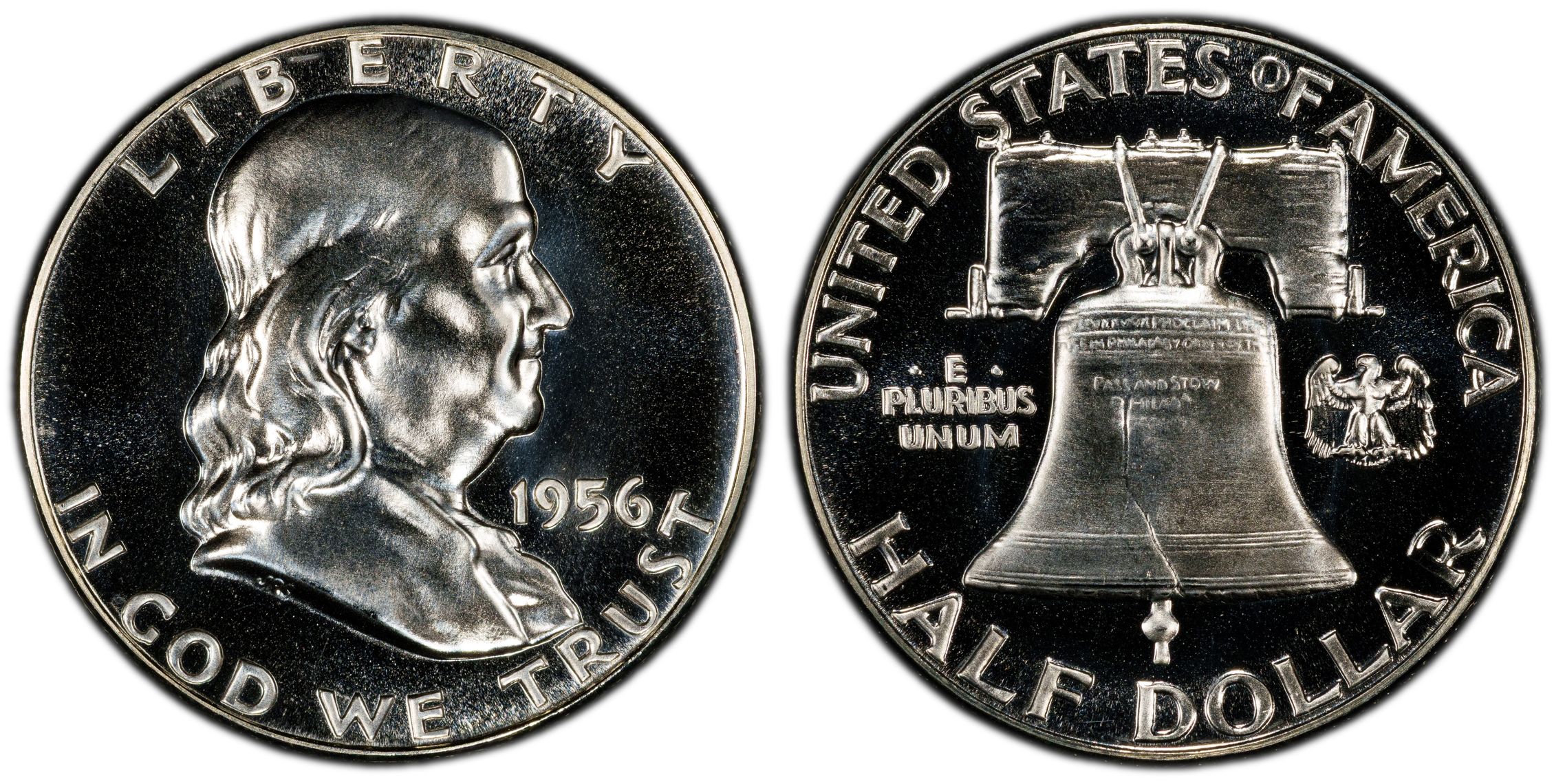
A tight eagle photo is useful, but a whole-coin view keeps it tied to the right date and item. If you ask someone to check your coin, include the front, back and a focused eagle detail. Use light that shows the feather lines. Do not clean or polish the coin to make a photograph look sharper.
If the lines remain unclear, leave the type undecided. A soft image, glare or weak detail is not proof that a feather is missing. It is better to request a clearer photo than to attach a confident Type 1 label to an unreadable eagle.
Identify the type before comparing prices
Reverse type is one part of a description. Surface condition and finish also matter when comparing Proof coins. The pictured reference does not give another coin the same grade or value.
For broader collecting context, see the Franklin half dollar value guide. This page answers the narrower design question: four feathers for Type 1, three for Type 2, with the date and Proof status checked separately.