
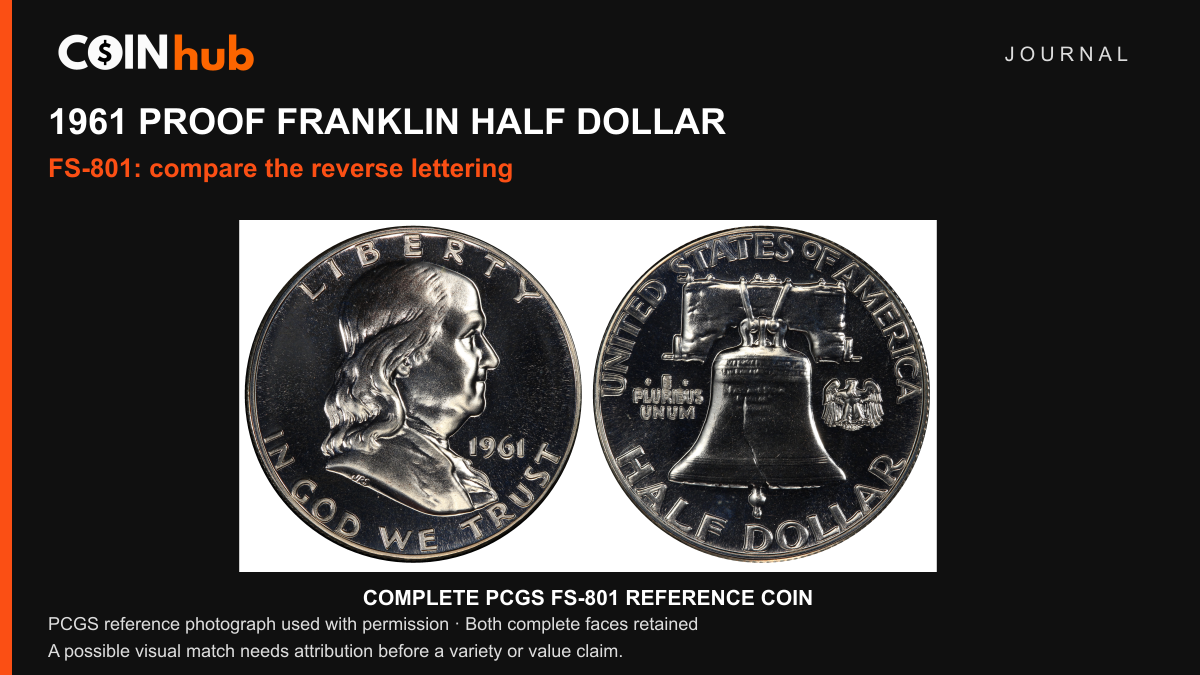
Start with the small motto beside the bell
The strong 1961 Franklin half dollar doubled die reverse known as FS-801 is a Proof variety. Look for a repeated raised outline in the reverse lettering, including E PLURIBUS UNUM beside the Liberty Bell. Then compare UNITED STATES and HALF DOLLAR. A second edge on one letter is not enough to name the variety.
PCGS lists FS-801 separately. Its guide to 1961 doubled dies notes more than one reverse variety. FS-801 is a reference number, not a grade. Do not attach the FS-801 number to every 1961 half with unusual lettering.
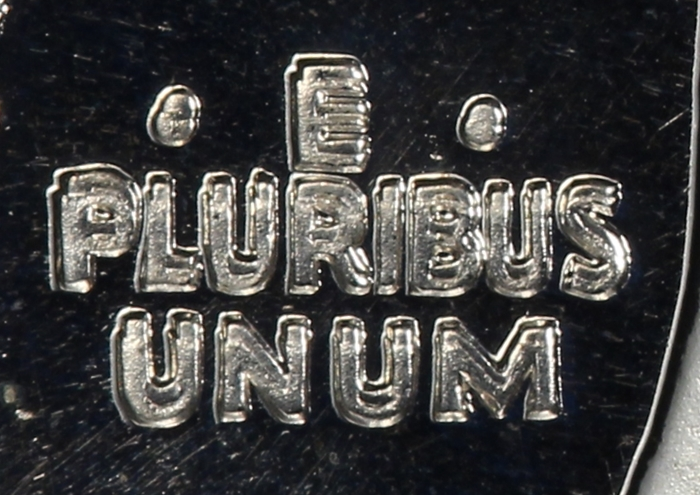
Match a pattern across the reverse
The reverse is the back of the coin. Keep a full view of it beside a sharp close-up. The photo above shows a known reference coin. It does not identify a coin you own. Match where the extra outlines sit and which way they extend. Their size alone is not enough.
- Find E PLURIBUS UNUM to the left of the bell. Look for clear separation within the raised lettering.
- Move outward to UNITED STATES and down to HALF DOLLAR. Check whether the same reference pattern appears in those areas.
- Keep the date-side photograph with these views. A cropped word cannot establish the year or show that all pictures belong to one coin.
Use even light and take a second photograph from another angle. Glare on a reflective surface can hide a detail or make an edge look doubled. If you cannot see the letters clearly, call the coin a possible match. Leave its exact variety open.
A doubled die is different from a second strike
A die is the tool that presses the design into a blank coin. On a doubled die, the repeated design was already in that tool before it struck the coin. Coins made with that die can carry the repeated features. The coin did not need to move and receive a second, misplaced strike to create them.
NGC distinguishes this from mechanical doubling, which happens when the coin is struck. It often leaves a flat, shelf-like step. Compare the raised shapes and the full known pattern. A coin can have both forms of doubling, so one flat edge does not settle every other feature on its reverse.
Proof describes how the coin was made
A Proof is a coin made for collectors with specially prepared dies and blanks. Proof does not mean a perfect grade. Nor does a shiny surface alone prove that an ordinary coin is a Proof. Ask three separate questions: How was the coin made? What shape are its surfaces in? Which die variety, if any, does it match?
For a local record of those questions, the CoinHub Variety Attribution Assistant can help you record the coin type, date, side and odd feature. It suggests what to check next. It cannot confirm a doubled die or assign an FS number. Use a recognized reference or an expert service to confirm the match before selling the coin as FS-801.
Confirm identity before comparing prices
Leave the surfaces as found. Do not polish the lettering to make it easier to see. Save full coin views, close-ups, any holder label and the source you used. A reference photograph's grade does not become the grade of your coin.
Compare prices for the same confirmed variety and Proof finish, in similar condition. An old sale result or a seller's asking price is not a current offer for your coin. For broader error-collecting reading, CoinHub founder Blake Alma's The CoinHub: An Ultimate Guide to Coin Errors is optional further reading. Keep using the exact reference features to check this variety.
References checked November 4, 2026: PCGS's FS-801 listing and historical doubled-die explanation, NGC's doubling comparison, and PCGS grading standards for Proof manufacture. Historical prices and population figures were not used as current estimates.