
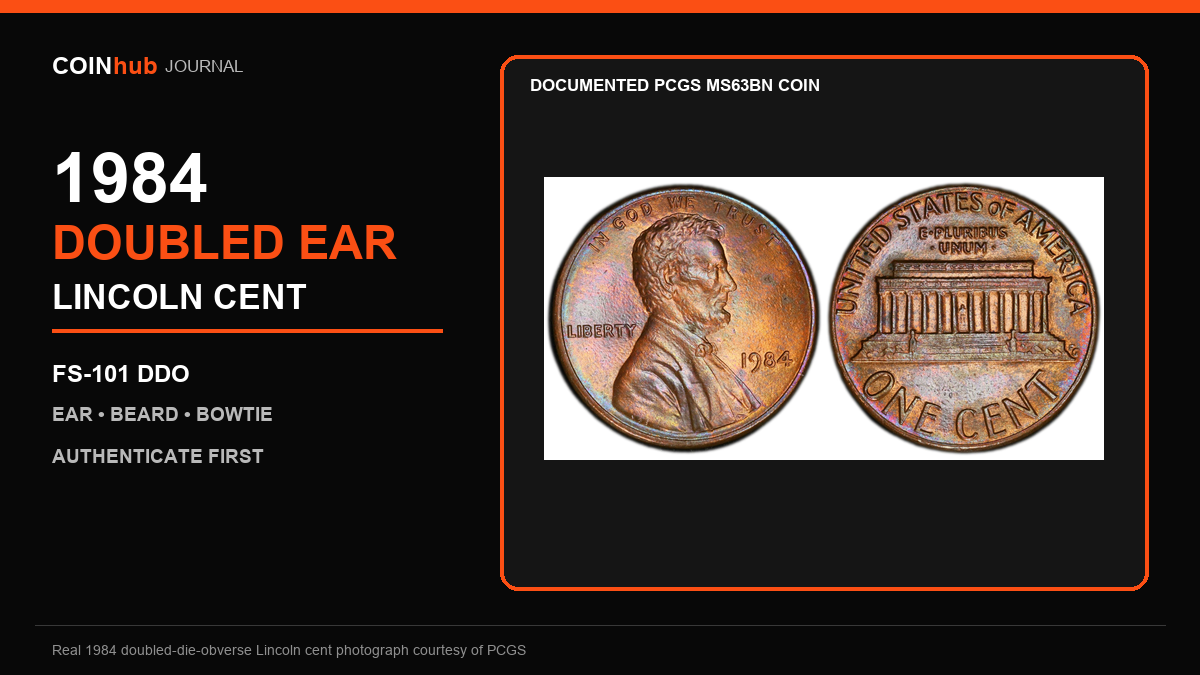
What collectors mean by “doubled ear”
“Doubled ear” is the convenient nickname for a doubled die on the obverse. It is not a second coin or a doubled strike. PCGS calls the 1984 doubled-die-obverse cent a major Lincoln-cent variety and describes the strongest doubling as south of Lincoln’s ear. PCGS also notes doubling in the beard and bowtie, which matters because the extra evidence helps separate a variety from a mark on one small area.
Use this three-point inspection order
- Look below the ear first. Use a loupe and even light. Seek a clear doubled lobe or separated outline, not a soft shadow.
- Check the beard. A genuine candidate should offer supporting doubled detail in the same general direction.
- Check the bowtie. This is the third corroborating area PCGS identifies. If the ear is questionable and the other areas do not support it, call the coin inconclusive.
Know the normal coin before judging the variety
PCGS lists the regular 1984 Philadelphia cent as copper-plated zinc, 19.00 millimeters, and 2.50 grams. Those specifications can help flag an obviously wrong planchet or altered item, but they do not prove FS-101. The attribution comes from the doubled design—not the scale reading alone.
Lookalikes to reject
- Machine doubling: flat, shelf-like movement can appear around letters or design edges but lacks the hub-doubled variety diagnostics.
- Contact marks: a hit near the ear can make a single outline look doubled at the wrong angle.
- Plating problems: zinc-cent plating blisters or corrosion can distort surfaces without creating doubled design detail.
- Camera artifacts: reflections and aggressive sharpening can invent a second line in a listing photo.
What about value?
A claimed price is not a value guide. PCGS records an auction result for a high-grade brown example, but that does not establish a price for every circulated coin or every online “doubled ear” listing. Attribution, color, grade, eye appeal, and buyer demand matter. If the diagnostic is convincing, professional variety attribution is more useful than treating a casual photograph as proof.
Frequently asked questions
Does every 1984 penny have the doubled ear?
No. The variety is a specific doubled-die-obverse attribution. Most 1984 cents are normal issues.
Is the 1984 doubled ear a mint error?
It is generally collected as a die variety. The doubled design originates in the die rather than from post-mint damage or a second strike.
Can I identify it from one close-up?
A good ear close-up is a starting point, but the beard and bowtie are useful corroboration. Authentication is appropriate for a strong candidate.
Source and image note: Diagnostics and specifications were checked September 12, 2026 against PCGS CoinFacts for 1984 1C Doubled Die Obverse, PCGS #3060, and NGC VarietyPlus. The hero includes a documented real PCGS MS63BN coin photograph from that CoinFacts record under Blake’s approved PCGS/NGC photo permission; CoinHub added the editorial layout.