
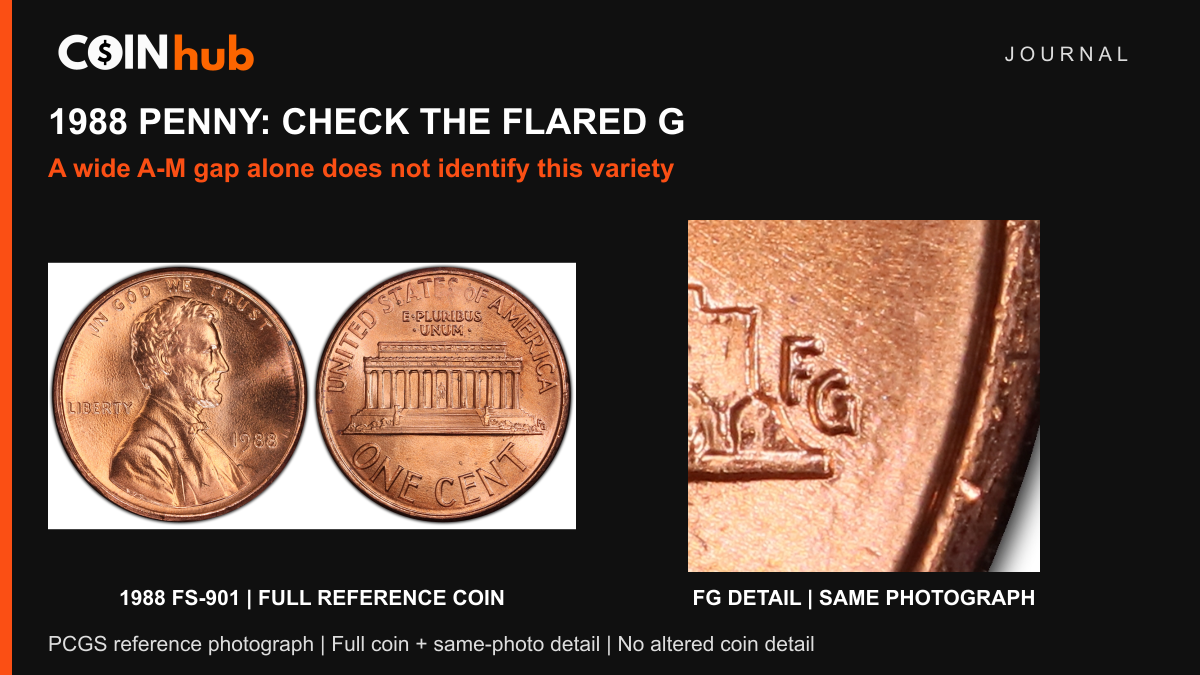
Start with the G beside the Memorial
Quick answer: A 1988 penny with the reverse of 1989 has a different shape to the G in the designer's initials, FG. Look for a small serif on the G's upright bar and a bar that extends below its lower curve. A wide gap between A and M alone does not identify this variety.
The date is on the front, or obverse. The initials are on the back, or reverse, just right of the Lincoln Memorial. You need clear views of both areas. A sharp close-up of FG without a readable date leaves out half the identification.
Collectors often call this the Flared G or Reverse of 1989 variety. PCGS lists a 1988 Flared G as FS-901. The photograph above shows a PCGS reference coin and an enlarged view from that same photograph. It is not a grade or attribution assigned to a reader's find.
What changed between the two reverse designs?
A die is the tool that stamps one side of a coin. A working die can carry a slightly different version of the design even when the main picture looks the same. A transitional reverse occurs when a date is paired with a design associated with another year.
Error-Ref documents 1988 cents from both Philadelphia and Denver with the 1989 reverse. The relevant change is in the style of FG, the initials of reverse designer Frank Gasparro. This is not an 8 struck over a 9, and it does not require a second strike.
Wexler's original working-die listings describe two useful G features. On the later design, the top of the upright bar has a small serif, a short projecting stroke. The bottom of that bar also reaches below the lower right curve. On the normal 1988 design, those features are absent.
| Check | Normal 1988 reverse | Reverse of 1989 |
|---|---|---|
| Top of the G's upright bar | No distinct projecting serif | A distinct small serif |
| Bottom of the upright bar | Does not extend below the lower right curve | Extends slightly below that curve |
| A and M in AMERICA | A wide gap can be normal | The gap alone is not the deciding test |
Why a Wide AM search can lead you astray
Wide AM and Flared G are not interchangeable tests. A normal 1988 cent can have the wide letter spacing that would be noteworthy on certain later dates. The question here is which reverse design appears on a coin dated 1988.
Our 1992 Close AM guide deals with a different date and reverse change. Carrying a rule from one year to another can turn an ordinary cent into a false match. Always attach the date and mintmark to the diagnostic you are using.
Make a useful photo record before naming the variety
- Take one complete photograph of each side. Keep the date and any D mintmark readable.
- Take a close-up of FG with the Memorial steps still visible for context.
- Move the light and take a second view. Glare can hide a small serif or make a damaged edge look like one.
- Compare both G features against the same design reference. A generally thick letter is not enough.
- Keep the original images. Heavy sharpening and digital outlines can create apparent detail that was not recorded.
Do not scrape the initials or clean around them. If wear, corrosion or a hit has removed the relevant shapes, a brighter picture may still leave the result uncertain. Record that limit rather than forcing an attribution.
A reverse design is not a complete working-die attribution
Wexler lists more than one working die for the Denver transitional reverse. Each listing uses other marks to distinguish it. Recognizing the broad G style does not establish a particular working-die number. Compare the complete coin and the listed markers before using a more precise label.
The CoinHub Variety Attribution Assistant can help organize the date, mintmark, side and feature. It cannot confirm FS-901, assign a working-die number or authenticate a coin. Keep a possible match qualified until the diagnostics have been checked.
Identify first, then consider a price
A sale of a certified high-grade example does not price a worn, damaged or unverified coin. Any useful comparison needs the same variety, condition, color designation and certification context, plus a dated completed sale. An asking price is a different kind of evidence.
For broader error terminology, CoinHub founder Blake Alma's The CoinHub: An Ultimate Guide to Coin Errors is an optional CoinHub book. The primary diagnostic references linked above remain the basis for this specific identification.
Sources checked October 17, 2026: PCGS CoinFacts, Error-Ref and Wexler's Coins and Die Varieties. Photograph courtesy of PCGS under CoinHub's saved photo permission. Full original and a labeled FG crop from that same image; no coin detail altered. No variety mintage, roll-search odds or current value is claimed.