
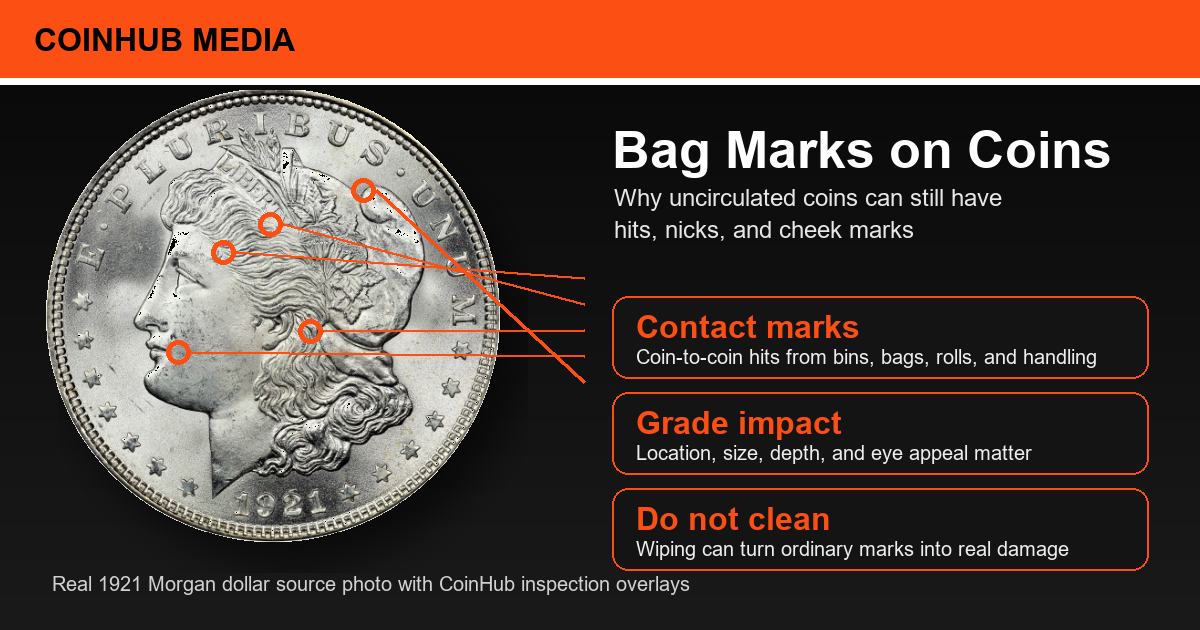
Quick answer: Bag marks are contact marks caused when coins hit, slide, or rub against other coins or hard surfaces during minting, bulk storage, transport, rolls, bags, or handling. A coin can be uncirculated and still have bag marks. The key question is whether the marks are normal contact marks or serious post-mint damage, and how much they hurt eye appeal and grade.
Many new collectors see a shiny coin with small hits on the cheek, field, or eagle and assume it must be circulated or damaged beyond value. That is not always true. Business-strike coins are made in quantity, ejected from dies, moved through bins, counted, transported, rolled, bagged, and handled before a collector ever sees them. Even Mint State coins can pick up contact marks before they enter circulation.
The problem is that not every mark means the same thing. A few light contact marks can be normal on an uncirculated Morgan dollar, Peace dollar, Kennedy half, quarter, or modern dollar coin. Deep gouges, cleaning hairlines, rim damage, or heavy scrapes can push a coin out of premium territory fast. This guide explains how to separate ordinary bag marks from red flags before you grade, sell, or clean a coin.
What Are Bag Marks?
Bag marks are a common nickname for small nicks, hits, abrasions, and contact marks on a coin's surface. PCGS notes that business-strike coins can receive contact marks before leaving the Mint, including when they drop into containers and later move through kegs, cloth bags, bank handling, and other bulk storage. PCGS also points out that "bag marks" is not perfectly precise because not every contact mark actually happens inside a bag.
Collectors still use the term because it is practical. When someone says a Morgan dollar has cheek marks or a modern dollar has bag marks, they usually mean coin-to-coin contact that happened during ordinary production and handling, not intentional scratching or cleaning.
How To Check Bag Marks on a Coin
Location matters as much as count. A small hidden tick in hair detail may matter less than one obvious hit on Liberty's cheek or in a wide open field. Heavy coins and softer metals can show more contact because coin-to-coin impacts leave stronger marks. That is why silver dollars and gold coins often get discussed in terms of bag marks.
Bag Marks vs. Damage vs. Wear
| Surface clue | What it may mean | Collector response |
|---|---|---|
| Small scattered ticks with full luster | Normal contact marks on an uncirculated coin. | Evaluate grade, eye appeal, and whether the coin is worth certification. |
| Deep gouge or long scrape | More serious damage or mishandling. | Be cautious before paying a premium or grading fee. |
| Flat high points with dull surfaces | Possible circulation wear, friction, or rub rather than just bag marks. | Compare the high points with protected areas under one light. |
| Fine parallel lines | Possible cleaning, wiping, or slide marks. | Do not clean further. Cleaning can hurt value more than the original marks. |
Do Bag Marks Lower Coin Value?
Yes, they can. Bag marks are one reason two coins with the same date and mint mark can sell for very different prices. A coin with strong luster, clean focal areas, and only small scattered marks may qualify for a better grade and stronger premium. A coin with heavy cheek marks, distracting field hits, or dull rubbed high points may stay in a lower Mint State grade or be less attractive to buyers.
That does not mean every marked coin is bad. Some series are rarely found without marks, and older business-strike coins were not packaged like modern collector products. The market usually compares the coin against what is normal for the issue. A common-date Morgan dollar with heavy cheek hits may be ordinary. A condition-rarity coin with unusually clean surfaces may bring a much stronger premium.
CoinHub grading decision
Before paying for grading, ask whether the coin needs a high Mint State grade to make the fee worthwhile. If the value depends on MS65 or better and the coin has obvious focal-area hits, use CoinHub's coin grading break-even calculator before submitting it.
Where Bag Marks Matter Most
- Morgan dollars: cheek marks and open-field hits are easy to see and can heavily influence eye appeal.
- Peace dollars: broad open surfaces make scrapes and ticks stand out quickly.
- Gold coins: softer metal can show contact marks clearly, especially on larger denominations.
- Modern dollar coins and quarters: roll and bag handling can leave hits even on coins that never circulated.
- Proof and special-finish coins: contact marks are usually more serious because collectors expect cleaner surfaces.
Should You Clean Bag Marks?
No. Cleaning will not turn a contact-marked coin into a higher-grade coin. Wiping, polishing, or using household cleaners can add hairlines, strip luster, and create a bigger problem than the original mark. If a coin has premium potential, handle it by the edges, put it in an inert holder, and get an opinion before doing anything to the surface.
If you are sorting a collection, separate coins with strong dates, mint marks, silver or gold value, and unusually clean surfaces. Then separate heavily marked, cleaned, or damaged coins into a lower-priority group. The goal is not to make the coins look better. The goal is to avoid making them worse.
Quick Triage Before Selling or Grading
- Check the date and mint mark first. A better date can still matter even with marks.
- Look for full luster. Bag marks can exist on uncirculated coins, but wear changes the conversation.
- Study focal areas. Cheeks, portraits, open fields, and central devices get the most buyer attention.
- Use the right floor value. For silver coins, compare collector premium with melt value using the silver melt calculator.
- Document important coins. Add photos and notes in the free CoinHub Tracker before sending coins out or selling them.
Sources and Research Notes
Research for this guide checked current search results for "bag marks on coins" and "bag marks coin grading." Primary grading context came from PCGS on examining contact marks. Competitor review included APMEX on bag damage and a current CoinGrader AI article targeting the same query. The CoinHub angle is more practical for collectors: identify the mark type, protect the coin from cleaning damage, decide whether grading makes financial sense, and route the coin into selling or inventory tools.
FAQ
Can an uncirculated coin have bag marks?
Yes. A coin can be Mint State and still have contact marks from production, bulk storage, bags, rolls, transport, or handling.
Are bag marks the same as scratches?
Not always. Bag marks are usually contact marks from coin-to-coin handling. A deep scratch, cleaning line, or gouge can be more serious damage.
Do bag marks mean a coin should not be graded?
Not automatically. The decision depends on the coin's date, rarity, luster, mark location, expected grade, and grading cost.
What coin areas should I check first?
Start with the cheek, portrait, open fields, eagle breast, central design, and any large blank areas where marks stand out.