
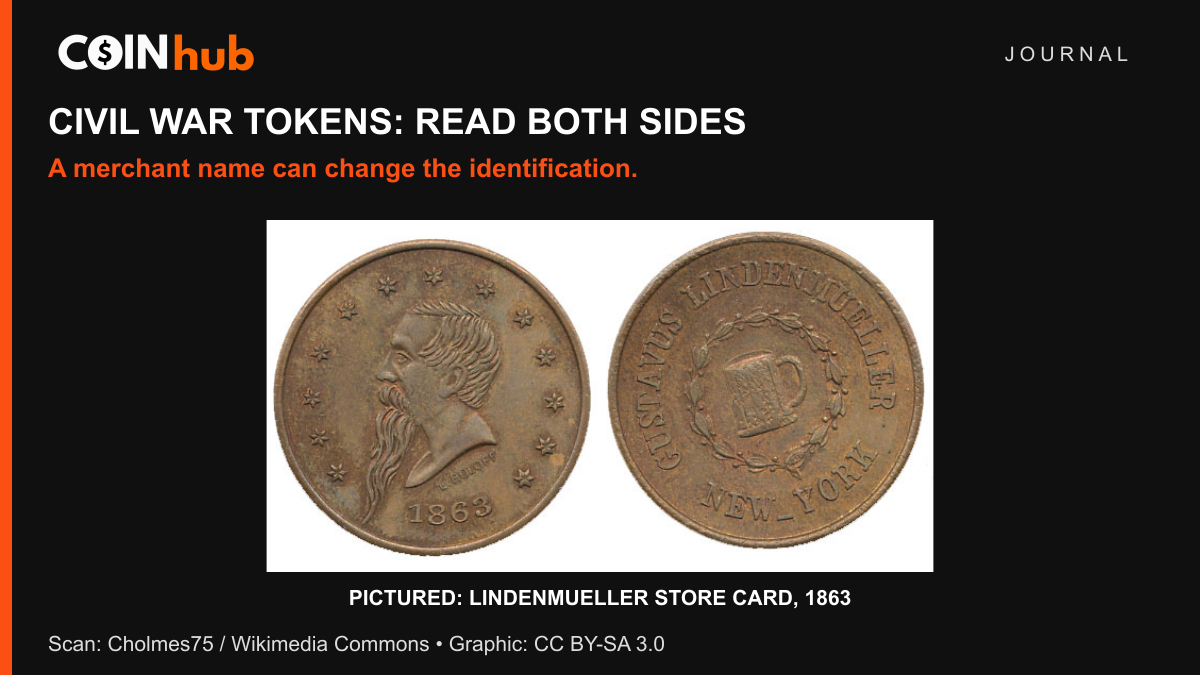
Civil War tokens fall into three main groups: store cards, patriotic tokens and sutler tokens. A store card advertises a merchant, brand or product. A patriotic token usually pairs stock designs or messages. A sutler token belongs to the trade of merchants who supplied soldiers.
Read both sides before choosing a group. A flag, eagle or Liberty head on one side does not rule out a store card. The business name on the other side may be the more useful clue.
Start with the words, then the picture
| Group | First clue to record | What to check next |
|---|---|---|
| Store card | Merchant, brand or product name | Town, state and the design on the other side |
| Patriotic token | Slogan, portrait or symbolic design | The full pair of designs, not just one familiar image |
| Sutler token | Supplier's name and often a military unit | Exact wording and the specialist catalog entry |
The Civil War Token Society explains that merchants could pair a custom advertising design with a stock design. Patriotic issues generally used stock designs on both sides. A sutler was a merchant supplying troops; tokens from that trade often name the merchant and regiment.
A store card is a token, despite the name. In the pictured example, GUSTAVUS LINDENMUELLER and NEW YORK are the useful merchant clues. The photograph shows the two sides of one token dated 1863.
Why businesses issued them
Small change became hard to obtain during the Civil War. Private tokens helped merchants make change and advertise their shops. PCGS describes many of these pieces as close in size and shape to the small U.S. cent. Similar size did not make them regular U.S. Mint cents.
Do not assume every surviving token went through a cash drawer. The Token Society notes that some were advertising pieces or special strikes for collectors. A date and a well-preserved surface do not reveal the full history of an individual piece.
What a catalog number adds
The group is just a start. Next, match the designs used to strike both sides. The tools that strike them are called dies. A small change in a letter or design can mean a different entry in the book.
NGC's category guide distinguishes Fuld references for patriotic tokens and store cards from the separate reference used for sutler tokens. For store cards, record the place and merchant as well as any catalog number. Copy a certified label exactly rather than shortening it to “1863 token.”
For example, two pieces can share an eagle design while carrying different business names on their other sides. Saving only the eagle photo loses the information that separates them. Keep a front-and-back image pair and a transcription of all readable lettering.
Build a record that leaves room for uncertainty
Start with the date if present, complete wording, diameter, weight and clear photos. If a letter is worn away, mark it as unreadable. A guessed town can send your research toward the wrong merchant.
Leave metal, exact variety and authenticity unconfirmed when the evidence is weak. Surface color alone is a poor basis for a rare-metal claim. The Society specifically warns that some copper and brass tokens were later silver-plated.
Compare prices once you know what you have. A listing for a different merchant or die pair is not a match just because both pieces say 1863. Start with a clear record of what you can see. An expert can then check the details and help with the value.