
Leave the table with answers, not just a coin
The advantage of a coin show is immediate access to the object and the person offering it. You can examine both sides, ask what a label means and discuss an unclear feature. That opportunity is most useful when you arrive with a short process. This checklist is for an in-person collector purchase, not an auction-bidding strategy or a list of coins to invest in.
1. Confirm exactly which coin is on the table
Read the date, mintmark, denomination and any variety description yourself. Compare those observations with the holder, envelope or dealer’s label. If your want list says a particular reverse type, do not settle for the right year alone.
Write a plain identification line: “1880 Morgan dollar, mintmark to confirm, raw.” An unfinished line is a prompt for another look. It is better than assuming the coin matches the label because several nearby pieces do.
2. Inspect with permission and adequate light
Ask to see the coin before reaching into a display or opening any packaging. Leave certified holders closed. If the dealer permits handling a raw coin, use an edge grip over the table or a safe surface. Examine both sides and whatever edge is visible without forcing a holder apart.
Bring a loupe you know how to use. The American Numismatic Association’s first-show advice emphasizes close examination, questions and respectful dealer interactions. If a lamp, reflection or holder scratch makes the coin difficult to assess, ask for a different view. Do not polish away uncertainty. Our handling guide covers the physical routine.
3. Check what supports the description
For a certified piece, use the grading service’s own verification page and compare the returned date, denomination, grade, variety and designation with the holder. NGC’s buying guide specifically recommends checking that information before purchase.
A certificate-number match is one check, not a substitute for comparing the actual coin and holder. If a record has photographs, compare visible features. If something conflicts, pause and ask the dealer to help resolve it. Do not assume a scanned code or a familiar-looking slab answers every authenticity question.
For a raw coin, ask whether the grade is the seller’s opinion and what supports a claimed variety. Record the distinction. A seller’s “possible” should not become your “confirmed.” See the CoinHub label guide for the fields that are easy to confuse.
4. Compare the same type of evidence
Compare the exact date, mintmark, variety, condition and certification status. A spectacular auction result is not a useful shortcut if its coin differs in the feature that drives the price. Keep asking prices separate from completed sales, and note when your comparison is old.
At the show, you can ask how the dealer arrived at the asking price. You can also look at other tables before deciding. If you want another person’s opinion on the dealer’s coin, ask permission before taking it away. The purpose is to understand the purchase, not to turn every conversation into a demand for a discount.
5. Agree on the total before money changes hands
Ask for the total for the specific payment method you intend to use. Clarify any stated tax or fee in that quote instead of trying to reconstruct it after paying. If trading another coin, record the trade credit and additional payment separately so you know what the exchange actually cost you.
A useful note reads “seller’s quoted total: ___; payment method: ___; trade credit, if any: ___.” This is a record of the agreement, not an assertion that a particular fee or tax applies everywhere. Keep your own spending limit separate from the dealer’s asking price.
6. Ask about the terms that matter to you
Ask what happens if a later examination raises an authenticity or attribution concern. If you care about a return option, ask whether one exists, what conditions apply and how to contact the seller after the show. Have any material promise written on the receipt.
Do not assume an online store’s terms apply at the table, or that a show purchase is automatically returnable because you change your mind. This checklist does not supply a dealer policy. It prompts you to obtain the actual one before deciding.
7. Keep a record you can understand later
Ask for a receipt identifying the seller, date, coin, paid amount and any important agreed terms. Add the certification number when applicable. Keep the original envelope or tag with your record; do not discard useful provenance while reorganizing the collection.
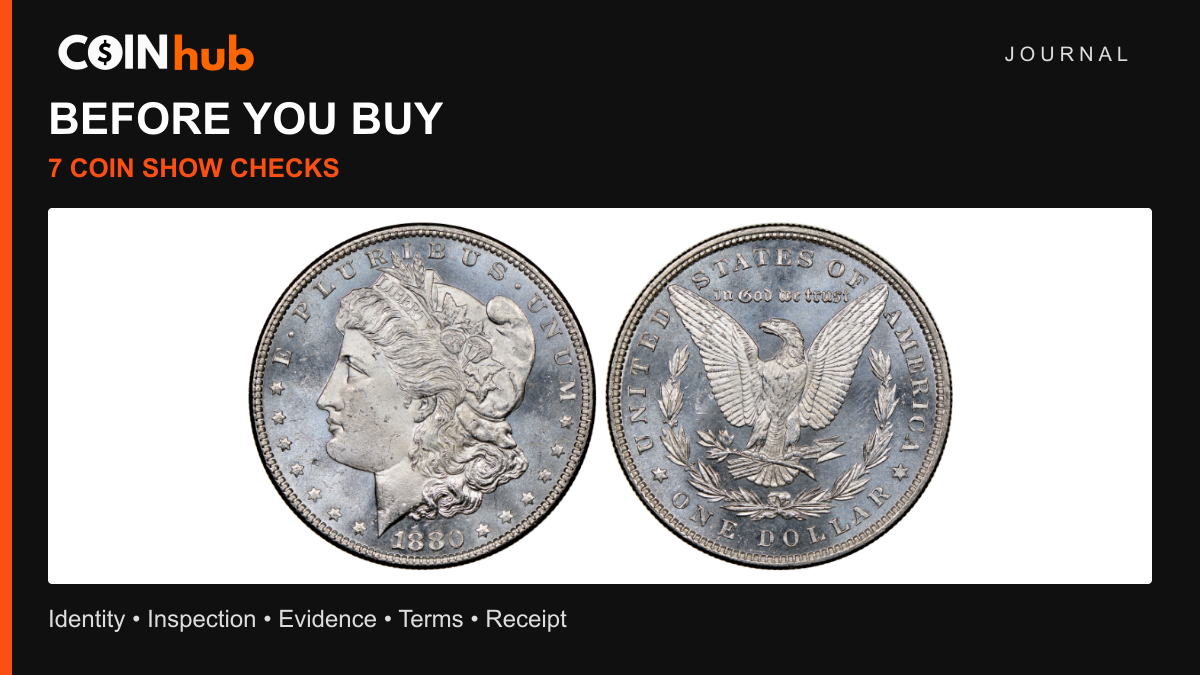
After the purchase, photograph the coin and paperwork for your own inventory. Keep personal contact details private. The real Morgan dollar in this article’s graphic is only a reference photograph, not a coin offered for sale.
A compact decision card
| Write down | Your answer |
|---|---|
| Exact coin and holder | Date, mintmark, type, variety, service and grade |
| What you inspected | Both sides; edge if visible; unresolved areas |
| Evidence | Certificate check, comparison and seller explanation |
| Deal | Total, payment method, written terms and seller contact |
| Decision | Buy, seek more information, or pass |
Is leaving without buying a wasted visit?
No. A clearer understanding of a series, a useful dealer contact or a better comparison can make the visit worthwhile. A purchase is optional; resolving an uncertainty before a future purchase can be valuable in itself.
Sources and search intent checked September 13, 2026. This is a general collector checklist. It does not state a current show schedule, coin value, dealer return policy or legal entitlement.