
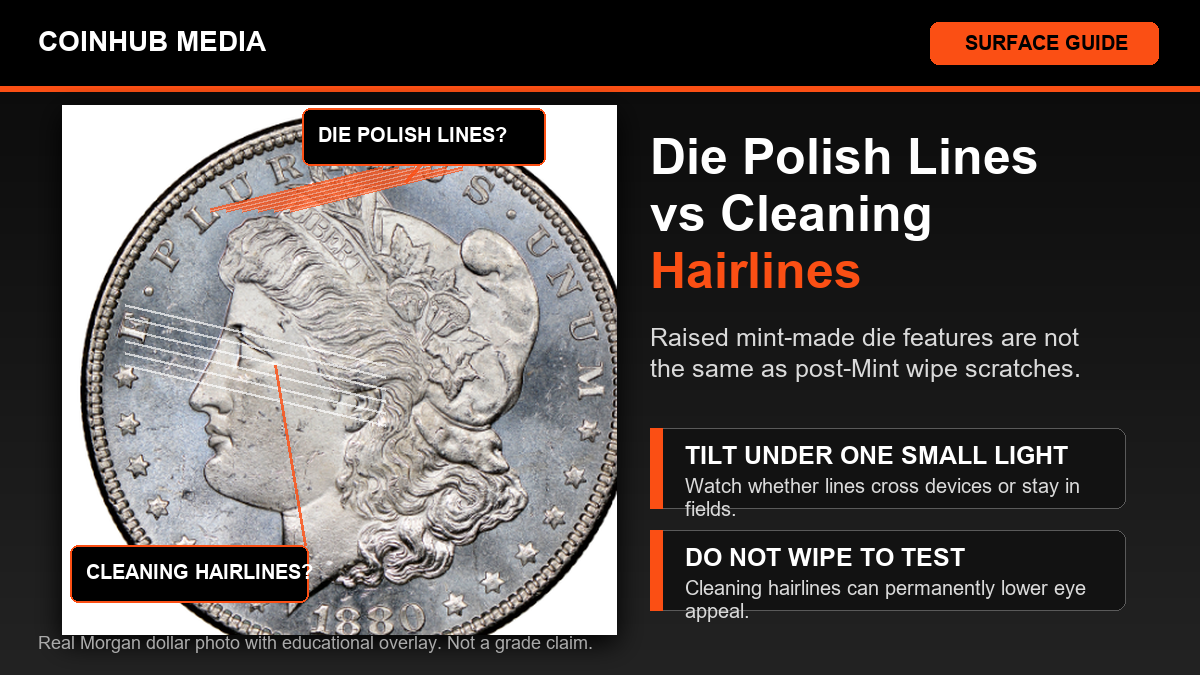
How To Tell The Difference
Quick answer: Die polish lines are usually raised lines created on the die before the coin was struck, while cleaning hairlines are usually fine scratches on the coin after it left the Mint. The fastest clue is to tilt the coin under one small light and ask whether the lines run under devices like letters and portraits, or cut across the coin's surface.Few coin-surface questions cause more confusion than thin bright lines. A collector sees parallel marks in the field and wonders: is this harmless die polish, a cleaned coin, a prooflike surface, or simple scratches?
The answer matters because die polish can be a normal mint-made feature, while cleaning hairlines can hurt eye appeal, grading results, and resale value. This guide gives you a practical inspection process before you buy, grade, photograph, or sell the coin.
What Are Die Polish Lines?
Die polish lines come from work done to the coin die, not from a collector rubbing the finished coin. Mint workers may polish a die to remove clash marks, rust, roughness, or other defects. When that polished die strikes a planchet, fine raised lines from the die can appear on the finished coin.
PCGS has described die polish as a real diagnostic on some special-strike coins, including distinctive swirling die polish in the fields of known 1964 Special Mint Set Kennedy half dollars. The point is not that every polished-looking coin is special. The point is that die polish can be mint-made and repeatable, especially when the same die feature appears on multiple examples.
What Are Cleaning Hairlines?
Cleaning hairlines are usually fine scratches caused after the coin was struck. They can come from wiping, polishing, jewelry cloths, abrasive dips, paper towels, old album slides, or any handling that drags grit across the surface. Under a light, they often flash as thin bright lines.
PCGS and NGC both warn that cleaned or otherwise problem surfaces can prevent normal numeric grading. NGC details grading specifically includes coins with surface problems such as improper cleaning and scratches, while PCGS discusses cleaning and other surface problems in its no-grade/details discussions.
Fast Comparison: Die Polish or Cleaning?
| Clue | Die polish lines | Cleaning hairlines |
|---|---|---|
| Raised or incuse? | Often raised because the line came from the die. | Often incuse because the finished coin was scratched. |
| Where they appear | Usually strongest in fields and may stop at design elements. | Can cross fields, devices, portraits, lettering, and high points. |
| Direction | May follow a die-polish pattern, sometimes swirling or localized. | Often runs in many parallel wipes or random contact directions. |
| Luster behavior | May sit within otherwise natural cartwheel luster. | Can break luster or create a washed, unnatural brightness. |
| Repeatability | May match other coins struck from the same die. | Unique to that coin's later handling. |
The One-Light Tilt Test
Do Die Polish Lines Hurt Value?
It depends on the coin. Light die polish on a common Morgan dollar may be normal and not especially valuable. On some varieties, Proofs, specimen coins, or early die states, die polishing can be part of the story. Heavy die polish can still affect eye appeal if it distracts from the coin.
Cleaning hairlines are different. They can reduce collector demand, make a coin harder to sell, and lead to a details-grade outcome. A rare coin can still have value with hairlines, but the market usually treats a problem-free example more favorably.
Common Mistakes Collectors Make
When Should You Get a Second Opinion?
Get a second opinion if the coin is a key date, a Proof, a high-grade silver dollar, an expensive type coin, or a coin you are thinking about sending to PCGS or NGC. Photos alone can be misleading because lighting can exaggerate or hide both die polish and hairlines.
If you are sorting an estate, separate coins with suspicious wipe marks from coins with normal-looking luster. You do not have to solve every surface question immediately; you just need to avoid cleaning them, avoid overpaying, and keep the best candidates protected.
FAQ
Are die polish lines considered an error?
Usually no. Die polish lines are normally treated as a die-state or mint-made surface feature, not a dramatic mint error. They may still help identify a die or explain a coin's look.
Can a cleaned coin still grade?
Sometimes it can be authenticated and receive a details grade, but obvious cleaning can prevent a normal numeric grade. The result depends on the coin, the severity, and the grading service's review.
Can I remove cleaning hairlines?
No safe home method can put original metal and luster back. Trying to remove hairlines usually risks adding more damage.
Are die polish lines common on Morgan dollars?
They can be seen on Morgan dollars and many other coin types. The key is not the series alone; it is whether the lines behave like mint-made die features or post-Mint scratches.