
The space below the main design
An exergue is the space below a coin's main design, often set apart by a line. It can hold a date, letters or other marks. The word tells you where to look. It does not, by itself, tell you what the marks mean.
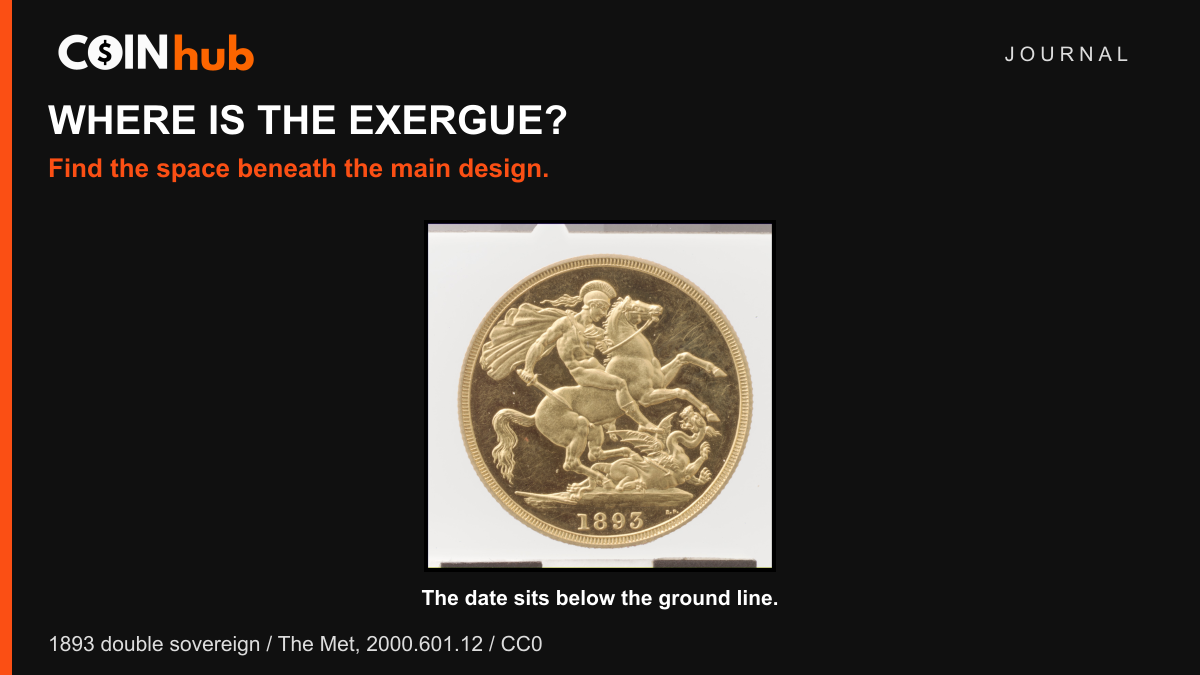
On the 1893 British double sovereign pictured here, look below Saint George and the dragon. A strip of ground runs beneath the scene. The date sits in the space below it. That lower space is the exergue.
A useful distinction: “Date in exergue” tells you both the kind of detail and its location. “Exergue” alone names the space, not a type of date or a mintmark.
Find the boundary before reading the letters
The Royal Mint's glossary describes an exergue as a segment set apart by a line, usually one that represents the ground. The Perth Mint's glossary points to sovereigns as an example of a date in that space.
Start with the whole coin face rather than a tight crop of one letter. Turn the image until the main scene is upright. Then find its lower boundary and look beneath it. This keeps “below the design” from becoming “whatever happens to be at the bottom of my photo.”
A worn or poorly lit image may hide the boundary. In that case, compare a clear reference photo of the same coin type. Do not draw a line through the design in your mind just to give every low-placed mark an exergue.
Read the museum example in three parts
The Metropolitan Museum of Art identifies this coin as an 1893 Queen Victoria proof double sovereign, object 2000.601.12. It credits Benedetto Pistrucci with the reverse, or back, design. The photograph gives us a specific example to read without making a claim about another coin.
- Find the scene. The horse, rider and dragon fill most of the reverse. They help you orient the image.
- Find the ground. Beneath the scene is the raised strip that forms its base. Follow its lower edge toward the date.
- Read the separate space. The digits 1893 sit below that base. Record the date and its location as separate observations.
A useful photo note would be: “Reverse: 1893 below the ground line, in the exergue.” That is more precise than “numbers at the bottom.” It also gives another reader a feature they can find in the full image.
This exercise does not date an unknown coin from its style, assign a grade or authenticate a specimen. It describes the museum coin shown. A similar scene on a different issue still needs its own reference.
Keep the space separate from nearby terms
The field is the background around the design and lettering. The rim is the raised border around a coin face; the edge is the narrow third side. An exergue is a more specific location within a face. These terms help you point to different places, even when all appear in one photograph.
A mintmark has a different job: it identifies a place of manufacture. Its meaning depends on the coin and issuing authority. A mark does not become a mintmark simply because it sits in the exergue. Likewise, a date elsewhere on a coin remains a date.
For the wider vocabulary, NGC's guide to the parts of a coin distinguishes the fields, rim, edge, lettering and mintmarks. Use a coin-specific reference when you move from locating a mark to decoding it.
Make a note you can check later
When reading an auction or museum entry, pair its words with the full photo. Save the source link and copy only the letters you can actually see. If one character is unclear, say so. A question mark in your private notes is better than a confident but guessed mint attribution.
The practical habit is simple: locate first, transcribe second, interpret with a reference third. That order turns an unfamiliar word into a useful way to describe a coin, without asking the word to prove more than it can.