
Separate the timing claim from the coin’s grade
The easiest way to misread a modern coin holder is to combine several different statements into one. The issue name identifies the coin. The numerical grade reports a grading assessment. A release designation concerns a defined timing program. Attractive label artwork does not make these three statements interchangeable.
What PCGS First Strike requires
PCGS’s current First Strike policy describes coins issued within the first 30 days of a mint’s release, with specified exceptions. Its two published routes are worth reading carefully: the package sent to PCGS can be postmarked on or before the issue’s cutoff, or the coins can be submitted in their original unopened U.S. Mint shipping box bearing a postmark before the specified cutoff.
Those rules do not say every eligible coin must finish grading within 30 days. They also do not support opening an old box and assuming its original shipping date will still establish eligibility. World-coin submissions require additional release and purchase documentation under PCGS’s policy.
What NGC Early Releases means
NGC defines Early Releases and First Releases equivalently for eligible coins received by NGC or an approved depository during the initial 30-day release period. The two phrases do not establish two different levels of quality. They should also be kept separate from NGC designations that explicitly concern documented production events.
The NGC FAQ says ordinary eligible submissions must arrive by its posted cutoff. Original packaging is generally unnecessary, but particular sets and later packaging releases can have additional requirements. Eligibility is issue-specific, and some options are limited to bulk submissions.
| Question | PCGS First Strike | NGC Early Releases / First Releases |
|---|---|---|
| Key deadline evidence | Published postmark or qualifying unopened-box route | Receipt under the applicable published requirements |
| Where to check eligibility | PCGS issue and cutoff list | NGC eligible-issue and cutoff lists |
| Does the wording change MS 69 into MS 70? | No | No |
| Does it alone identify press order? | No | No |
Three dates that collectors can accidentally mix up
The date on a coin is not automatically its release date, and an order date is not automatically the beginning of a designation window. NGC’s FAQ distinguishes release from sale because a mint may accept orders before making an issue available. Use the service’s published entry for the particular issue rather than adding 30 days to whichever date appears first on a receipt.
For your records, keep separate fields for the coin’s year, the documented release date and the applicable service cutoff. Add the source link and the day you checked it. That small separation prevents a collection spreadsheet from turning a remembered purchase date into an unsupported eligibility claim.
Compare two listings without letting the label do the work
Imagine two listings describe the same issue and numerical grade, but only one advertises an early-release designation. Start by confirming that they really are the same mint, finish and issue. Then compare the surfaces shown, the certification details, the seller’s terms and the total price. A timing label cannot resolve a mismatch in the underlying coin.
If the designation is part of your collecting goal, record it as a separate preference. If your goal is an example of the design, decide whether that extra label wording matters to you. Neither approach requires inventing a universal percentage premium or assuming that every future buyer will value the designation equally.
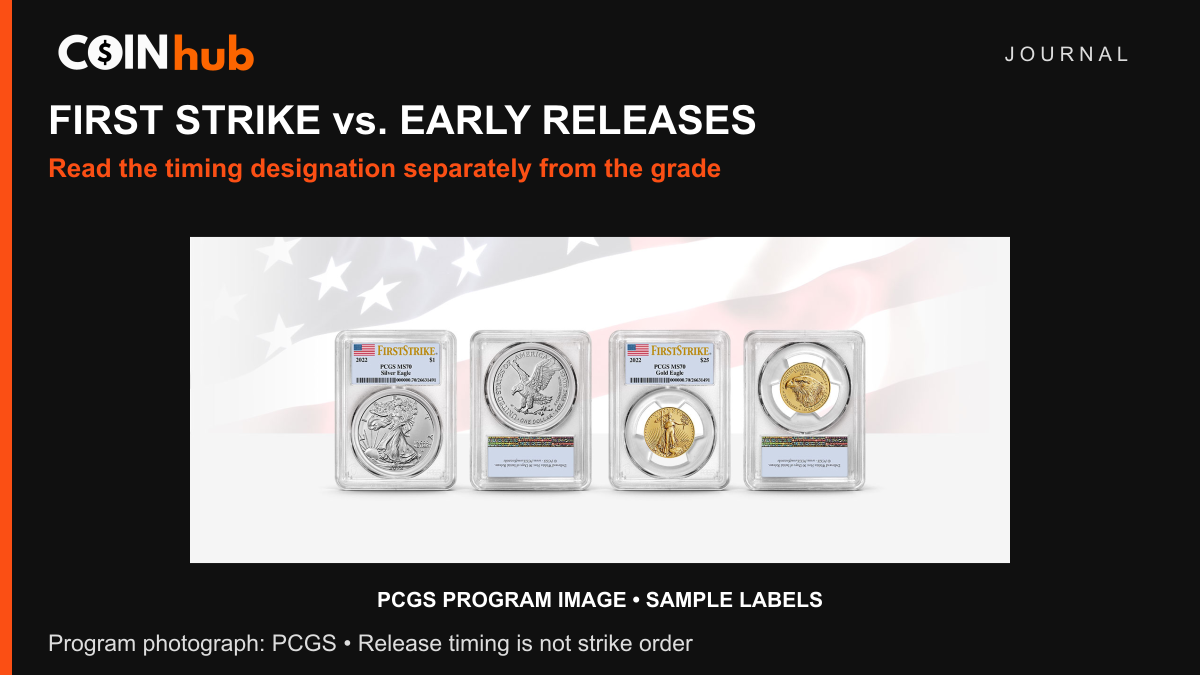
The photograph above is PCGS’s program image showing sample First Strike holders. It illustrates label wording, not the order in which those coins came off a press. For the broader task of checking a holder, use our guide to reading PCGS and NGC labels.
Before shipping coins for a designation
Find the exact issue in the service’s current list, read its submission and packaging requirements, and keep a copy for your records. If a box, set identity or deadline is uncertain, ask the service before opening packaging or paying for a submission. A general article cannot determine eligibility for an unexamined package.
For coins already certified, compare the label with the service’s verification record. Preserve the full designation text in your inventory. Keep the grading assessment, timing designation and any separate provenance claim in their own fields so that one is never mistaken for evidence of another.
Official PCGS and NGC policies checked September 21, 2026. Issue eligibility and submission rules can change; follow the service’s current instructions for a specific submission. No universal label premium or production-order guarantee is implied.