
Start with the bell—and the name on the holder
A bright photograph or an attractive portrait can distract from the small reverse detail that matters here. Turn the coin over, find the lower bell, and read the service’s own definition before making a judgment. FBL is a specific attribution, not a general synonym for a nice Franklin half dollar.
PCGS and NGC criteria side by side
| Service | Published requirement | Important boundary |
|---|---|---|
| PCGS | Full separation of the bottom bell lines, without major cuts or marks interrupting that separation | PCGS specifies MS60 or better. |
| NGC | All horizontal bell lines must be distinct | NGC says Mint State is not required; it does not apply FBL to proofs. |
These are summaries of PCGS’s published FBL criteria and NGC’s explanation. Open the original references when evaluating a submission. In particular, do not carry the PCGS minimum grade over to NGC as though both services stated the same rule.
Nor does a comparison table predict a crossover result. A service must evaluate the actual coin under its standards. A seller’s description, a third-party opinion and an attribution printed on a certified holder should be recorded as different kinds of evidence.
What our photograph shows
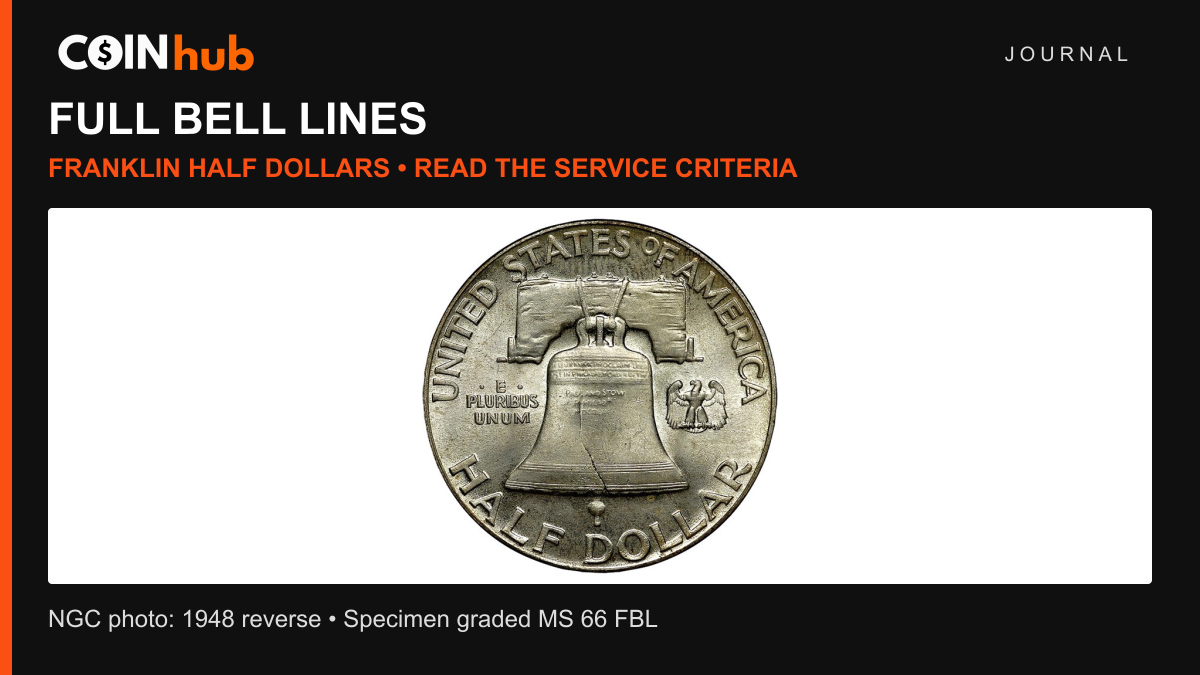
The hero uses NGC’s real reverse photograph of a 1948 half dollar graded MS 66 FBL. Follow the bell down to its flared base and locate the horizontal lines. The large diagonal crack belongs to the pictured bell design; the horizontal detail is the area under discussion.
Use the full image to orient yourself, then open NGC’s larger reference photographs. Our header scales the original image to fit the page. It cannot supply the same information as examining a coin under movable light, and the photographed specimen’s grade does not transfer to a coin that merely looks similar.
A useful inspection record
- Identify the issue. Record the date and mintmark from complete photographs, not from a loose envelope.
- Keep the whole reverse in frame. Save a full view before making a close-up of the bell. A crop alone can lose orientation and context.
- Use more than one light direction. A reflection can hide a line or make a surface mark harder to see. Keep each original photo rather than replacing it with an aggressively sharpened version.
- Separate observations from conclusions. Write “line unclear near the left end” or “mark crosses lower lines” before writing a proposed designation.
- Record the source of the attribution. If the coin is certified, copy the service, grade and designation exactly. Leave it in its holder.
A short record might read: “1948, reverse photographed under two light positions; holder says NGC MS 66 FBL; certification details saved.” For a raw coin, replace the holder entry with “uncertified; designation not established.” That difference makes your notes more useful when asking another collector for help.
Why FBL is not a complete value estimate
Before comparing sales, match the issue, service, grade and designation. Also inspect the individual coin and the terms of the sale. A price attached to another date or a much higher grade cannot tell you what your example would bring.
Our broader Franklin half dollar guide covers dates and collecting context. This page concentrates on reading FBL standards; it supplies no current price table or guaranteed premium. For safe inspection, see handling coins without fingerprints.
Can a circulated Franklin half dollar qualify?
Check the service. PCGS’s published rule requires MS60 or better. NGC explicitly says a coin need not be Mint State. That does not mean every sharply detailed circulated coin qualifies.
Does a proof automatically get an FBL label?
NGC does not use FBL for Franklin proofs. Keep a proof’s finish and grade separate from a business-strike designation when researching labels.
Should I clean the bell to see the lines?
No. Change the lighting and photograph the surface as it is. If the evidence remains unclear, seek an experienced grading opinion instead of trying to expose detail mechanically.
Primary references and Google/Bing results checked September 15, 2026. Practical recording steps are CoinHub editorial guidance; no grade is assigned to a reader’s coin.