
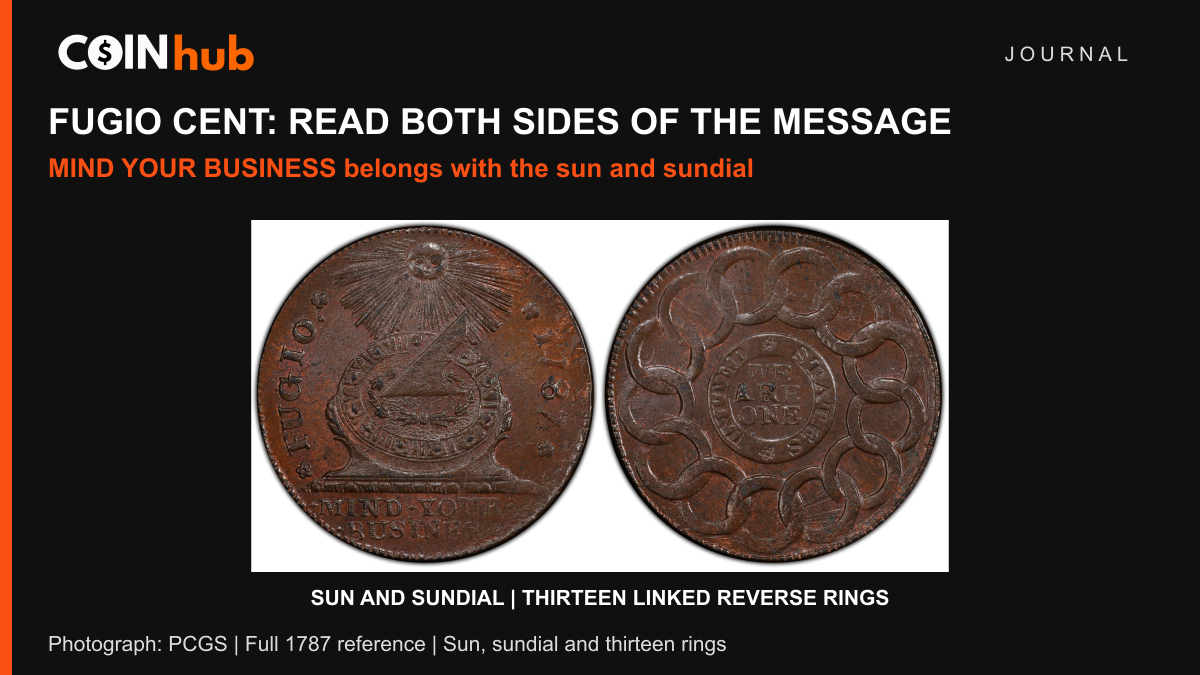
“Mind Your Business” on the 1787 Fugio cent is best read with the sun, sundial and word FUGIO above it. The Smithsonian reads the design as a call to tend to your affairs while time passes. This is a reading of the coin, not a quote from a Benjamin Franklin speech.
Turn the coin over and the message becomes collective. Thirteen linked rings surround WE ARE ONE and the national name. Reading both faces gives more context than treating one blunt-sounding phrase as the coin's entire point.
Three details belong in the same picture
The front places a sun above a sundial. FUGIO appears at the side, the date 1787 on the other side, and MIND YOUR BUSINESS below. The sundial is a tool for marking time. Its presence changes how the words can be understood.
The Smithsonian's Fugio record says Franklin inspired the design. It links the sun and dial with the passing of time. That wording does not claim that Franklin cut every detail into the dies, the steel tools used to strike coins.
In a 2011 PCGS essay, Jaime Hernandez reads the motto as a call to focus on one's work and affairs. Name the source when using that view. We can read the words on the coin. To say exactly what Franklin meant, we would need his own words about this coin.
| Visible feature | Useful context | Keep this distinction |
|---|---|---|
| Sun, sundial and FUGIO | The time-passing reading considers them together | The coin does not contain a long written explanation |
| MIND YOUR BUSINESS | Often read as attention to one's work and affairs | A modern rude-sounding reading is not the only interpretation |
| Thirteen rings and WE ARE ONE | The reverse presents linked states and unity | Read the back as well as the front |
A national copper issue before the later cent series
The Smithsonian places the Fugio issue under the Congress of the Confederation in 1787. That body came before the modern United States Congress. It chose James Jarvis to make the copper cents. Keep that setting in mind when a seller loosely calls a Fugio an early federal Mint penny.
Name the issue with care. Coins made for a colony, a state or Congress belong to different parts of the story. A claim about America's “first coin” can blur those groups. Calling this a Fugio cent gives the reader a more exact starting point.
What the complete reference photograph shows
The PCGS photo above shows both faces of one genuine catalog reference. Follow the sun's rays toward the dial and find the motto below it. On the back, trace the linked rings around the center. Read the smaller words as well as the large ones.
The matching PCGS CoinFacts entry names this reference within the Fugio series. Its photo does not show every die variety, or version made from a different set of dies. Letter positions and small details can differ across the series.
Keep worn or weak letters separate from missing inscriptions. A dark photograph can conceal a word that is present on the coin. Ask for a clear full-face view before interpreting a partial image. Do not scrape or polish the surface to reveal the motto.
A 1787 date is not enough to establish the issue
Later pieces can also carry the date 1787. PCGS separately catalogs New Haven restrikes. A restrike is a later striking associated with an earlier design. The date written on a coin and the year it was actually made are separate questions.
Record the metal, all the words, both faces and any sound provenance. Provenance means records of who owned the coin. Keep a holder label with the photos and check it with the named service. A known motto or matching date does not prove that a coin is genuine or establish its grade or value.
For a collection note, write what you can see first: sun and dial on the front, motto below, linked rings on the back. Then name the source for what the message may mean. The next reader can check the words and the historical view as two distinct parts of your note.
References: Smithsonian object nmah_1096631, Jaime Hernandez's June 2011 PCGS interpretation, and the linked PCGS original-issue and restrike records, checked October 16, 2026.
Photograph: PCGS, complete reference pair from CoinFacts entry 889, reused under CoinHub's saved permission. Original photograph resized in full with CoinHub labels and branding outside the coin. Both faces belong to the same catalog reference.