
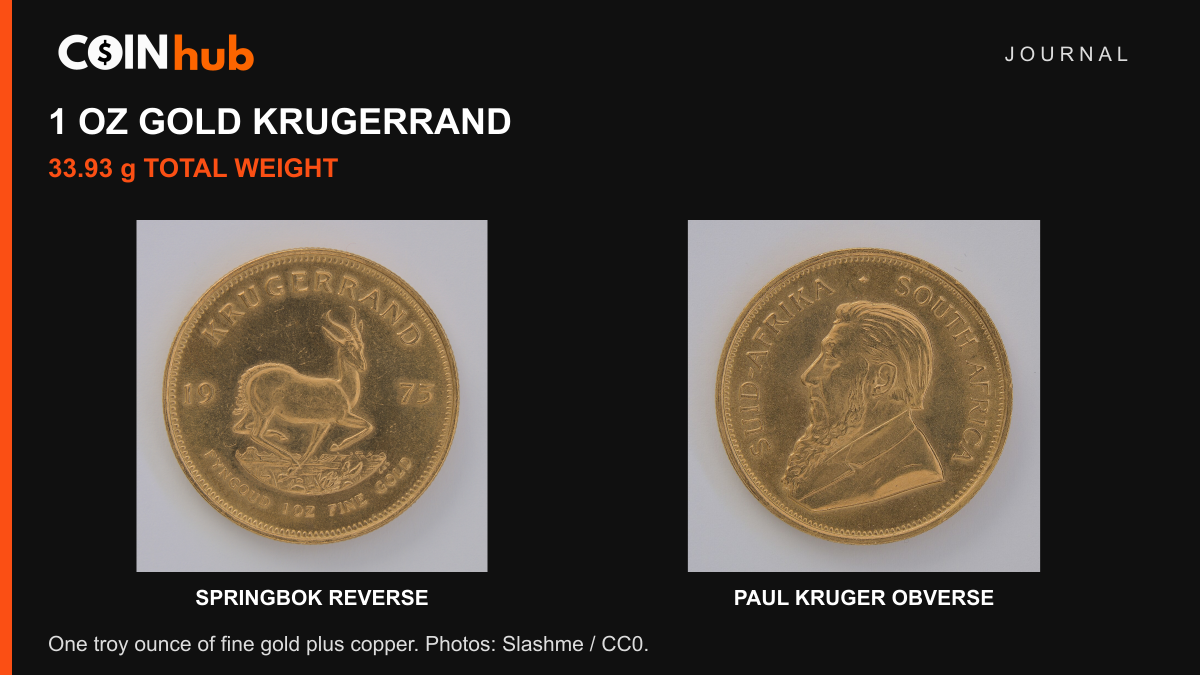
The one ounce refers to the gold inside
A standard one-ounce gold Krugerrand has a nominal total weight of 33.93 grams. It contains one troy ounce of pure gold, about 31.10 grams. Copper in the alloy adds the rest of the weight. The extra grams do not mean the coin contains extra gold.
This distinction matters when you read a scale or a metal-value calculator. Gross weight means the whole coin. Fine gold weight means only its gold content. A holder, capsule or mount adds another weight that belongs to neither figure.
The South African Mint's current range lists its one-ounce gold proof Krugerrand at 33.930 grams and describes the one-ounce coin's pure gold content. Rand Refinery identifies the gold Krugerrand as a 22-carat gold-and-copper alloy. These are specifications for the coin type, rather than a test of the example in your hand.
What 22-carat gold means
On the carat scale, pure gold is 24 carats. A 22-carat alloy is 22 parts gold out of 24 parts in total. That is about 91.67% gold by weight. Copper accounts for the remaining share in this coin.
You can check the relationship with rounded numbers: 33.93 grams multiplied by 22, then divided by 24, is about 31.10 grams of gold. The copper share is about 2.83 grams. This explains the extra mass without treating it as a bonus above the stated ounce.
Keep the two weights separate: 33.93 grams is the nominal whole-coin mass. One troy ounce is the stated fine gold content. The rounded arithmetic here does not set manufacturing tolerances or measure an individual coin's purity.
Do not subtract the alloy twice
A calculator may ask for either gross grams and purity or fine metal in troy ounces. Read its field label before entering a number. If it asks for fine gold content, the standard one-ounce coin's stated content is already one troy ounce of gold.
Multiplying that fine ounce by 91.67% again would remove gold a second time. Conversely, entering 33.93 grams as pure gold would count the copper as gold. Those mistakes push the estimate in opposite directions.
| Input requested | What belongs there | Common mistake |
|---|---|---|
| Whole-coin mass in grams | The gross coin weight, with its alloy identified | Including a capsule or mount |
| Fine gold content in troy ounces | One for the standard one-ounce gold issue | Applying the 22-carat fraction again |
| Observed sale or asking price | A dated price for the actual product and condition | Treating a metal estimate as a dealer offer |
The CoinHub Bullion Premium Tracker lets you enter metal content and compare a spot reference with an observed price. Confirm its inputs yourself. Its starting prices and product rows are examples, and the tool does not supply a guaranteed Krugerrand offer.
Read the coin before using the number
Our real 1975 reference photograph shows FYNGOUD 1 OZ FINE GOLD beneath the springbok. The portrait side shows Paul Kruger. Keep the whole design, date and weight wording in view when you record a coin.
Smaller gold Krugerrands and silver Krugerrands have separate specifications. Do not apply this full-size gold figure to one of them just because the portrait looks familiar. The Mint's current range lists those products separately.
A scale reading is one observation
Weigh a loose coin only when you can handle it without damage. Do not open a sealed grading holder just to obtain a reading. Record the scale unit and whether packaging was included. A result near the nominal mass does not prove that a coin is genuine or contains the stated gold.
If the readings or design do not agree with the correct issue, leave the identity unresolved and seek a competent examination. Do not file an edge or scrape a surface to test it. Keep identification, fine gold content and a possible sale price as three separate entries in your notes.
Specifications checked October 18, 2026. Reference photographs: Slashme / Wikimedia Commons, CC0; complete 1975 coin photos resized, coin details unchanged. The source filenames reverse the side names; the portrait and springbok shown here determine the labels.