
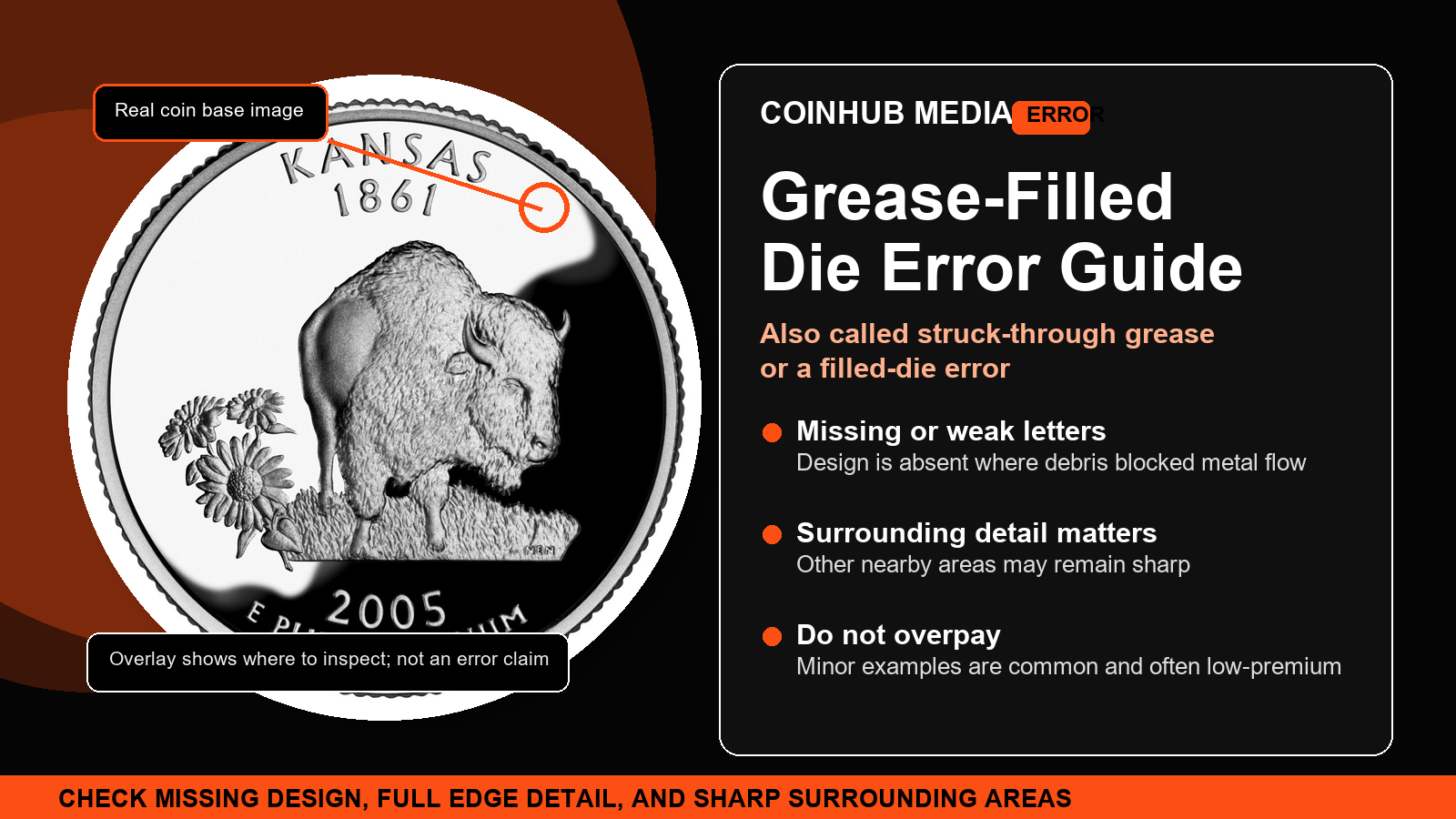
How To Spot a Possible Filled-Die Error
A grease-filled die error, often called a struck-through grease error or filled-die error, happens when grease, oil, dirt, or compacted debris blocks part of a coin die during striking. The result can be weak, blurry, or missing design details while nearby parts of the coin still look sharp.
A real grease-filled die error usually shows missing or weak design where foreign material blocked metal flow into the die. It should not look like normal wear across the whole coin, a scratch, a gouge, or a flattened coin from circulation damage.
Minor grease-filled die errors are common and often bring little or no premium. Dramatic examples, retained struck-through material, or errors that remove a major design area can be more collectible, but authentication and eye appeal matter.
What Is a Grease-Filled Die Error?
During the strike, the coin blank is pressed between dies that contain the recessed design. If those recessed areas are clogged by grease, oil, dirt, or other debris, metal cannot fully flow into the blocked part of the die. That is why letters, numbers, dates, mint marks, or design details may appear weak, mushy, or missing.
Collectors use several overlapping names for this family of errors: grease-filled die, filled die, struck-through grease, struck thru grease, and missing design element. The exact label depends on what happened and how the coin looks, but the collector question is usually practical: did this happen during the strike, or did the coin get worn or damaged later?
Start with these checks:
- Look for localized weakness: the affected area may be weak or missing while nearby letters and devices remain sharp.
- Check whether the surface is sunken or flat: struck-through grease usually prevents part of the design from forming; it does not normally create a raised blob by itself.
- Compare both sides: a grease strike-through can affect one side only. A die adjustment or very weak strike often affects both sides more broadly.
- Inspect the edge: on reeded coins, a full edge can help separate a struck-through grease look from some low-pressure striking issues.
- Watch the surrounding detail: if the whole coin is slick, dark, bent, scratched, or evenly worn, the missing design may be circulation damage instead of a mint error.
CoinHub tip: missing letters are not automatically valuable. Some online listings turn tiny filled-die quirks into big claims. Before buying or sending a coin for grading, make sure the missing design is dramatic enough to matter and not just a minor quality-control issue.
Grease-Filled Die vs Damage, Wear, and Weak Strike
| What You See | More Like a Grease-Filled Die | More Like Something Else |
|---|---|---|
| Missing letters or date detail | Specific letters, numbers, or design areas are weak while nearby detail remains sharp | Entire area is worn smooth, scratched away, polished, or scraped |
| One side versus both sides | Can affect only the obverse or only the reverse | Broad weakness on both sides may point to weak strike, die adjustment, or planchet issues |
| Surface texture | Weak, flat, blurry, or absent design where metal did not fill the die | Raised bumps, cuts, gouges, corrosion, or fresh exposed metal suggest damage or another die problem |
| Edge detail on quarters/dimes | Reeding may remain full even though part of the design is weak | Weak or missing edge detail can suggest a different strike problem |
| Value potential | Better when the missing area is large, obvious, unusual, or retained | Minor one-letter weakness, common pocket change, and hype listings usually need caution |
Why "IN COD WE TRUST" Coins Get Attention
One reason grease-filled die errors get attention is that missing letters can change the way a motto or inscription reads. State quarters, America the Beautiful quarters, American Women quarters, cents, nickels, and other circulating coins can all show weak or missing letters when die fill blocks part of the design.
The best-known chatter often involves missing parts of "IN GOD WE TRUST," but the nickname is less important than the diagnostics. Check whether the missing letters are actually caused by blocked die detail, whether the surrounding letters remain strong, and whether comparable examples have real collector demand.
Are Grease-Filled Die Errors Valuable?
Most small grease-filled die errors are common. A single weak letter on a circulated coin may be interesting, but it may not be worth the grading fee. A larger struck-through area, a clear retained object, a dramatic missing motto, or a sharp uncirculated example can draw more attention from error collectors.
PCGS describes struck-through errors as a broad and common mint-error category, with retained struck-through pieces usually scarcer than ordinary non-retained strike-throughs. NGC also notes that minor struck-through examples on circulating coins are common enough that not every tiny obstruction receives major-error treatment. That is why CoinHub recommends careful diagnosis before relying on an online asking price.
How To Photograph One for an Opinion
- Take a straight-on photo of the obverse and reverse.
- Take a close-up of the missing or weak design.
- Take a second close-up of the same area under angled light.
- Photograph the edge if the coin has reeding or if strike pressure is part of the question.
- Compare it with a normal coin of the same denomination and type when possible.
If you want to compare other error types, use CoinHub's quarter error guide, penny error list, nickel error list, dime error guide, and error or damage checker. Those pages help separate mint-made errors from ordinary post-mint damage.
Grease-Filled Die Error FAQ
Is a grease-filled die error the same as a struck-through error?
It is part of the struck-through family. The coin is struck while grease or similar material blocks part of the die or interferes between the die and planchet.
Does a grease-filled die error make a coin rare?
Not automatically. Minor filled-die errors are common. A coin becomes more interesting when the missing design is large, obvious, unusual, high-grade, or tied to a collectible variety.
Can a weakly struck coin look like a grease-filled die error?
Yes. That is why collectors check both sides, the edge, and the surrounding design. A grease-filled die often creates localized missing detail, while weak strike or die adjustment issues can affect the coin more broadly.
Should I submit a suspected grease-filled die error for grading?
Only when the coin is dramatic enough, valuable enough, or uncertain enough to justify the cost. Many small filled-die examples are worth less than the cost of certification.
Bottom Line
A grease-filled die error should show a minting problem, not just a worn or damaged coin. Look for localized missing design, sharp surrounding detail, useful edge clues, and realistic value expectations before treating a weak letter or missing motto as a major find.