
Make the measurement useful before interpreting it
The most useful result is a small evidence record: what you weighed, which units you used, the readings you obtained and the reference you compared them with. “It weighs right” leaves out almost everything another collector needs to assess your conclusion.
Start with the right specification
Read the date, denomination and mintmark, then establish the particular issue and composition. Save the reference URL or catalog citation. The U.S. Mint’s circulating coin specifications are a useful starting point for the issues they cover; a current table is not automatically a reference for an older silver, copper or special collector issue.
Keep the standard weight separate from any documented manufacturing tolerance. Do not invent a universal acceptable percentage for every coin. Wear, damage, the intended issue and measurement uncertainty all need context. If the applicable tolerance is unknown, write “not established” in the record instead of silently treating the nominal weight as an exact pass/fail boundary.
Set up the scale
American Weigh Scales identifies 0.01-gram readability as a practical general-purpose option for many collectors. Readability is the display increment; it is not a guarantee of accuracy to that digit. Check capacity and the manufacturer’s stated performance, too.
- Use a stable surface, away from drafts and vibration.
- Follow the instrument’s setup and calibration instructions, using the specified reference mass rather than another coin.
- Select grams and confirm a stable zero.
- If a protective tray is needed, tare the empty tray before adding the coin. The total physical load still counts toward capacity.
- Take multiple readings, removing and replacing the coin gently between them. Recheck zero and retain the readings.
Handle the coin by its edge over a safe surface. Do not remove a coin from a certified holder just to weigh it. A holder-plus-coin reading includes the holder; subtracting the weight of a different holder does not reliably isolate the coin’s mass. When direct measurement is unsuitable, record that limit and seek another form of examination.
Use this measurement record
| Field | What to save |
|---|---|
| Coin identification | Date, denomination, mintmark, issue and full-face photographs |
| Reference | Published standard, units, source and any documented tolerance |
| Instrument | Scale model, readability and calibration/check details |
| Object on platform | Bare coin, or exact holder/tray arrangement and tare procedure |
| Readings | Each stable result, with units; note drift or inconsistent results |
| Conclusion | Consistent, inconsistent or inconclusive—not “authenticated by weight” |
For example, if your repeated readings disagree visibly, the next step is to resolve the measurement setup. Choosing only the reading nearest the expected value hides information. If readings are stable but the reference is for the wrong issue, repeat the comparison with the correct reference before drawing a conclusion.
Two cases show the limits
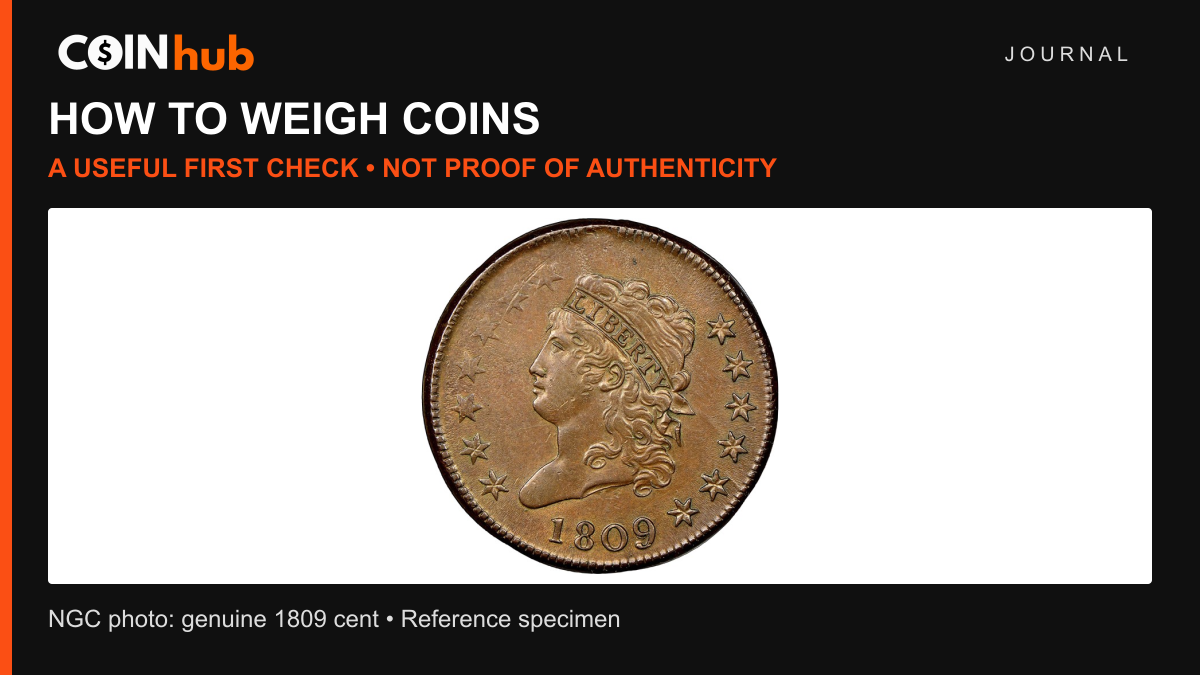
In NGC’s 1809 cent case study, a counterfeit weighed 12.72 grams against an expected 10.9 grams. Composition and surface evidence supported the finding. Our hero shows the separately identified genuine comparison coin, not that overweight counterfeit.
By contrast, NGC’s 2012 five-ounce silver Panda case explains how a counterfeit can match weight and diameter while having a thicker edge and the wrong composition. A good-looking scale result cannot rule out that kind of problem.
Decide what needs checking next
Keep the weight record with clear photographs of both faces and the edge. If the reading conflicts with a well-established specification, first verify units, zero, the object weighed and the issue identification. If the conflict remains, obtain a qualified examination rather than cleaning, scraping or otherwise altering the coin.
A consistent reading is a reason to continue the evidence-based inspection, not a certificate of authenticity. For careful handling during that work, see how to handle coins without fingerprints.
Can a kitchen scale do this?
Check its display increment and stated performance. A scale that rounds to whole grams cannot show small differences that a suitable finer instrument may reveal.
Does the wrong weight prove a mint error?
No. Measurement problems, an incorrectly identified issue, damage and counterfeit possibilities must be considered. Weight alone does not name the cause.
Research refreshed September 15, 2026 for the original August 12 reservation. Practical measurement record is CoinHub editorial guidance. No value, grade or authenticity determination is assigned to a reader’s coin.