
A coin turned into a personal keepsake
A love token coin is a coin changed into a personal keepsake, often by smoothing one face and engraving a name, initials or a picture. The engraving was added after the coin was made. It is not a mint error, and the coin's date does not prove when the message was cut.
These small objects can carry a family connection even when their original owner is unknown. The best way to read one is to separate what the coin shows from the story you hope it tells.
Keep two records: Describe the original coin in one field and the later engraving in another. Add names, dates and family history only when you can state where that information came from.
Why collectors call them love tokens
The Bank of Canada Museum's account of love tokens describes coins made into gifts for loved ones. The name covers more than romance. Such keepsakes could mark a birth, a marriage or another personal event.
PCGS's overview places their American popularity from the Civil War era into the late nineteenth century. Seated Liberty dimes were a common choice, but engravers used other coins too. Some tokens became jewelry, so a hole, loop or pin fitting may be part of the object's later history.
That history does not turn every altered coin into a love token. A random scratch, a test mark and a planned engraved design are different observations. Describe the marks first; use a more specific name when the evidence supports it.
Read the pictured engraving without forcing a name
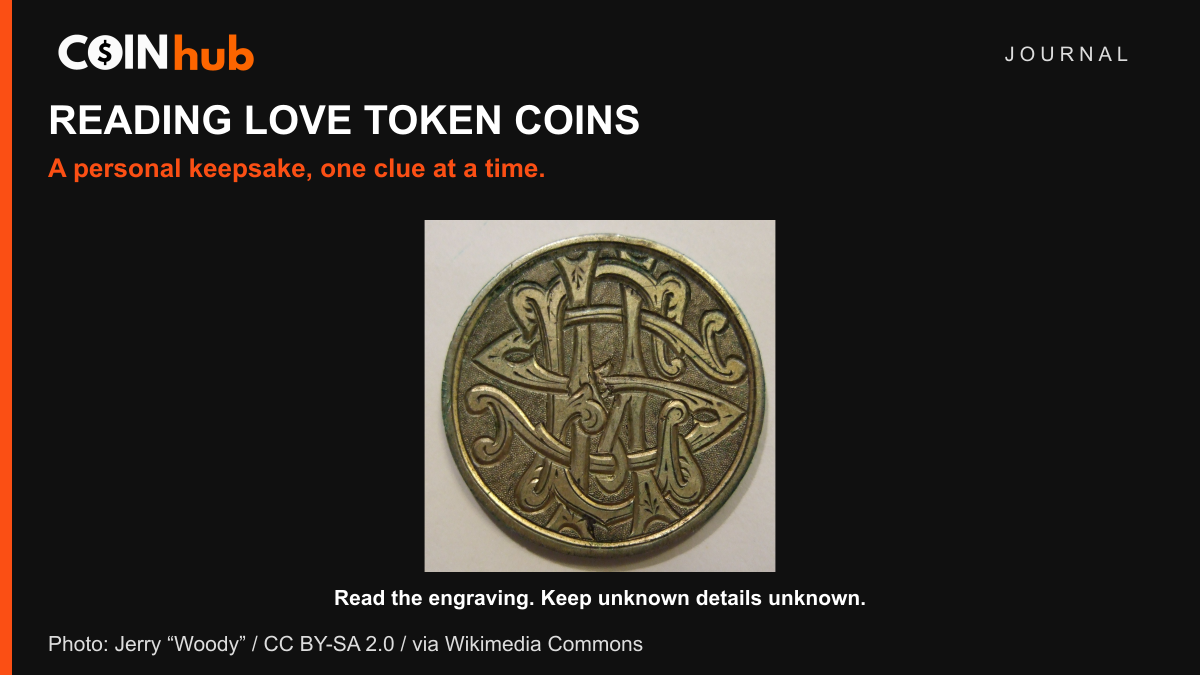
The photograph above shows a design cut into one face of a coin. Large letter forms cross one another, with curved flourishes around them. This joined-letter design is called a monogram. Its decoration can make the order of the letters hard to judge.
The photographer's record identifies the host coin as an 1841 thaler. “Host coin” means the coin used as the base for the later work. The record suggests a later nineteenth-century engraving, but it does not establish an exact engraving date or name the recipient.

For this view, a careful note might read: “Ornate overlapping letters; exact reading uncertain. Source identifies an 1841 host coin. Recipient unknown.” That leaves room for later research. It is more useful than turning a possible letter into a confident family name.
Do not use the photo's color alone to identify the metal. Lighting, surfaces and the camera can affect color. Likewise, this single face does not show every clue on the other side or edge.
The original coin date is only one part of the story
A coin could be engraved soon after it was made or much later. Write “coin dated 1841” when that is what your evidence establishes. Do not shorten it to “gift made in 1841” unless a separate source supports that claim.
A clear message can be easier to record than a monogram. The Smithsonian lists an 1876 U.S. quarter love token with a Bible and the word MAMA engraved on its reverse. The inscription tells us something about the design. It does not, by itself, identify the mother or the person who gave it.
Even a family story deserves its own source note. Record who told you the story and when. Keep an old envelope or handwritten label with the object, but distinguish its wording from facts verified elsewhere.
Make a record someone else can check
- Photograph both faces and the edge. Include the whole object and any attached fittings. Keep the original images as well as close-ups.
- Record the surviving coin details. Note the date, country and denomination when readable. Leave missing details unknown rather than filling them from a similar listing.
- Transcribe the added design. Separate clear letters from possible letters. Describe symbols and the layout without inventing their meaning.
- Save the ownership evidence. Keep receipts, labels and family notes. An old-looking object and a documented family link are separate findings.
If you cannot read the letters, try viewing a clear photograph at several orientations. Compare complete strokes rather than one flourish. Ask a second reader to write down an independent reading before showing them your guess.
Collect the engraving on its own terms
PCGS notes that the quality of the engraving and the type of host coin can affect collector interest. That is a different question from the value of an untouched example of the same date. An attractive design is not proof of a rare coin, a famous owner or a particular sale price.
Keep the coin as found while you document it. Avoid polishing the surface or removing a fitting just to make the original design easier to see. CoinHub's coin-handling guide covers basic handling precautions.
A love token can be interesting without a solved identity. A readable design, a careful record and an honest “unknown” preserve more of its story than a confident guess.