
Milk Spots on Silver Coins: What Collectors Should Know
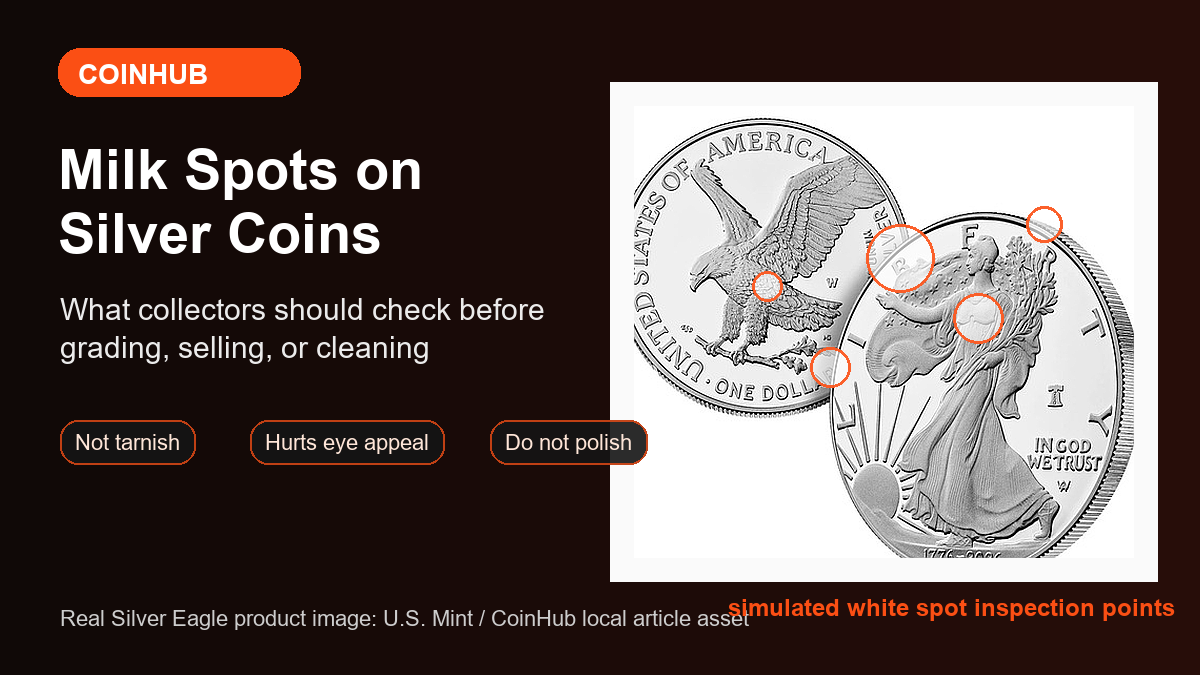
Quick answer: Milk spots are cloudy white marks that can appear on modern silver coins, especially bullion coins such as Silver Eagles, Silver Maples, and silver rounds. They do not remove the silver content, but they can hurt eye appeal, resale premium, and sometimes the grade. Do not polish or scrub them off.
Milk spots are frustrating because they can show up after a coin already looked clean. A Silver Eagle, Maple Leaf, Panda, or modern commemorative may leave the mint, dealer, or original tube looking brilliant, then develop cloudy white patches later. That is why collectors talk about milk spots differently from ordinary toning, fingerprints, haze, or dirt.
The practical question is not just "what caused this?" It is "what should I do before I grade, sell, or store the coin?" This CoinHub guide focuses on that decision.
What Do Milk Spots Look Like?
Milk spots usually look like chalky, cloudy, pale-white patches on the coin surface. They can be tiny dots, hazy smears, or larger cloudy areas. Under a single light, they often look different from natural silver toning because they sit as dull white interruptions rather than rainbow color, gray patina, or normal contact marks.
Milk Spots vs. Tarnish, Haze, and Fingerprints
| Surface issue | How it usually appears | Collector response |
|---|---|---|
| Milk spots | Cloudy white patches or dots, common on some modern silver bullion coins. | Do not scrub. Decide whether the coin is bullion, collectible, or grading-worthy. |
| Toning | Gray, gold, blue, purple, or rainbow surface color from chemical reaction over time. | Some toning is attractive; ugly or artificial toning can hurt value. |
| Haze | Foggy film across proof or modern surfaces. | May be a conservation question, but amateur wiping can permanently damage the coin. |
| Fingerprint | Partial ridge pattern or dull print, often from bare-hand handling. | Often hurts eye appeal, especially on proof and high-grade coins. |
Do Milk Spots Lower Value?
They can. The silver weight does not disappear, so the coin's melt value or bullion floor is still tied to metal content. The collector premium is where milk spots matter. A spotted modern silver coin can sell for less than a clean example of the same date, mint, finish, and grade level because buyers pay for eye appeal.
For ordinary bullion, the discount may be modest if the buyer is mainly paying for silver. For proof Silver Eagles, certified 70 coins, low-mintage modern silver issues, or coins marketed heavily on flawless surfaces, spotting can matter much more.
CoinHub grading decision
Before paying grading fees, ask whether the coin needs a high numerical grade to justify the cost. If the answer is yes and milk spots are obvious, the coin may be a poor grading candidate unless it has rarity, a special label market, or another reason collectors will still compete for it.
Can Milk Spots Appear After Grading?
Yes. That is one reason collectors get confused when a coin in a holder develops spots. PCGS has publicly discussed modern silver coins that were spot-free when graded but later developed spots. NGC also notes that white milk spots can negatively affect grade, while spots that develop after encapsulation are not treated as something the grading service can control.
That does not mean every spotted slab is worthless. It means the slab grade, market premium, and current eye appeal all need to be considered together. A buyer looking at the coin today will usually care about what the coin looks like now, not only what it looked like on the day it was certified.
Should You Try To Remove Milk Spots?
Do not polish, scrub, dip aggressively, or use household cleaners on a spotted silver coin. Even if the white mark seems to fade, hairlines, dull patches, residue, or stripped surfaces can do more damage than the original spot. On collectible coins, cleaning is often worse than the problem the owner was trying to fix.
If the coin has enough value to justify professional help, consider asking a reputable dealer or a professional conservation service before doing anything. If it is a common bullion coin, the safest answer is usually to leave it alone, store it properly, and price it honestly when selling.
How To Store Silver Coins To Reduce Risk
- Use inert holders: choose quality capsules, tubes, or non-PVC flips instead of soft plastics that can leave residue.
- Limit handling: hold coins by the edge and avoid touching proof or mirrorlike surfaces.
- Control humidity: store silver in a dry, stable environment away from heat swings.
- Separate premium coins: keep proof, burnished, reverse proof, and high-grade candidates in better protection than bulk bullion.
- Photograph important coins: if a valuable modern silver coin is clean today, photos can help document its condition over time.
What About Silver Maple Leafs and MintShield?
The Royal Canadian Mint introduced MintShield technology to reduce the appearance of white spots on Silver Maple Leaf bullion coins. The Mint describes it as invisible to the eye and says it does not change the coin's purity or composition. That is useful context for collectors comparing modern silver bullion products, but it should not be treated as a guarantee that every silver coin from every mint will stay spot-free forever.
When To Worry and When To Move On
Worry more when the coin is a proof, a high-grade certified piece, a special modern issue, a coin you planned to submit for grading, or an item whose value depends heavily on flawless eye appeal. Worry less when the coin is ordinary bullion bought close to melt value and the buyer is mainly paying for silver weight.
If you are sorting inherited silver, modern bullion, or a mixed collection, separate spotted pieces from cleaner premium pieces. Then compare the coin's metal value with its collector premium. CoinHub's silver melt calculator can help with the bullion floor, while the coin grading break-even calculator can help decide whether certification makes sense.
Sources and Research Notes
Research for this guide checked current search results and grading-service guidance, including PCGS eye appeal guidance, PCGS modern silver spot policy, NGC Conservation notes, NGC white spots on modern silver coins, and the Royal Canadian Mint's MintShield information. Competitor pages tend to explain what milk spots are; this CoinHub article adds a collector triage workflow for grading, selling, and safe storage.
FAQ
Are milk spots on silver coins the same as tarnish?
No. Tarnish is usually surface toning or oxidation color. Milk spots are cloudy white marks often associated with modern silver bullion surfaces and can behave differently from normal toning.
Do milk spots reduce the amount of silver in a coin?
No. Milk spots do not remove the coin's silver content. They can still reduce collector premium because they hurt eye appeal.
Can a graded 70 silver coin develop milk spots later?
Yes, it can happen. A slab protects the coin from many handling risks, but modern silver spotting can still appear after certification.
Should I clean milk spots off a Silver Eagle?
No. Cleaning or polishing can leave permanent surface damage. For a valuable coin, ask a reputable dealer or professional conservation service before doing anything.