
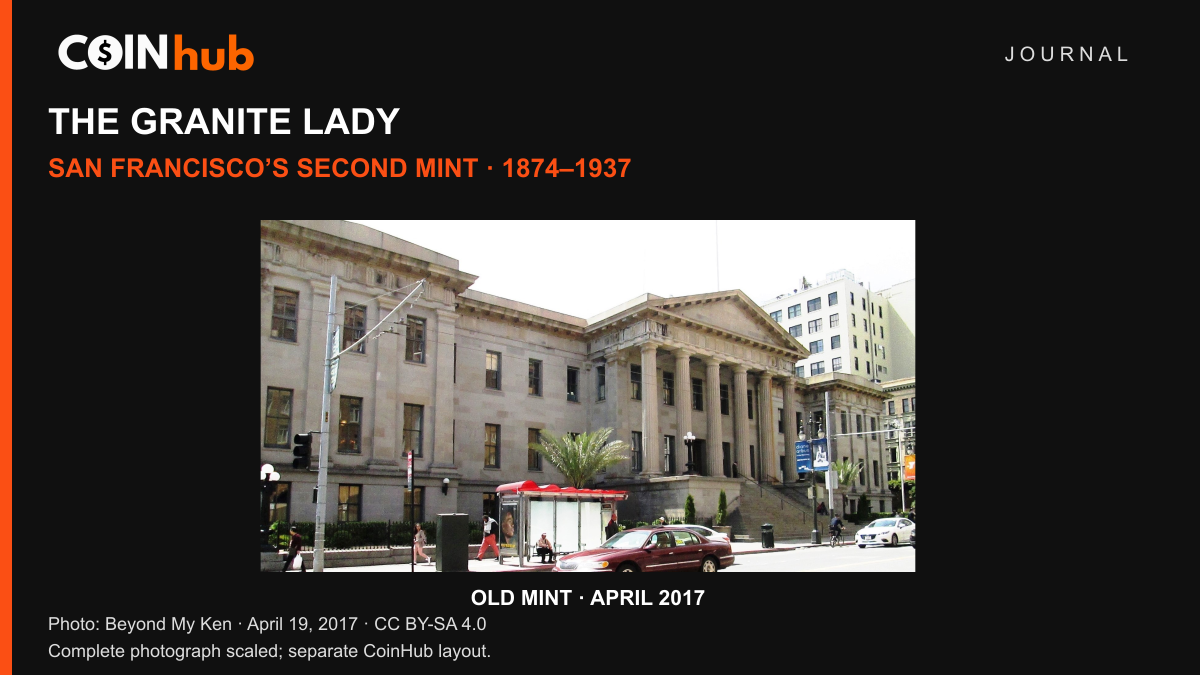
The Old San Francisco Mint, known as the Granite Lady, was the city's second Mint building. In a November 5 anniversary post, the U.S. Mint recalled its handover in 1874. The building at Fifth and Mission Streets is a different place from the San Francisco Mint in use today.
The Mint's official post identifies November 5, 1874, as the day the completed building was turned over to Superintendent A. H. LaGrange. It credits Treasury architect Alfred B. Mullett with the design. This is a look back at a historic handover, with no new coin or tour announced.
One mint, three buildings
The Granite Lady was not San Francisco's first Mint. The official timeline says the first Mint opened on April 3, 1854. It moved to a larger building in November 1874. A third site followed in 1937.
| Date | What changed | Building to keep in mind |
|---|---|---|
| 1854 | The San Francisco Mint opens. | The first, smaller facility. |
| 1874 | The Mint moves to Fifth and Mission. | The Granite Lady, shown in the photograph. |
| 1937 | Operations move to the third location. | The current San Francisco Mint. |
That order helps when a coin reference simply says San Francisco. The name can cover more than one building. A photo of the Old Mint does not show where the Mint makes coins today.
Look at the entrance, then the corners
The photo above was taken in April 2017. Look at the tall columns, broad steps and the pointed roof over the entrance. Those shapes help explain the temple-like look described in the Mint's post. The street scene is from 2017, not the 1874 handover.
Treasury's architectural history calls the style Greek Revival. The central portico, or covered entrance, is the main feature. The wings at the corners project forward, giving the long front a clear shape rather than one flat wall.
Treasury records that Mullett and his staff completed the designs in 1868. The plans and the 1874 handover are different stages in the building's story. Keeping both dates attached to their events avoids turning a design date into an opening date.
Why its survival mattered in 1906
The Old Mint survived the 1906 earthquake and fires that wrecked much of the city. Treasury describes a joint effort by Mint staff, volunteers and firefighters to save it. The building's strength and its distance from nearby structures also helped.
The building did more than stand amid the ruins. Treasury says it became a place for relief work. Money put back into use also helped the city recover. This was a public role beyond making coins.
What collectors should keep separate
A mint mark identifies a mint, rather than a specific room or building. Use the coin's date and denomination when researching its issue, then match the right period of Mint history. CoinHub's U.S. mint-mark reference is a starting point for reading those letters.
The current San Francisco Mint makes proof sets and commemorative coins allowed by Congress. Its official page says that site is not open to the public. That is a different building. It does not tell you which events you can attend at the Granite Lady today.
For a visit, check the exact venue and current event details before making plans. For a coin, keep its own identity and condition at the center of the search. An anniversary post about a building does not establish a new release, a coin's rarity or its price.
Sources and photograph: The Mint's anniversary post and current timeline, plus Treasury's building history. Beyond My Ken took the main photo on April 19, 2017. It is on Wikimedia Commons under CC BY-SA 4.0. The complete photo is scaled within a CoinHub layout. No building detail was added or removed.
