
A raised bump is a clue, not a verdict
A penny with an unexpected lump attracts attention, especially when a search result promises a rare error. Before attaching a name or a price, ask which part of the coin has changed: its design, its surface coating, or the metal underneath. Those are different problems and need different evidence.
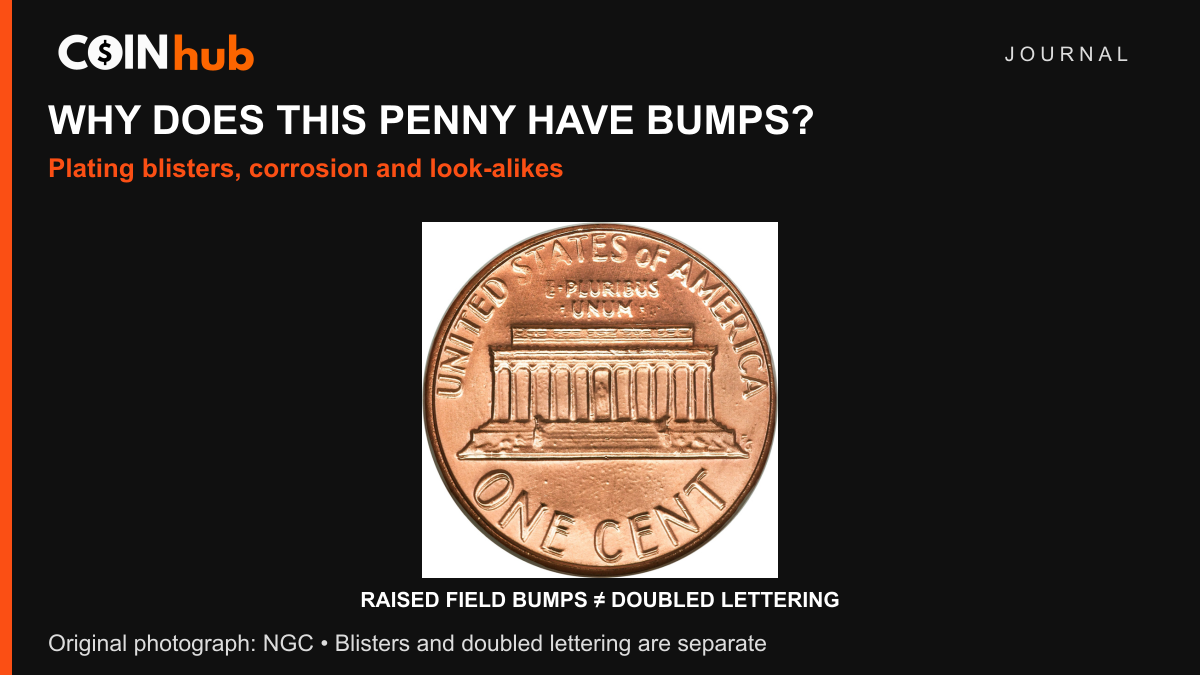
The reference photo above makes that distinction especially important. NGC identifies the specimen as a 1983 doubled-die reverse cent that also has gas-related bumps. Its doubled lettering and its plating blisters are separate features. Finding a bump on another penny does not identify the doubled-die variety.
Why zinc cents can blister
The copper-colored exterior of a zinc cent is a coating over a different metal. If the coating is poorly bonded, gas can raise it away from the underlying core during the striking process. Error-Ref's illustrated explanation shows both circular and linear forms. The surface disturbance need not be a neat round bubble.
Composition matters. The 1982 transition included different cent compositions, so the date alone does not settle which construction you are examining. Use our 1982 copper-versus-zinc cent guide when that distinction is the starting problem. Do not scratch a coin to expose its core.
NGC's conservation discussion explains how fragile the plating/core relationship can be. Its early-date examples should not be treated as a rule that later zinc cents cannot blister.
Compare the possible explanations
| Observation | Possible explanation | What it does not prove |
|---|---|---|
| A smooth raised dome or line | Separated plating may be involved. | A photo does not prove that the space beneath it is hollow. |
| A raised area with discoloration, breaks or crusty material | Corrosion beneath or through the plating may be involved. | It does not establish a valuable mint error. |
| Repeated outlines in letters or design elements | A separate doubling question needs its own diagnostics. | Nearby blisters do not authenticate a doubled die. |
| A torn or missing patch | Plating loss, corrosion or damage needs evaluation. | Every exposed patch is not a lamination error. |
These are observation categories, not an authentication key. A coin can have more than one condition at once. Error-Ref distinguishes hollow blisters from solid bumps caused by subsurface corrosion, but that is not an invitation to press the bump to find out.
Do not pop, scrape or clean the bump
Pressing a raised area can collapse it or break the coating. Scraping away a discolored patch can destroy the evidence you wanted to understand. Either action leaves you with an altered object and a harder attribution problem.
Instead, place the coin on a clean, soft surface and take an overall photograph of each side. Add a close view with light from one direction and another with the light moved. Keep the original files. Avoid filters, artificial sharpening and edited backgrounds that make small surface features look more dramatic.
If the coin is already in a certified holder, photograph the entire label too. Do not open the holder simply to test a bump. For loose coins, handle the edge and keep any old envelope or provenance with the photographs.
Does blistering make a penny valuable?
A blister alone is not a reliable reason to assign a substantial premium. A useful valuation needs the coin's identity, the actual feature, its condition and evidence of comparable completed sales. A seller's “rare bubble error” title supplies none of those by itself.
The pictured 1983 coin is a good example of why comparisons need care. A price attached to its doubled-die attribution would not tell you what ordinary plating bumps are worth. Read our 1983 doubled-die reverse guide for that separate variety question.
Corrosion and other surface problems can also affect certification. NGC's Details grading guidance explains why a coin can retain visible design detail while having a condition problem. More texture does not automatically mean more collectible.
What to send for a second opinion
Give a knowledgeable dealer or error specialist the date, mintmark if present, full photographs of both sides, close-ups under two light directions, and any holder information. Describe what you actually see: “three raised bumps below the lettering” is more useful than an unsupported diagnosis.
For the wider set of possible cent errors, use our penny error reference. Keep the specific blister question separate until the evidence supports a conclusion. The best next step is usually better documentation, not a physical experiment on the coin.
Research checked September 23, 2026. Mechanism and comparison limits follow Error-Ref and NGC. The archival NGC image intentionally shows coexisting features; it is not a price example or a diagnosis of a reader's coin.