
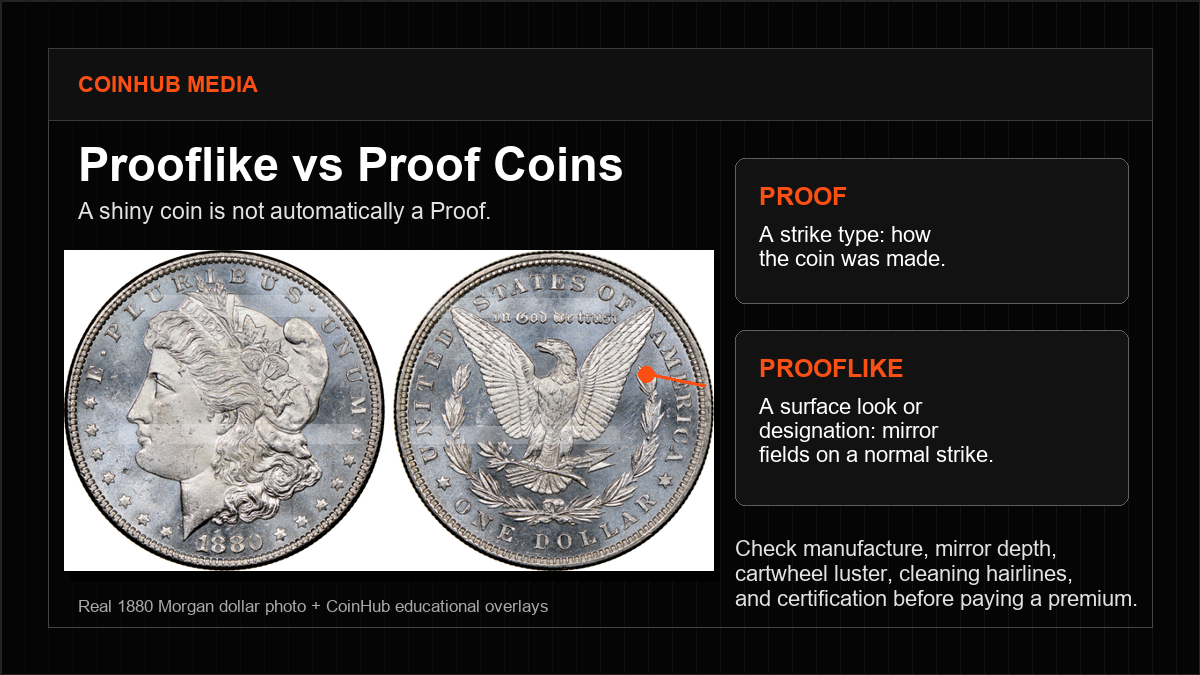
Why a Shiny Coin Is Not Always a Proof
Quick answer: A Proof coin is a special method of manufacture, usually made for collectors with prepared dies, special handling, and a different production process. A prooflike coin is normally a business-strike coin whose surfaces happen to look mirrorlike. The shine can be exciting, but the label depends on how the coin was made and how grading services evaluate the mirrors.Collectors run into this question all the time with Morgan dollars, modern commemoratives, bullion coins, and estate coins in old holders. A coin catches the light, the fields look dark and reflective, and the first thought is: "Is this a Proof?" Sometimes it is. Many times it is not.
The important distinction is that Proof is not just a look. It is a special manufacturing category. Prooflike is different. It usually means a coin made for normal distribution has unusually reflective fields, often because it was struck from fresh or polished dies. That can matter for value, but it should not be confused with an actual Proof issue.
Proof vs. prooflike at a glance
| Feature | Proof coin | Prooflike coin |
|---|---|---|
| What the term means | A special collector strike or manufacturing method. | A reflective surface appearance on a coin that is usually not a Proof. |
| Grading label | Often labeled PF or PR, depending on the grading service. | Often still Mint State, with PL or DMPL/Deep Mirror Prooflike when it qualifies. |
| Why it looks mirrored | Specially prepared dies, planchets, and handling can create the finish. | Fresh or polished dies can leave reflective fields on business strikes. |
| Best first check | Confirm the coin was actually issued as a Proof for that date, mint, and type. | Check mirror depth, contact marks, strike, cartwheel luster, and grading-service designation. |
Why prooflike Morgan dollars confuse collectors
Morgan dollars are one of the classic series where prooflike and deep-mirror prooflike pieces get collector attention. A business-strike Morgan can have watery fields and strong contrast even though it was not made as a Proof. That is why an 1880 or 1881 Morgan with reflective fields should not automatically be called a Proof just because it looks flashy in photos.
The practical question is not only "is it shiny?" The better question is: does the coin have the correct issue history, strike type, surface quality, and mirror depth to support the label? A certified holder can be helpful here because the difference between normal Mint State, Prooflike, Deep Mirror Prooflike, and actual Proof can affect buyer confidence.
Five checks before calling a coin prooflike
Prooflike does not always mean high grade
A coin can have prooflike fields and still show bag marks, rub, haze, hairlines, or unattractive spotting. Prooflike is not the same thing as "perfect." It is possible for a reflective coin to have a lower numeric grade than a less reflective coin with cleaner surfaces.
That is why collectors should evaluate prooflike coins in two steps: first decide whether the mirrors are real and strong enough to matter, then judge the coin's condition. Reflective fields can make marks easier to see, which is one reason prooflike coins can be unforgiving under strong light.
Where sellers get it wrong
Online listings often use "prooflike" too casually. Some sellers use it for any shiny coin. Others use it for polished or cleaned coins because the photo looks bright. A stronger listing should explain the reason for the term: visible mirrored fields, series context, certification if present, and whether the coin is actually labeled PL or DMPL by a grading service.
Should you pay more for a prooflike coin?
Sometimes, but only when the market recognizes that prooflike designation for the series and the rest of the coin is attractive. Morgan dollars are the most familiar example, but not every reflective coin earns a major premium. Eye appeal, certification, rarity, and buyer demand all matter.
If you are sorting an inherited collection, do not clean a shiny coin to "make it more prooflike." Cleaning can permanently hurt collector value. Set reflective candidates aside, compare them with certified examples, and get help before selling if the date, mint mark, or surface quality looks promising.
FAQ: Prooflike vs. Proof Coins
Is every mirrorlike coin a Proof?
No. A coin can have mirrored fields and still be a business strike. Proof refers to the method of manufacture, while prooflike describes reflective surfaces.
What does DMPL mean?
DMPL usually means Deep Mirror Prooflike, a stronger mirror designation used for some business-strike coins, especially Morgan dollars. The exact standard depends on the grading service.
Can a cleaned coin look prooflike?
It can look bright, but cleaning is not the same as natural prooflike mirrors. Hairlines and flat shine are red flags.
Should I grade a prooflike-looking coin?
Consider grading if the coin is a better date, a series where PL/DMPL premiums matter, or valuable enough that authentication would help a buyer trust the attribution.